


Timing can decide whether a TikTok post gains momentum or disappears before it has a chance to spread. Even strong content can stall early if it is published when user attention is low, fragmented, or heavily competed for.
TikTok’s system reacts quickly in the first 15 to 60 minutes after a video goes live. Early views, watch time, likes, comments, shares, and completion rate all help determine whether the platform keeps pushing the video wider or slows distribution.
Late-night posting carries the highest risk
The period from 00.00 to 04.00 is widely considered one of the worst windows for posting. At that point, user activity is at its lowest, and most users in Indonesia are asleep.
That means early interaction is often minimal, even when the video itself is strong. By morning, the upload can already be buried under thousands of newer posts.
For accounts targeting a global audience, Southeast Asia still matters because the region is one of TikTok’s major markets. A post that misses this active window can lose useful early traction before broader viewers even see it.
Early morning looks busy, but attention is split
The 06.00 to 08.00 window can seem promising because users are online. In practice, many people are only checking notifications, scrolling briefly during breakfast, or watching while commuting to work or school.
That pattern usually produces short watch time and little room for comments or shares. Videos that need concentration, such as educational or storytelling content, are more likely to be skipped.
When that happens, the algorithm reads weak engagement signals. A post may still receive some views, but it loses the early response that helps it build broader reach.
Work hours are not ideal for entertainment content
Between 09.00 and 12.00, many users remain active, but the context is not favorable for long or demanding videos. During working hours, people often open TikTok discreetly and avoid content that requires too much focus.
Sprout Social has reported that engagement levels between 09.00 and 12.00 are among the lowest on weekdays. The same data shows that a video posted at 10.00 has 37% less chance of entering FYP than one published at 18.00.
That gap matters because TikTok depends on quick early reactions. If viewers do not pause, react, or finish the video, distribution can slow down early.
Lunch hour brings traffic, but also heavy competition
Around 13.00, user activity may rise, but the timeline becomes crowded at the same time. Hundreds of thousands of creators often post in the same period, so fresh content reaches viewers within seconds.
That makes competition for attention unusually tight. The average lunch break also lasts only 15 to 30 minutes, which leaves little room for complex videos.
Short videos under 15 seconds tend to fit that behavior better. More detailed content often gets skipped because users do not have enough time to engage deeply.
Nighttime loses momentum after the prime window
After 22.00, TikTok’s prime time is considered over. Users begin preparing for sleep, scrolling slows down, and comments or shares decline sharply.
Posts published after that hour can still get views from followers. However, the push toward new audiences usually weakens, which makes growth harder.
Content designed for relaxation or ASMR may still suit this time. For education, comedy, or challenge videos, the window is less effective.
Why timing matters as much as editing quality
TikTok evaluates real-time human response, not production quality alone. If the first 30 minutes produce a completion rate below 50%, a like rate below 3%, and almost no shares, the system may stop distributing the video earlier.
That is why avoiding dead hours is as important as choosing the right creative angle. A strong post still needs a fair launch window to compete before it gets buried by other uploads.
Practical ways to reduce the risk
TikTok’s Schedule feature can help Pro accounts publish content at a more active hour after editing is finished late at night. It allows a video to go live at times such as around 06.30 to 07.00 or before the lunch period becomes too crowded.
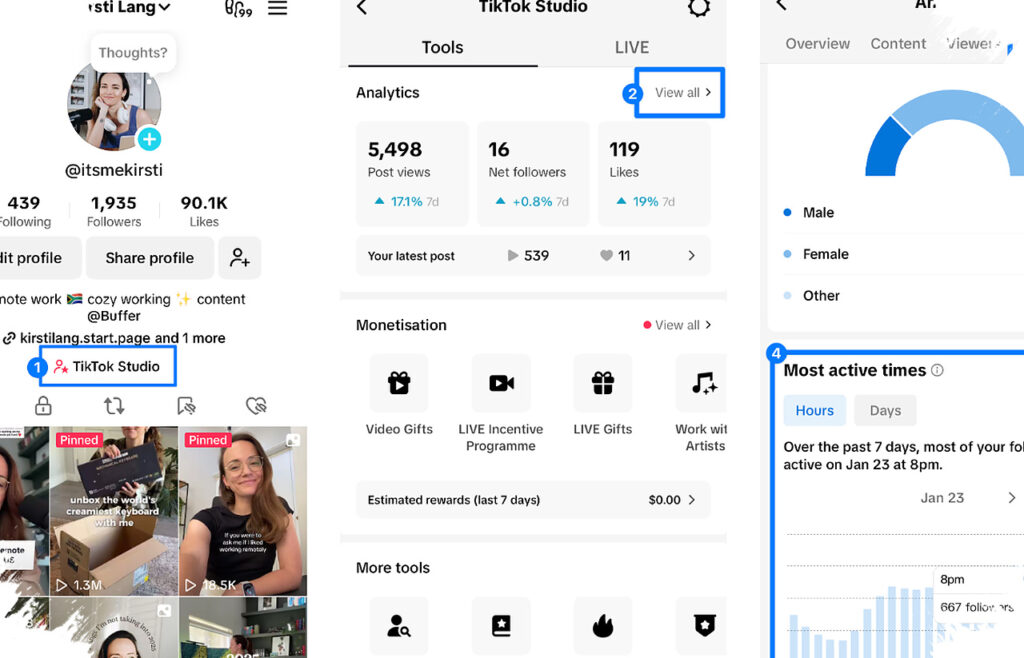
Creators are also advised to monitor account Analytics and test different upload times for one to two weeks. Audience behavior remains the best guide, since each niche can show different activity patterns.