


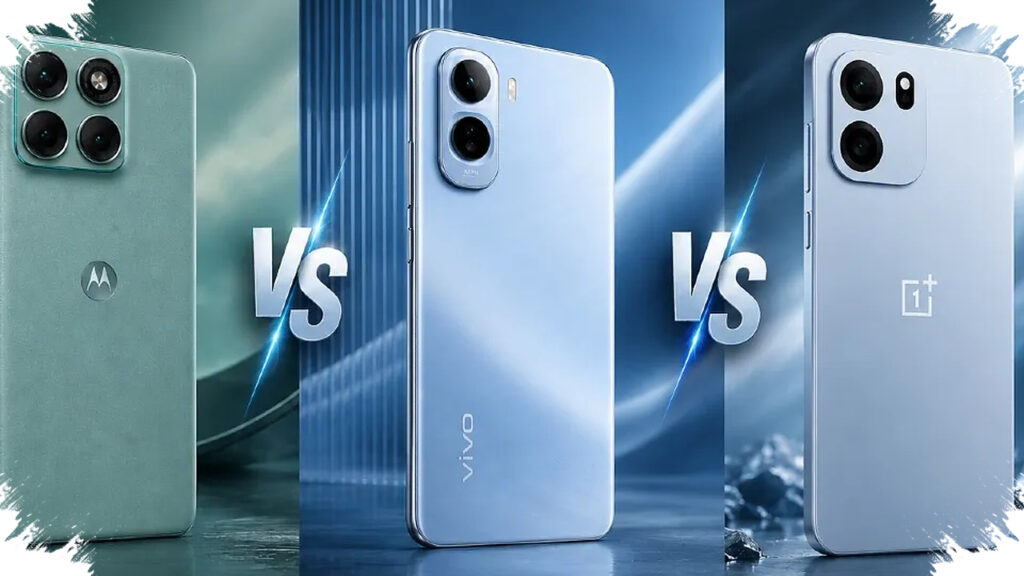
For buyers comparing Motorola Edge 70 Fusion and OnePlus Nord CE6, the deciding factor is not simply battery size. The more balanced package belongs to Motorola, while OnePlus saves its strongest case for endurance and charging extras.
That split is already visible in the way the two phones are positioned. Motorola Edge 70 Fusion arrived in March 2026, while OnePlus Nord CE6 followed in May 2026, and both sit in the upper mid-range category with Android 16.
Motorola starts with a lower price and stronger core hardware
Pricing gives Motorola an immediate advantage. The base 8 GB + 128 GB version of the Edge 70 Fusion costs 26,999 rupees, while the same configuration of the Nord CE6 starts at 29,000 rupees.
Both phones use Snapdragon 7s Gen 4 and an Adreno 810 GPU, but Motorola pairs its chip with LPDDR5X memory. OnePlus uses LPDDR5 and UFS 3.1 storage, which helps explain the gap in benchmark results.
Performance leans clearly toward Edge 70 Fusion
In daily use, the Motorola model is the one that looks more convincing. Its AnTuTu score is around 1,149,292, which is about 22 percent ahead of the Nord CE6 at roughly 942,010.
The same pattern appears in Geekbench. Edge 70 Fusion records about 1,263 in single-core and 3,421 in multi-core, while Nord CE6 sits near 1,098 and 3,111 respectively.
That difference matters beyond numbers on a sheet. Motorola is better positioned for steadier frame rates and longer-term performance consistency, helped by stronger optimization and thermal management.
The display advantage also goes to Motorola
Each device uses an AMOLED panel with a 144Hz refresh rate, so both should feel fast and smooth. The difference comes from size, resolution, and brightness.
Nord CE6 offers a 6.7-inch display with 1220 x 2712 resolution, while Edge 70 Fusion stretches to 6.8 inches and 1272 x 2772. Motorola also reaches a much higher peak brightness of 5,200 nits, compared with 3,600 nits on the OnePlus phone.
That makes the Motorola screen the more capable choice for bright outdoor conditions. It also sits inside a slimmer body at 7.99mm and 193 grams, versus 8.5mm and 215 grams for the Nord CE6.
OnePlus answers with tougher protection
Where OnePlus pulls ahead is durability. The Nord CE6 carries IP68, IP69, and IP69K ratings, while the Edge 70 Fusion is rated IP68 and IP69.
For users who want stronger resistance against water and dust exposure, that extra layer of certification matters. Still, the tougher protection does not erase Motorola’s stronger all-around balance in design, performance, and everyday usability.
Camera flexibility remains better on the Motorola phone
Motorola also brings the more versatile camera setup. The Edge 70 Fusion uses a 50 MP main camera with a Sony LYT-710 sensor, a 13 MP ultrawide camera, and a 32 MP front camera.
The Nord CE6 matches Motorola with a 50 MP main camera and a 32 MP selfie camera, but its secondary camera is only 2 MP. Without an ultrawide lens, its shooting options are more limited.
That gives Motorola the edge for people who want wider framing, including landscapes and other scenes that benefit from a broader field of view. It is also described as stronger in low-light situations, with more natural color output.
Battery is the one area where OnePlus clearly wins
The Nord CE6 makes its strongest statement in endurance. It packs an 8,000 mAh battery, 80W fast charging, 27W reverse charging, and bypass charging.
Motorola is not weak here either, with a 7,000 mAh battery and 68W fast charging. Even so, OnePlus remains the more appealing option for users who want longer time between charges and a more complete charging toolkit.
That leaves the comparison with a fairly clear shape. Nord CE6 is the battery-first option, but Edge 70 Fusion looks like the better overall mid-range phone for most buyers because it combines lower pricing, stronger performance, brighter display output, slimmer design, and more flexible cameras.
Source: tech.sportskeeda.com