
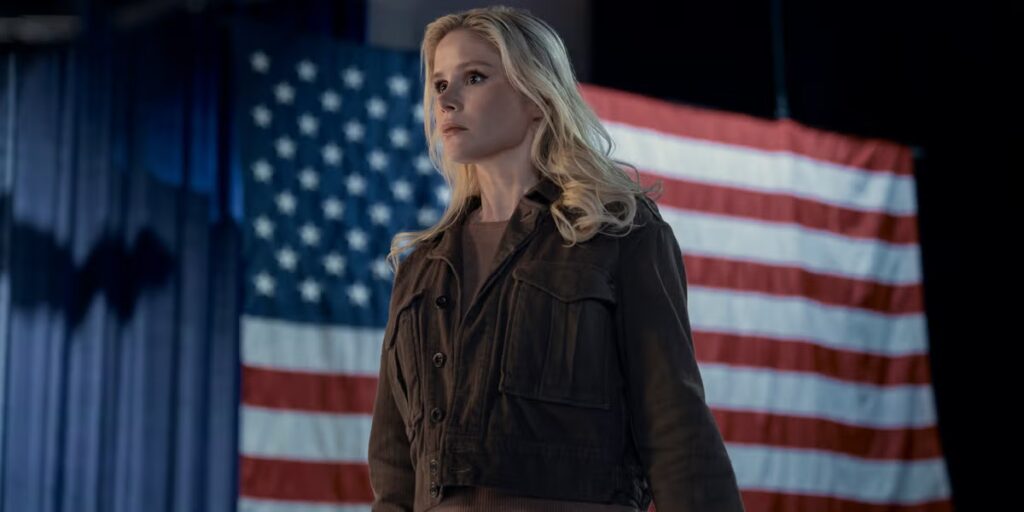
Erin Moriarty is drawing a clear line between her real life and Annie January’s final stretch on The Boys, and the overlap is impossible to ignore. In the show’s fifth season, Annie’s battle to hold on to hope mirrors Moriarty’s own fight to reclaim stability after a Graves’ disease diagnosis.
The actress said the penultimate episode became a turning point on both fronts. It was the first episode she filmed after starting treatment for the autoimmune disorder, and she said the change was immediate: she began to feel like herself again and could enjoy acting without feeling physically uncomfortable.
An illness that changed the work
Moriarty said the symptoms had been building quietly before the diagnosis. She described debilitating fatigue, nausea, weight loss, brain fog, numbness in her feet, and even losing the ability to walk not long after filming one earlier episode.
Graves’ disease is an autoimmune condition that causes hyperthyroidism, and Moriarty said it affected her ability to think clearly and make decisions. “It’s like a system-wide failure,” she said, adding that the condition made ordinary work feel far more difficult than viewers could see on screen.
She also had to deal with criticism about her appearance before the diagnosis was known publicly. Moriarty said she was already under intense online scrutiny when outside comments about her looks added to the pressure behind the scenes.
How Annie’s story reflects her own
On The Boys, Annie January starts the series as an idealist who believes she can do good from inside the Seven. But the character becomes increasingly disillusioned with Vought International and Homelander’s grip on power, eventually stepping away from the Seven in season 3 to join the resistance.
That arc matters in the final season, where Annie is pushed close to despair after learning that Homelander has received V1, a compound tied to immortality. Moriarty said that moment leaves Annie almost “devoid of hope,” which makes her later recovery in the story more meaningful.
A key part of that recovery comes through Marie Moreau from Gen V, who challenges Annie’s old line, “Since when did hopeful and naive become the same thing?” Moriarty said the exchange forces Annie to confront who she used to be and to remember that she wants that version of herself back.
Why Annie’s father matters in the final season
Before the final season moved into its last stretch, Moriarty said she made one request to showrunner Eric Kripke: Annie had to meet her father. She said the story could not end without that scene, and Kripke agreed.
That decision gives Annie a source of strength outside her core group, even if it does not solve everything. Moriarty said the moment helps Annie regain clarity when she most needs it, especially when she is searching for a reason to keep going.
Mother’s Milk, Jack Quaid, and the real-life parallel
The emotional center of the penultimate episode deepens when Mother’s Milk helps Annie during a mission at Vought Studios. He tells her about a time he pulled a wounded pigeon back to health, using that story to argue that saving even one life is worth the effort.
Moriarty said she has always felt a strong, underappreciated bond between Annie and Mother’s Milk. She noted that he sees what Annie needs in a way few others do, and that connection helps move the character back toward purpose.
That same kind of support happened off camera. Moriarty said Jack Quaid noticed something was wrong and urged her to see a doctor, telling her he was worried and that she needed medical help.
She said that warning changed everything. Without it, she might not have pursued proper care the next day, and she credits that intervention with leading her to a diagnosis that explained the symptoms she had been trying to dismiss.
Finding strength in speaking openly
Moriarty said speaking publicly about the diagnosis still feels difficult, partly because she worries about taking up too much space. But she also said she has learned from Annie’s advocacy and from the character’s refusal to let other people define her.
That idea becomes especially clear in the penultimate episode, when Annie chooses to save a group of Homelander supporters who have mocked and attacked her. Moriarty said that choice reflects Annie’s core identity, even when the people she helps have shown her hate.
For Moriarty, that same lesson became personal. She said she has learned that the most important thing is not the outside noise, but the part of herself that remains unchanged by it, and that realization helped her protect her own health and sense of identity.
A final stretch shaped by recovery
By the time filming wrapped, Moriarty said she felt deep gratitude toward the cast and crew, whom she described as a second family. She said she had been so sick that it felt as if she had not really been present for long stretches of production, and seeing her coworkers again made the recovery feel real.
As The Boys moves toward its ending, Moriarty is also letting go of Annie. But the actress said the experience of illness, treatment, and support changed the way she sees both the role and herself, especially after learning that sharing her story might help others feel less alone or push them to seek answers of their own.