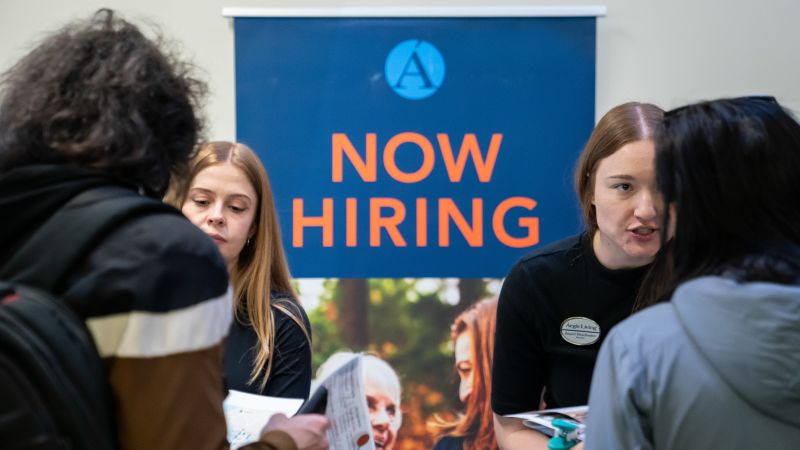
The US labor market added 172,000 jobs last month, a stronger result than economists expected and another sign that hiring is regaining momentum. The unemployment rate stayed at 4.3%, while the latest figures also pointed to a broader recovery after a stretch of uneven job growth.
The Bureau of Labor Statistics data showed that gains topped 100,000 for the third straight month, a pattern not seen since early 2024. That pace has helped lift average job growth to 188,000 a month over the past three months, far above last year’s weaker monthly trend.
A labor market that is warming, not booming
Economists had expected just 105,000 jobs to be added, so the latest report came in well above forecasts. Guy Berger, chief economist at Homebase, said the job market is “moving in the right direction,” while adding that it is still not at the heated levels seen in 2021 and 2022.
Recent revisions also strengthened the picture for earlier months. March payroll gains were raised by 29,000 to 214,000, and April’s total was revised up by 64,000 to 179,000 jobs.
That leaves the year-to-date monthly average near 114,000 jobs, which is much better than last year’s pace when monthly gains were extremely weak. The data suggests employers are still hiring, even if the market has not returned to the kind of broad, fast growth seen in stronger cycles.
Hiring is spreading across more sectors
May’s gains were not limited to one industry, which made the report more encouraging for analysts watching for a deeper rebound. Leisure and hospitality added an estimated 70,000 jobs, local government payrolls rose by 52,000, and healthcare and social assistance added 47,200 positions.
The spread of hiring matters because healthcare had carried much of the labor market in prior months. Economists said the latest report showed signs that more industries are starting to contribute, even if the shift remains modest.
Temporary help services also posted another increase, extending a five-month streak of growth in a segment often seen as a leading indicator of labor demand. In addition, Berger said there were gains in construction, manufacturing and transportation, with the temporary sector showing signs of turning after a long decline.
Wage growth is slowing as inflation stays a concern
Even with stronger hiring, the report carried a warning for workers. Annual wage growth eased to 3.4% in May from 3.6% the month before, and that could leave pay gains trailing inflation by close to 1 percentage point based on projections for the Consumer Price Index.
Joe Brusuelas of RSM US said it is hard to celebrate faster job growth when real wages are slipping. He said many workers are likely struggling to keep up with basic expenses, which keeps the labor report from looking entirely positive.
Consumer prices have also been moving higher again, adding pressure to household budgets. The Consumer Price Index rose from 2.4% at the start of the year to 3.8% in April, and the next reading is expected to show annual price growth above 4%.
Longer job searches point to a softer labor market
The headline job gain does not erase signs of strain underneath the surface. BLS data showed that the number of people unemployed for 27 weeks or longer rose to nearly 2 million, the highest level since December 2021.
Lisa K. Simon of Revelio Labs said the labor market remains in a low-hire, low-fire pattern, even as job growth trends upward. She said some industries are doing “a lot of the heavy lifting” while the broader market still shows signs of weak matching between employers and job seekers.
That mismatch is also reflected in the way many businesses are hiring cautiously. Economists said uncertainty tied to inflation, wars, tariffs and the broader policy environment is making employers hesitant, while many workers are staying put because new opportunities remain limited.
The latest report therefore shows two labor-market realities at once: hiring is improving, but pay growth, long-term unemployment and cautious employer behavior continue to weigh on the picture.
Read more at: www.cnn.com-

-

-

-