


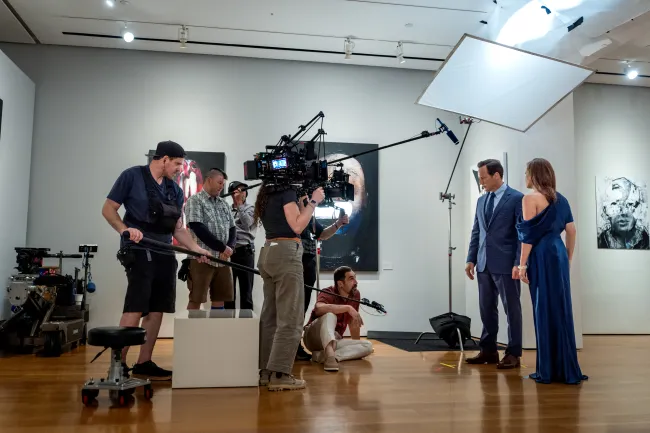
Eben Bolter approached Apple TV’s “Cape Fear” with a clear challenge in mind: how to honor one of Martin Scorsese’s most visually forceful thrillers without turning a ten-episode series into a copy of the 1991 film. The cinematographer said the original movie has “so much atmosphere” and captures “Scorsese at his most expressive and playful,” but the longer format demanded a different rhythm and a slower release of tension.
That balance shaped the look of the series from the start. Bolter worked with creator Nick Antosca and pilot director Morten Tyldum to define a visual language that could nod to Scorsese, Freddie Francis, the 1962 film, and the John D. MacDonald novel “The Executioners” while still feeling new.
Building a TV version of a cinematic classic
Bolter said the first step was deciding what not to do. The movie compresses its energy into a two-hour runtime, while the series has 10 hours to sustain dread, suspense, and character development.
“We’ve got 10 hours, so how do we let the show develop?” Bolter said. He added that the team wanted to avoid exhausting viewers in the pilot by using every visual trick at once, because that would make the style feel empty later.
That thinking led to a more controlled approach to the show’s camera work. Rather than treating each episode like a standalone showcase, Bolter and his collaborators built a visual system that could expand over time and support the story as the pressure mounted.
A voyeuristic perspective
One of the most important choices was to make the series feel watched. Bolter said the team leaned on long lenses and zooms to create the sense that someone could be observing the characters from a distance at any moment.
That idea fits the story’s central threat, with Javier Bardem’s Max Cady looming over married attorneys played by Patrick Wilson and Amy Adams. Bolter said the production also wanted to introduce Cady from behind, “like a panther hunting its prey,” which helps turn his presence into a slow, predatory warning.
The series also uses occasional punchy zooms during action, echoing the energy of the Scorsese film without relying on it scene by scene. Bolter said those tools were planted early and then allowed to grow across the season as the visual vocabulary widened.
A visual bible that kept evolving
Before filming, Bolter assembled what he called a “visual manifesto,” collecting references from film, television, and photography. But the document was not treated as fixed, and it changed as production moved forward.
Bolter said images from the show itself were added as soon as they were captured, and by the end of Episode 3, the material had become a kind of bible for the series’ look. That guide was then shared with incoming directors so they could quickly understand the visual tone and continue building on it.
He described the process as an invitation rather than a restriction. The idea was to hand directors “our little toy box” and encourage them to take risks with the material.
Story first, shot second
Despite the strong visual ambition, Bolter said the crew stayed focused on the drama in each scene. The team did not work from a rigid “wide, medium, close-up” formula, but instead asked what the scene was trying to say and from whose point of view it should be seen.
That approach gave the show a looser and more expressive style, but it also required flexibility on set. Bolter said plans were often adjusted once the actors began working through the material, especially when performances evolved in ways that made a prebuilt lighting setup less useful.
He said the real question was how much visual style was necessary to serve the story, and how much might interfere with the actors. In long dialogue scenes, he often preferred to move faster and keep the performance alive rather than lock the production into one technically perfect setup.
Performance over perfection
Bolter repeatedly emphasized the value of cross-shooting, which allowed multiple angles and actors’ coverage to be captured at the same time. That method reduced the need to stop and reset frequently, giving performers more room to improvise and adjust.
The tradeoff was less control over lighting finesse. Bolter acknowledged that the image could be less sculpted, but he saw the trade as worthwhile if it improved the scene itself.
“There’s no point in having a bad scene with beautiful lighting,” he said. For Bolter, the strongest visual storytelling comes from supporting the actors, not overpowering them.
Making heat visible
The show’s Southern setting also became a major part of the cinematography. Shot in Georgia, “Cape Fear” was designed to feel humid, heavy, and physically uncomfortable, with a sweaty atmosphere that Bolter said he became “a little bit obsessed” with capturing.
He came to the shoot after finishing the most recent season of “Slow Horses” on a winter beach in England, and the contrast made the Georgia heat feel even more intense. That experience informed the way he approached atmosphere on screen.
To sell the climate, Bolter worked closely with art, costume, hair, and makeup departments. The production used haze inside rooms, wet down sidewalks, trees, and windows, and added subtle heat-haze effects below the lens with a flame bar and a helium bar.
Costumes carried sweat marks, makeup kept adding moisture to faces, and the art department used a slightly glossy paint on locations so even interior walls seemed to shimmer. Bolter said all of those details were meant to combine into a convincing physical sensation of heat.
A demanding shoot
The series was shot over 140 days, a schedule that Bolter described as a marathon. He noted that television production requires stamina under the best conditions, and the heat made the process even harder for the crew.
As an alternating director of photography, Bolter had short breaks to prep the next episode, but the rest of the team had to keep working every day. That reality made the shoot both physically and mentally demanding, especially as the production pushed through severe weather.
Even so, the cinematography aimed to preserve the uneasy energy that defines the story. By blending Scorsese-inspired movement, deliberate voyeurism, and an oppressive Southern climate, the series builds its own identity while staying tied to the fear and tension that made the original “Cape Fear” so memorable. “Cape Fear” is currently streaming on Apple TV.
Read more at: www.indiewire.com