


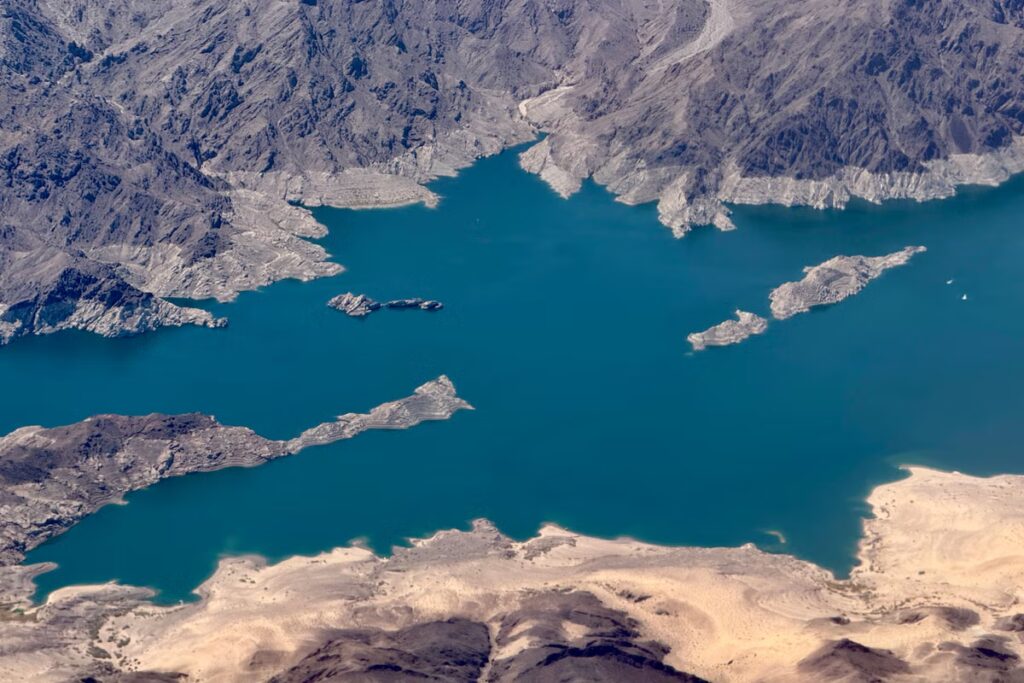
The Colorado River system is moving closer to a dangerous tipping point as experts warn that Lake Mead and Lake Powell may be headed toward a “system crash.” The warning centers on falling reservoir levels that could strip both lakes of their ability to store water and instead turn them into little more than pass-through channels.
Researchers and former water officials say the risk is no longer abstract. If dry conditions continue and water use does not drop sharply across the Southwest, the region could face a severe loss of control over one of its most important water supplies.
Why Lake Mead is under pressure
Lake Mead has a key threshold at 975 feet above sea level, where it would begin losing much of its storage function. On Friday, it stood at about 1,049 feet, according to the Las Vegas Review-Journal, but officials say that level could keep falling.
The concern is tied to a recent Trump administration decision to reduce water releases from Lake Powell. That move could push Lake Mead down by about 28 feet by July 2027, which would place it well below its previous record low.
Anne Castle, a study author, said the problem is not just low water, but the point at which the system stops working as a buffer. “If that happens, it’s like the Colorado River is running free,” she told the Las Vegas Review-Journal.
Lake Powell faces its own danger
Lake Powell has a different but equally serious threshold. Experts warn that if its level falls below 3,490 feet, structural and plumbing problems at Glen Canyon Dam could make it extremely difficult, or even impossible, to release water safely downstream.
Federal managers have already taken emergency steps to avoid that outcome. Those steps include cutting releases and moving water in from upstream sources, all in an effort to slow the decline and prevent a near-term crisis.
Rhett Larson, a water law professor at Arizona State University, said managers may be running out of options if the dry pattern continues. “Unless Mother Nature bails us out, I don’t see what emergency measures the federal government can take next year,” he told the Las Vegas Review-Journal.
A basin that supplies millions
The Colorado River Basin provides water to about 40 million people across seven Western states. Another unusually dry winter has deepened concern that the system could fall into a crisis faster than many officials expected.
The report behind the warning suggests that a stronger snow season could still offer short-term relief. An upcoming El Niño pattern could help boost runoff and give Lake Mead and Lake Powell about two more years before conditions deteriorate again.
That would not erase the structural risks, though. Experts say it would only delay the pressure on a system already operating with little margin for error.
Who would feel the impact first
A system crash would not automatically leave major cities without water. Las Vegas, Phoenix and Southern California have backup supplies and conservation systems that can soften the immediate blow.
Castle said that protection does not extend to everyone. “Not every water user has that potential of using other sources,” she said, adding that agricultural users and some rural communities could be “in a world of hurt.”
The first signs would likely show up in tighter restrictions, including stronger limits on lawn watering. Some municipalities in Colorado already have such crackdowns in place, according to Colorado Public Radio News.
Farmers and rural areas could face the hardest hit. The report and Colorado State University say deeper cuts could reduce crop yields and push food prices higher, while lower water levels could also reduce hydropower generation at Lake Mead and Lake Powell and raise electricity costs, according to The Colorado Sun.
The warning now facing the Southwest is simple: without much lower water use and better runoff, the system that supports millions of people could lose the ability to cushion the next dry stretch.