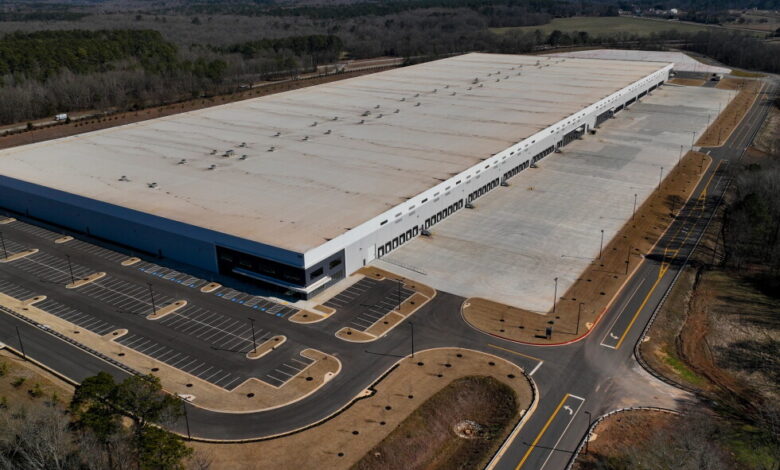
U.S. Immigration and Customs Enforcement is backing away from a sweeping plan to turn warehouses into detention sites for as many as 10,000 people at one location. The retreat cuts into former Homeland Security Secretary Kristi Noem’s $38 billion push to rapidly expand detention capacity.
The reversal is already spreading across several states. Federal officials told a judge Monday that a warehouse bought in Romulus, Michigan, will be sold, while local officials in Social Circle, Georgia, and the El Paso suburb of Socorro said their plans are also unraveling.
Warehouses at the center of the plan
The three communities are among 11 where the federal government spent a combined $1.074 billion on warehouses. The New York Times reported last week that federal immigration officials now plan to dispose of seven of those 11 properties, either by transferring them to other federal agencies or selling them.
DHS did not confirm that report, but said in a statement that it is “moving swiftly to utilize EXISTING detention space with our state and county partners.”
Pushback came quickly after the purchases became public. Claire Trickler-McNulty, a former ICE official under the Obama, Trump and Biden administrations, called the idea “Wildly foolhardy” when asked about the warehouse conversions.
She said ICE generally relies on contracted detention space, even though it owns a few facilities inherited from the old Immigration and Naturalization Service. “Facilities over 2,000 people just break down. It’s very hard to run a very big facility, to keep it staffed, to keep all of it moving,” she said.
Local anger, lawsuits and cost questions
Some communities objected on moral grounds, while others raised practical concerns about sewer and water systems. Seven federal lawsuits were filed, and regulatory hurdles created more problems in other locations.
Questions about what DHS paid for some of the warehouses also triggered an internal audit. The agency paid double what the New Jersey warehouse was valued at in tax records and nearly five times the assessed value of the Social Circle property.
New leadership, changing plans
After Noem was removed, her replacement, Markwayne Mullin, paused new warehouse purchases. Mullin, who took over and expanded his family’s plumbing business before serving in the U.S. House and Senate, said at his confirmation hearing that many municipalities lack the infrastructure capacity for waste and water.
That concern was central in Salt Lake City, where the costliest warehouse purchase came to $145.4 million. A federal lawsuit over that site said ICE officials told the mayor they might need to truck in water and sewage as an “interim solution.”
In Romulus, Michigan Attorney General Dana Nessel said it would have been an “abomination” if the 249,000-square-foot warehouse had been turned into immigrant detention after being purchased for $34.7 million. “The ICE warehouse proposal was every bit as ill-conceived as it was cruel and unnecessary, and I am relieved that this chapter is coming to a close,” she said.
What happens next in the remaining sites
Social Circle said in a statement last week that it had received notification from U.S. Rep. Mike Collins, a Republican, that DHS was no longer pursuing a detention facility there. In the El Paso area, acting ICE Director David Venturella told officials during an earlier visit that the agency had changed its plans for three warehouses it bought in nearby Socorro for $122 million, according to Rep. Veronica Escobar.
Escobar said ICE no longer plans to detain up to 8,500 immigrants there as originally envisioned. Instead, she said, the property will become an ICE campus with a smaller number of detainees, plus offices and training space.
Some communities are still waiting for clear answers. In Pennsylvania, state and local officials said Tuesday they had not received new information about two warehouses bought earlier this year, while the state continues to deny permits over concerns about drinking water and sewer service.
U.S. Rep. Dan Meuser, whose district includes both sites, said he met with DHS personnel Friday but was not told whether the buildings would be used for detention or sold.
In Georgia, Oakwood city manager B.R. White said Tuesday he was still trying to confirm rumors that a local warehouse will be sold. “I have not heard anything yet,” he said.
Some work continues elsewhere
In Maryland, ICE is still moving ahead with public comment on the environmental impact of a sprawling warehouse it wants to turn into a processing facility for immigrants. A judge had already extended a stoppage on that conversion, and an earlier announcement added more details, including six secure recreation yards.
Patrick Dattilio, founder of Hagerstown Rapid Response, said communication has been limited outside the lawsuit. Still, he said the group remains committed to blocking the warehouse from opening.
“It’s a big warehouse,” Dattilio said. “It’s not meant for people.”
Associated Press writers Marc Levy and Ed White contributed to this report.