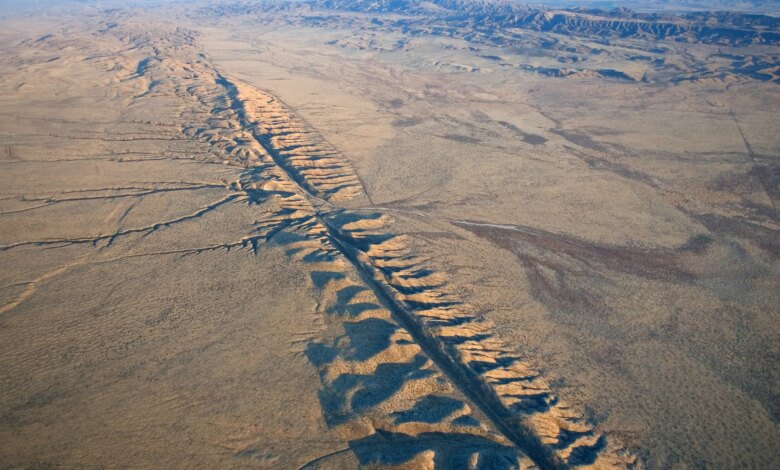
Southern California’s San Andreas and San Jacinto faults are under more stress now than at any point in the last 1,000 years, according to a new study. The finding does not predict the exact day of the next major earthquake, but it does sharpen the warning that the region is primed for one.
The study says pressure has been building for centuries as stress accumulates along the fault system. Researchers used geological evidence, including tree-ring records and sediment samples, to build a computer model of how that pressure builds over time and where it stands today.
Why the risk looks higher now
The model suggests stress has been steadily rising since the last Big One in 1857, one of California’s largest seismic events on record. Kate Scharer, a co-author of the study and a geologist with the U.S. Geological Survey, said the long gap since major ruptures on the Southern San Andreas and the San Jacinto has allowed a lot of stress to accumulate.
Harold Tobin, director of the Pacific Northwest Seismic Network and a professor at the University of Washington, said the idea that the fault segments could be nearing an imminent earthquake was already known. In his view, the new work adds a more quantitative and rigorous scientific basis to that concern.
Cajon Pass could shape how a rupture spreads
One area drawing attention is Cajon Pass, the narrow corridor between the San Gabriel and San Bernardino mountains. Lead author Liliane Burkhard, a research affiliate in the Hawaiʻi Institute of Geophysics and Planetology, described it as an “earthquake gate” that could either stop or transmit large ruptures between the San Andreas and San Jacinto faults depending on stress conditions.
If that happens, the rupture could spread farther across Southern California and affect millions more people across the Coachella Valley and San Bernardino County. Burkhard said she hopes to study other earthquake-prone regions where multiple fault systems interact in ways that remain difficult to predict.
Preparing for the Big One
Scientists agree that Southern California will experience another major earthquake; the uncertainty is when, not if. Ahmed Elbanna, director of the Statewide California Earthquake Center and a professor at USC, said it could happen “today, tomorrow, or in 10 years, or in 30 years,” adding that those are very short spans on geological time scales.
The study is also a reminder to prepare. Households are advised to keep an emergency kit with at least 72 hours of food, water and medications, along with a communication and reunification plan if cellphone networks fail after a quake.
Kate Scharer recommended resources from the Earthquake Country Alliance, while Elbanna said the study is a reminder that Southern California lives on a multi-strand fault system in one of the country’s most densely populated regions.