


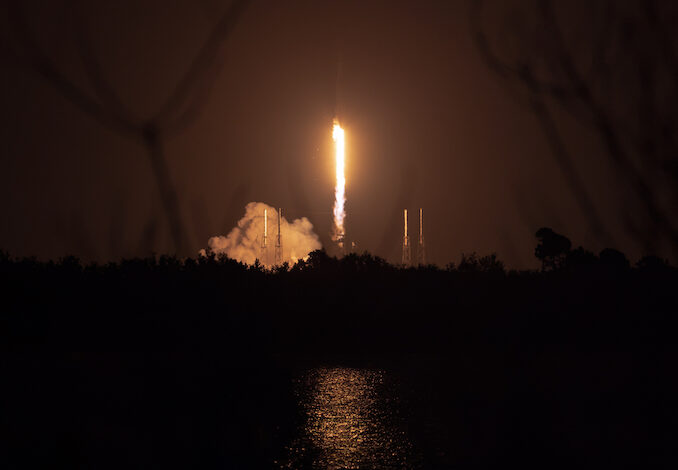
SpaceX launched a 7.5-ton SiriusXM satellite late Sunday, setting up another step in the company’s plan to refresh its geostationary fleet and replace older spacecraft still carrying the service today.
The mission lifted off from Space Launch Complex 40 at Cape Canaveral Space Force Station at 10:25 p.m. EDT, with Falcon 9 flying east after leaving the pad. Spaceflight Now reported that the launch came during a four-hour window that opened at liftoff.
Why SXM-11 matters
SXM-11 is built to help SiriusXM replace XM-5 and FM-5, satellites that launched in 2010 and 2009, respectively. SiriusXM said the spacecraft will improve signal reception, expand coverage in Alaska, and support audio entertainment and information services across the United States, Canada, and the Caribbean.
The company also described SXM-11 as the most powerful high-powered satellite in its fleet. SiriusXM said on LinkedIn that the spacecraft has been years in the making and is part of a broader effort to keep the service’s broadcast network refreshed.
| Satellite | Role | Launch Year | Service Note |
|---|---|---|---|
| SXM-11 | Replacement satellite | Not stated | Supports SiriusXM constellation refresh |
| XM-5 | Older satellite to be replaced | 2010 | Part of the aging geostationary fleet |
| FM-5 | Older satellite to be replaced | 2009 | Part of the aging geostationary fleet |
Built large, fueled for the long haul
The satellite weighs about 15,000 pounds, or 7.5 tons, and was deployed from Falcon 9’s upper stage a little more than half an hour after launch. It is based on the IM-1300 satellite bus and stretches 230 feet tall, with a 106-foot span once its solar panels are extended.
SiriusXM said roughly 60 percent of the spacecraft’s mass comes from onboard fuel. That helps explain why the satellite is so heavy, and why it is designed to stay useful for a long period once it reaches geosynchronous orbit.
Falcon 9 booster lands again
SpaceX flew the mission with Falcon 9 booster B1085, which was making its 17th flight. Its previous missions included NASA’s Crew-9, RRT-1 for the U.S. Space Force, Blue Ghost Mission 1, Fram2, SiriusXM’s SXM-10, MTG-S1, EchoStar XXV, and nine Starlink launches.
About 8.5 minutes after liftoff, B1085 landed on the drone ship A Shortfall of Gravitas in the Atlantic Ocean. Spaceflight Now noted that the landing was the booster’s 158th successful recovery, tying the record with the now retired Just Read the Instructions, which is being used for Starship operations.
Weather was favorable, but not perfect
The 45th Weather Squadron had forecast an 80 percent chance of favorable conditions at the opening of the launch window, improving to 90 percent later in the evening. Meteorologists were tracking possible interference from cumulus and anvil clouds.
Launch weather officers said weak and variable flow aloft could allow daily storm motions to remain dependent on sea breeze and outflow patterns. They also warned that storms and clouds could linger closer to the coast later into the night before slowly diminishing.
SXM-11 is the latest in SiriusXM’s fleet renewal effort, with SXM-10 having launched in June 2025 and expected to remain in service until 2040, according to a SiriusXM financial disclosure to the U.S. Securities and Exchange Commission. The new satellite now begins its journey toward orbit as the company continues shifting away from its oldest spacecraft.