


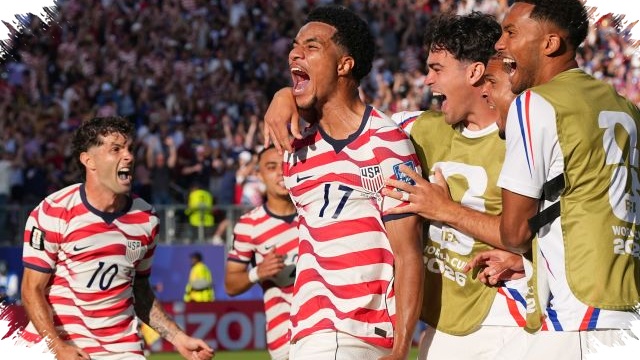
The biggest American men’s soccer victory in a generation came with a moment that could have defined everything. Instead, Folarin Balogun’s red card against Bosnia and Herzegovina ended up exposing something far more encouraging about the USA.
Leading 1-0 in a World Cup knockout match, the United States lost Balogun to serious foul play after a VAR review, then played the final 35 minutes a man down. What followed was not panic, but control, and that response may matter as much as the 2-0 scoreline itself.
Balogun’s dismissal will be debated
The challenge itself was messy and ugly in slow motion, even if it did not appear intended as an injury-first play at full speed. Referee Raphael Claus initially let it go, then changed the decision after reviewing the incident on the monitor following a VAR flag.
Claus ultimately showed Balogun a red card for serious foul play, a call that will be argued over by fans and analysts for some time. If Balogun is missed in the next match against Belgium, the sequence will be revisited even more closely.
The USA did not fold under pressure
Playing a man down for more than half an hour usually invites chaos, especially against a team that can send wave after wave of attacks toward goal. Bosnia and Herzegovina tried exactly that, loading up its attack and looking for the opening that would tilt the match.
Instead, the USA held firm. Led by Weston McKennie, Christian Pulisic and Malik Tillman, and backed by a defense that grew stronger after the sending-off, the Americans stayed organized, managed the game and waited for their moment.
| Key Match Moments | What Happened | Why It Mattered |
|---|---|---|
| Balogun’s goal | Gave the USA a 1-0 lead in the first half | Put the Americans in control before the red card |
| Balogun’s red card | Shown after a VAR review for serious foul play | Left the USA with 10 players for 35 minutes |
| Tillman free kick | Curled past the wall and the keeper in the 82nd minute | Sealed a 2-0 win and eased the pressure |
Tillman delivered the decisive response
The second goal belonged to Malik Tillman, whose free kick came after Sergiño Dest was fouled just outside the Bosnia box. Born in Germany to an American father and German mother, Tillman stepped into a dangerous moment and handled it with composure.
He took a short run-up and curled the shot over the wall, off the glove of goalkeeper Nikola Vasilj and into the net. The finish turned a tense knockout match into a statement win, and the reaction from the crowd and his teammates showed how much it meant.
That was the part of the night that stood out most. The USA showed the kind of calm, maturity and control that the best teams are expected to have when the match becomes difficult.
A sign of a team changing its habits
American men’s soccer has often had energy and talent, but not always the discipline to protect a result when the game turns chaotic. This time, the team looked different, and not just because it survived the red card.
Chris Richards said after the match that the group could take confidence from keeping two clean sheets in its last four games, adding that the team had not always had the best record in that area before. For a side with memories of past knockout collapses, this performance offered a more reassuring picture.
Those old fears were easy to understand. American fans have seen late pain against Belgium in 2014, the extra-time goal by Asamoah Gyan in 2010, and a heavy defeat to the Netherlands four years ago.
On this night, though, the USA absorbed the blow, answered it, and finished the job.