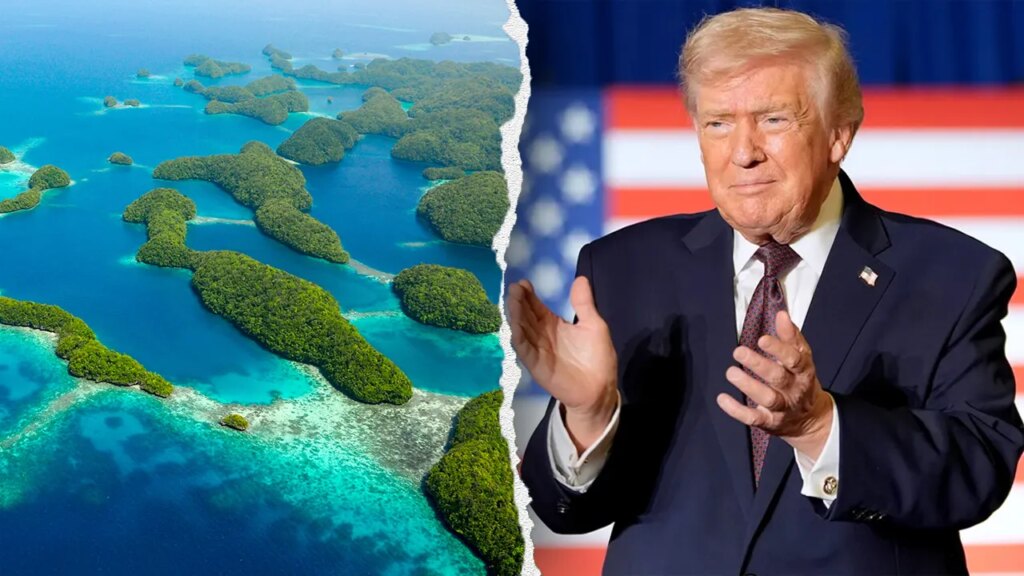
Palau has agreed to accept up to 75 deportees from the United States under a new deal valued at $7.5 million. This agreement aims to address Palau’s labor shortages by allowing “third-country nationals” who have never been charged with a crime to live and work on the island nation.
The arrangement was formalized through a memorandum of understanding signed by Palau and the U.S. government. Palau’s President Surangel Whipps Jr.’s office emphasized that this move will help fill critical job vacancies in the country, which has a population of approximately 18,000 people.
The U.S. Embassy in Koror praised Palau’s cooperation in enforcing U.S. immigration laws, underscoring such efforts as a priority for the Trump administration. “The United States granted $7.5 million to support relevant Palau public services,” the Embassy stated in a release.
Alongside the $7.5 million aid package, the Trump administration will also direct $6 million to bolster Palau’s struggling civil service pension system. In addition, $2 million will be allocated for new law enforcement initiatives to strengthen local security.
Palau has long depended on U.S. foreign assistance given its small economy and strategic location in the Pacific. The island has also been notable as a filming site for the reality TV series “Survivor.” Under a separate deal brokered during the Biden administration, the U.S. committed $889 million in aid to Palau over two decades.
This deportation agreement fits into a broader U.S. strategy under the Trump administration to manage immigration by repatriating illegal immigrants to willing third countries. Other nations such as Uganda, Rwanda, Eswatini, South Sudan, Costa Rica, Panama, and El Salvador have also agreed to receive deportees under similar arrangements.
The Palau agreement reflects a mutually beneficial approach, addressing U.S. immigration enforcement priorities while supporting Palau’s labor market needs. It demonstrates increasing cooperation between the U.S. and smaller nations in managing global migration challenges.
Read more at: www.foxnews.com