


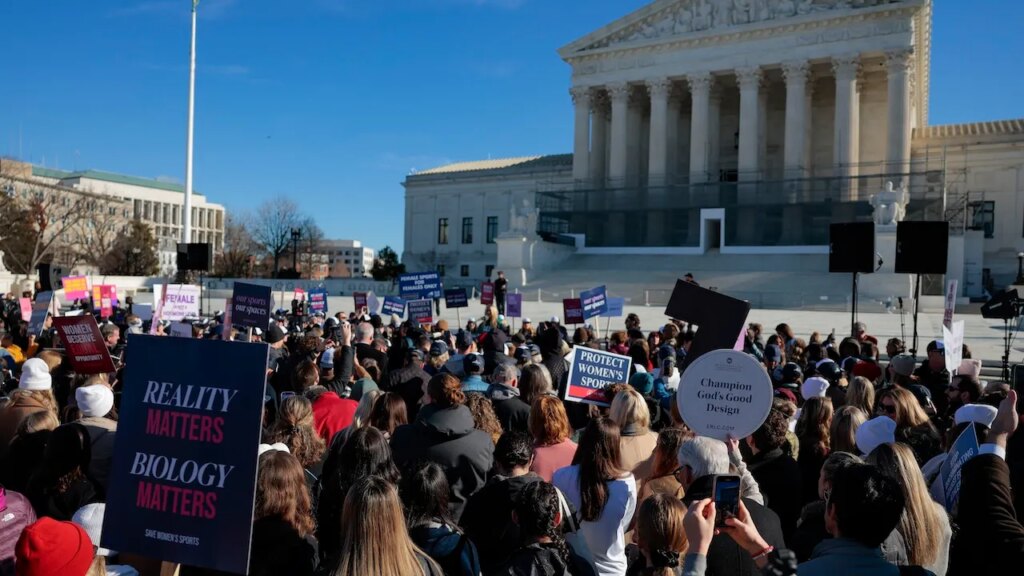
The U.S. Supreme Court recently heard two pivotal cases concerning the participation of transgender athletes in women’s sports. These cases challenge state laws that restrict transgender girls and women from competing on female athletic teams in public schools. Outside the court, protests revealed the intense societal divides, with advocates on both sides vocally expressing their stance.
Inside the courtroom, arguments revealed strategic shifts and legal complexities. Attorneys representing transgender athlete Lindsay Hecox moved to dismiss their own case, Hecox v. Little, which originally challenged Idaho’s law designed to protect women’s sports. The dismissal motion came as the Supreme Court took up the matter, highlighting evolving legal maneuvers in this high-stakes fight.
Disputed Graduation Timelines and Legal Implications
Central to the Idaho case is the issue surrounding Hecox’s graduation date from Boise State University. Initially, the legal team asserted that Hecox could graduate by May, which would render the lawsuit moot. However, later admissions indicated this timeline was unlikely, with a fall graduation more probable. Idaho Solicitor General Alan Hurst called this claim into question after state officials verified the athlete’s academic status.
Idaho Attorney General Raul Labrador emphasized the significance of this inconsistency, stating it underscored the plaintiffs’ shifting arguments and supported the state’s case. According to Labrador, the plaintiffs delayed making certain arguments until after the Supreme Court granted review, affecting the legal process.
West Virginia Case and the Definition of ‘Sex’
The second case involves a West Virginia transgender teenager challenging a similar state law. The ACLU, representing the athlete, urged the Court to avoid defining “sex” narrowly. Joshua Block, the ACLU attorney, argued that Title IX aims to prevent discrimination and is not about establishing a fixed biological sex definition.
Chief Justice John Roberts pressed Block on defining “sex,” ultimately prompting a concession that for the purpose of this case, “biological sex” could be accepted. Still, Block declined to provide a concrete definition outside the case, reflecting the complexity of this foundational legal question.
Allegations and Emotional Testimonies Raise Tensions
The atmosphere surrounding the West Virginia case intensified due to sexual harassment allegations lodged against the transgender athlete by a former teammate, Adaleia Cross. While the allegations were denied by the athlete and found unsubstantiated by school investigations, they became an emotional focal point during related events.
At a gala hosted by Alliance Defending Freedom (ADF), Cross’s mother recounted the alleged incidents, moving attendees to tears. Former athletes present expressed strong reactions, emphasizing concerns about safety and fairness in girls’ sports. These testimonies underscored the personal and social stakes involved beyond the legal arguments.
Diverse Voices Rally for Protection of Women’s Sports
Outside the Supreme Court, supporters of women’s sports laws included former athletes and activists who shared their experiences competing against transgender athletes. Notable voices such as former volleyball players Brooke Slusser and Payton McNabb articulated the physical and emotional toll they attribute to current policies.
Conversely, advocates for transgender inclusion gathered, voicing the need for equality and nondiscrimination. Lambda Legal CEO Kevin Jennings praised the West Virginia athlete as a symbol of courage for transgender youth. The lively and often contentious demonstrations illustrated the broader cultural conflict fueling the legal battles.
Legal Experts and Officials Expect a Conservative Majority
Legal observers widely interpret the Supreme Court’s conservative majority as inclined to uphold state laws excluding biological males from girls’ and women’s sports. Idaho’s Attorney General Labrador expressed confidence in the state’s position, highlighting judges’ difficulty articulating the opposing arguments during oral arguments.
West Virginia’s Attorney General John McCuskey shared optimism for a unanimous ruling favoring their side but acknowledged the complexities ahead. A Court decision is anticipated by summer, with significant implications for sports policy and the interpretation of Title IX protections nationwide.
Cultural Movements and Growing Public Debate
The national debate has galvanized advocacy groups and created a visible cultural movement. XX-XY Athletics, an organization opposing transgender participation in women’s sports, reported a rapid increase in support and endorsements from college athletes.
The issue has also produced tangible impacts in professional sports, prompting rule changes to safeguard women’s competitions from inclusion of biological males. At the Supreme Court hearing, the clash between competing philosophies on inclusion, fairness, and identity remained palpable.
This landmark Supreme Court case exceeds legal dimensions; it reflects a crucial moment in defining gender rights and protections in athletic competition. The eventual ruling will shape policies affecting millions of students, athletes, and institutions across the United States.
Read more at: www.foxnews.com