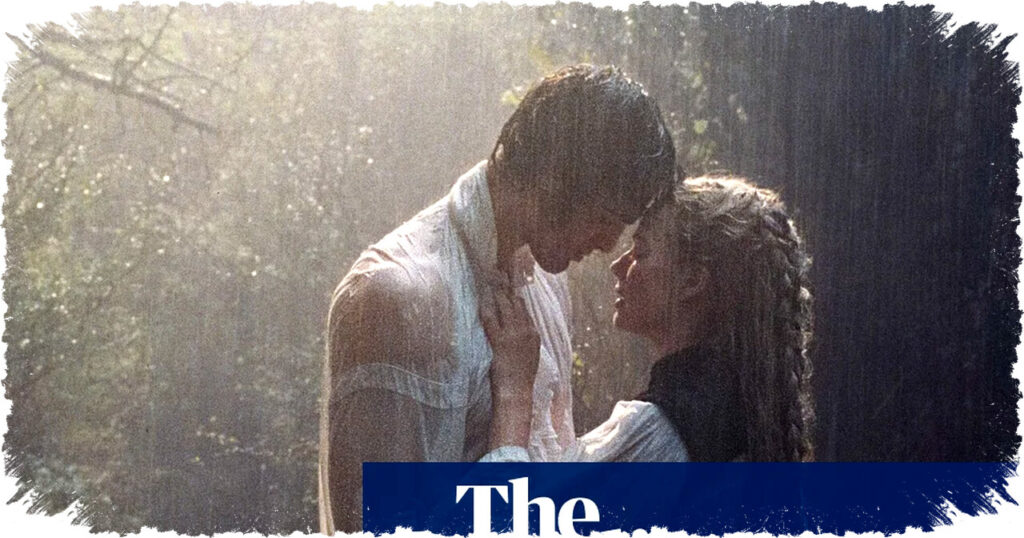
Emerald Fennell’s adaptation of Wuthering Heights brings a flamboyant and stylized reimagining of Emily Brontë’s classic novel, yet it struggles to balance its campy elements with the dark romanticism at the heart of the story. The film presents a highly theatrical visual style, resembling an extended fashion shoot on the Yorkshire moors, saturated with exaggerated costumes and a heavy-handed use of BDSM motifs.
Margot Robbie’s portrayal of Cathy highlights a provocative and playful edge, including scenes of self-pleasure that add a controversial and modern twist to the character. Jacob Elordi’s Heathcliff is depicted as a brooding outsider with a dramatically shifting look, evolving from a wild, long-haired figure into a more polished yet still emotionally troubled man.
Narrative Adjustments and Character Omissions
Fennell selectively reshapes the story by omitting significant characters and plotlines. Notably, Hindley Earnshaw, Cathy’s older brother, is entirely removed, with his destructive gambling and drinking transferred to the character of Mr. Earnshaw, played by Martin Clunes. This alteration simplifies the family dynamics but also reduces the depth of the traditional narrative.
The film also excludes the second half of Brontë’s novel, which follows the next generation, thereby focusing exclusively on the intense but truncated story of Cathy, Heathcliff, and Edgar Linton. This omission removes the broader context of the novel’s exploration of legacy and the consequences of past actions.
Issues of Authenticity and Representation
One of the most contentious aspects of Fennell’s adaptation is the near-erasure of Heathcliff’s racial identity. Originally described as having dark skin, Heathcliff’s origins and ethnicity are downplayed, which critics have interpreted as a missed opportunity to address themes of otherness and systemic prejudice embedded in the source material. The use of inverted commas around the title appears to signal a self-aware, postmodern detachment that complicates questions of authenticity.
Plot Overview and Character Dynamics
The storyline follows Mr. Earnshaw’s impulsive decision to adopt a street-smart boy from Liverpool, Heathcliff, making him a stepbrother to Cathy. As children, Cathy and Heathcliff share a wild, uninhibited friendship, which becomes strained by the rigid social divisions they must navigate as adults. Cathy marries Edgar Linton, a wealthy, mild-mannered neighbor, which devastates Heathcliff and triggers his departure and subsequent return as a wealthy, vengeful man.
Heathcliff’s alliance with Edgar’s sister Isabella introduces dark turns in the narrative, but the film trivializes his abusive treatment of her by portraying her as an amused and willing participant in their dysfunctional relationship instead of a victim of cruelty.
Narrative Lens and Storytelling Style
The character of Nelly Dean, the loyal housekeeper and unreliable narrator in the novel, remains a central figure through whose perspective much of the story is filtered. Hong Chau’s performance captures Nelly’s complexity and her critical role in the unfolding drama. A rare moment of meta-awareness occurs when Cathy directly confronts Nelly about her biased narration.
The film’s emotional peaks are intense yet stylized to the point of exhaustion, closely resembling the frenetic energy and visual extravagance found in Baz Luhrmann’s works. This highly theatrical approach dilutes the raw emotional core of the story, making moments of genuine feeling seem contrived.
Comparison and Reception
Compared with other adaptations, such as Andrea Arnold’s 2011 film, which leaned into the primal and passionate elements of Brontë’s novel, Fennell’s version feels more like a glossy, ironic spectacle than a heartfelt love story. It lacks the visceral impact and emotional authenticity that made previous efforts stand out.
This new Wuthering Heights offers a blend of camp and pseudo-romance, but ultimately comes across as an ersatz, exaggerated homage rather than a profound reinterpretation of the source. Its stylistic choices may alienate purists while intriguing viewers who appreciate highly stylized cinematic experiments.
Wuthering Heights is released in Australia on 12 February and in the UK and US on 13 February.