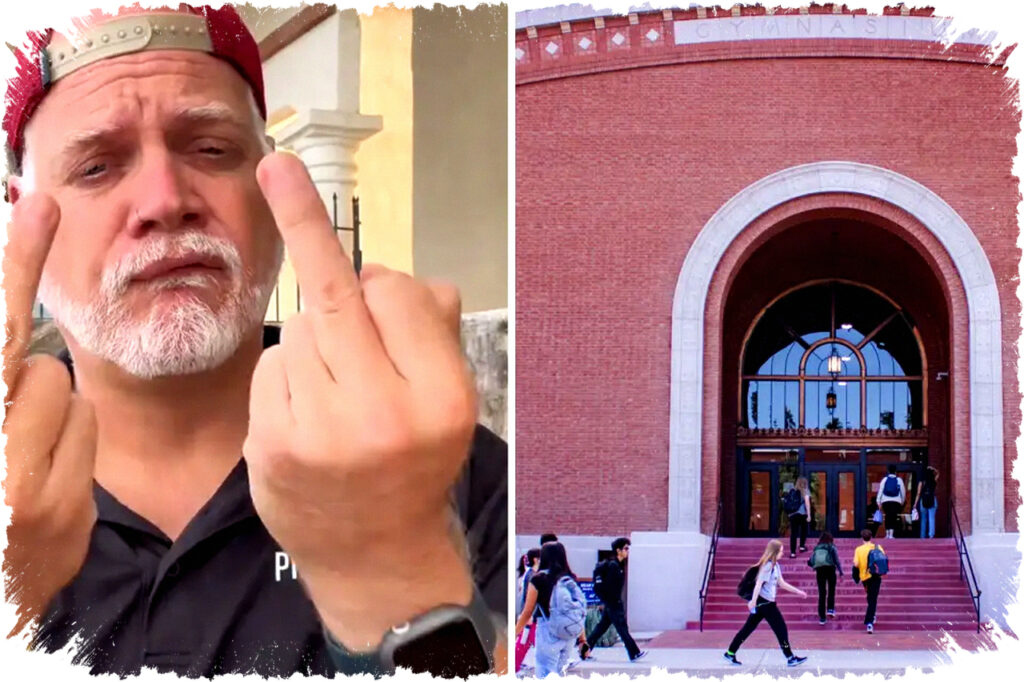
An American Sign Language lecturer at the University of Arizona, Jason Gervase, is under fire for posting inflammatory remarks on social media. He told his followers to "F—k off" if they identify as "MAGA" or "Zionists," sparking significant backlash.
Gervase posted a video addressing his more than 100,000 TikTok followers in which he said, "If you are MAGA, if you are a Zionist, or you are anti-human rights, this is not your space." His remarks have drawn sharp criticism from advocacy groups and members of the university community.
Advocacy Group Demands Termination
Liora Rez, founder and executive director of StopAntisemitism, reported that Jewish members and influencers within the ASL community flagged Gervase’s comments. She sent a formal letter to the University of Arizona demanding his termination on grounds of hate speech.
Rez expressed concern about the impact of Gervase’s rhetoric on students. She stated, “If I had a deaf child, I wouldn’t want them in a classroom with this kind of bias and hatred.” Her letter described his behavior as “deeply disturbing and fundamentally incompatible with the responsibilities of a university educator.”
Controversial Social Media Posts
In addition to his hostile statements toward MAGA supporters and Zionists, Gervase made posts telling followers to “F—k Israel.” He also appeared to endorse conspiracy theories surrounding a terror attack, suggesting it was a false flag operation orchestrated by Mossad, Israel’s intelligence agency.
When challenged, Gervase acknowledged the timing of his post but did not retract his agreement. These further amplified calls from critics who view his conduct as promoting hate and misinformation.
University Response and Academic Freedom
A spokesperson for the University of Arizona, Mitch Mieczyslaw, emphasized that Gervase’s personal views do not reflect the institution’s position. He noted, “Employees have the right to express personal views, even when those statements fall short of our values of respect and civil discourse.”
The university highlighted its Political Activity Policy, which requires employees to maintain objectivity and not let political interests affect their professional responsibilities. Nevertheless, the university refrained from disciplinary action, invoking protections tied to academic freedom and free speech.
Gervase’s Defense of His Speech
Gervase took to social media platform Threads to defend himself against calls for termination. He argued his comments are protected under the First Amendment, stating, “Criticism of Zionism, a political movement and ideology, is not an attack on a people or a faith.”
Claiming to be a “dedicated professor,” Gervase warned against what he described as a “coordinated digital mob” attempting to silence him. He praised academic freedom as a safeguard for his personal and political expressions.
Debate Over Free Speech and Hate Speech
Rez countered by distinguishing between protected free speech and hate speech. She explained that while individuals have the right to express unpopular opinions, hateful rhetoric carries consequences and can harm marginalized communities.
She pointed out a pattern where antisemitism and extremist hate speech tend to resurface following high-profile geopolitical events. Recent tensions involving the US, Israel, and Iran have exacerbated divisions, fueling the contentious discourse around Gervase’s comments.
Key Points of Contention
- Gervase instructed MAGA supporters and Zionists to leave his social media space.
- He posted explicit anti-Israel statements and supported false flag conspiracy theories.
- StopAntisemitism called on the university to terminate Gervase’s employment.
- The University of Arizona defended his right to free speech but distanced itself from his views.
- The debate accentuates tensions between academic freedom and protection from hate speech.
The controversy remains active as concerned groups continue to monitor the situation. The dialogue underscores broader national disputes about the boundaries between political expression, hate speech, and institutional responsibility in academia.