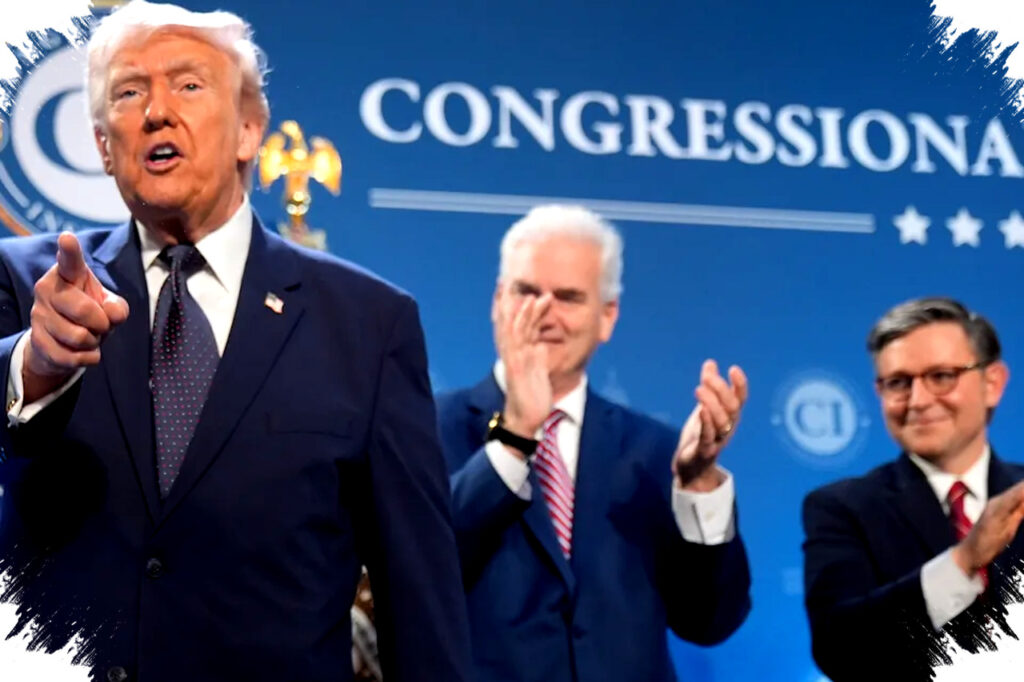
President Donald Trump has demanded that Congress pass a stringent proof-of-citizenship voting bill, linking its approval to his willingness to sign any other legislation. He specifically insists that the bill include a ban on most mail-in voting, a method widely used in many states, as a condition for his support.
At a GOP retreat in Florida, Trump emphasized that without tougher voting laws, Republicans would struggle to win elections. He described the legislation, known as the SAVE America Act, as crucial to securing victory in the upcoming midterm elections.
The SAVE America Act’s Key Provisions
The bill, already approved by the House, mandates that voters provide proof of citizenship via passports or birth certificates when registering. Additionally, voters would have to present photo identification at the polls, a practice common in multiple states.
Trump seeks to extend the act by outlawing mail ballots except for voters with disabilities, military personnel, or others with valid reasons. Voting experts warn that such restrictions could disenfranchise up to 20 million voters who lack immediate access to necessary documents. The mail voting ban could increase this number substantially.
Controversy and Opposition
Voting rights advocates express concern that the legislation encroaches on states’ constitutional authority over elections. Critics argue the bill may suppress voter turnout and disproportionately affect marginalized groups.
Senate Democrats, led by Chuck Schumer, have vowed to resist the bill, labeling Trump’s tactics as bullying. “This is what he does — he’s a thug, he’s a bully,” Schumer stated. The bill faces strong opposition in the Senate where Republicans hold only a slim majority.
Republican Divisions on Filibuster and Strategy
Among GOP senators, opinions diverge on how to overcome Senate filibuster rules that currently block the bill’s passage. Senate Majority Leader John Thune cautions that the so-called "talking filibuster" method to force a vote is unprecedented and fraught with risk.
Some Republicans advocate pushing the bill forcefully despite procedural hurdles, while others worry that extended debate and amendments could fracture party unity. Private caucus meetings are planned to address these challenges.
Broader Legislative Implications
Trump has stated no other bills will be signed until the voting reform is enacted, prioritizing it above all else. He also proposed adding unrelated measures concerning transgender rights restrictions and a foreign surveillance bill known as FISA, demonstrating an expansive legislative agenda tied to the voting bill.
The focus on proof-of-citizenship requirements reflects a longstanding priority of Trump’s MAGA coalition. However, there is significant concern from voter advocacy groups that these requirements could impose burdensome obstacles for eligible American voters, undermining electoral participation.
Context of Trump’s Ongoing Election Claims
The push follows Trump’s continued refusal to accept his 2020 election defeat. His Justice Department has investigated allegations of voting irregularities, including unusual FBI seizures of ballots in battleground states like Georgia and Arizona.
Despite widespread rejection of voter fraud claims by election officials, Trump insists that mail-in voting is susceptible to fraud and must be curtailed. Meanwhile, mail ballots are endorsed by many as vital tools to increase accessibility and participation in the democratic process.
In summary, Trump’s demand to end most mail-in voting within the framework of the SAVE America Act signals a contentious battle over voting rights and election integrity heading into the midterms. The debate highlights deep partisan divides over election laws and the balance of federal and state control in U.S. elections.