


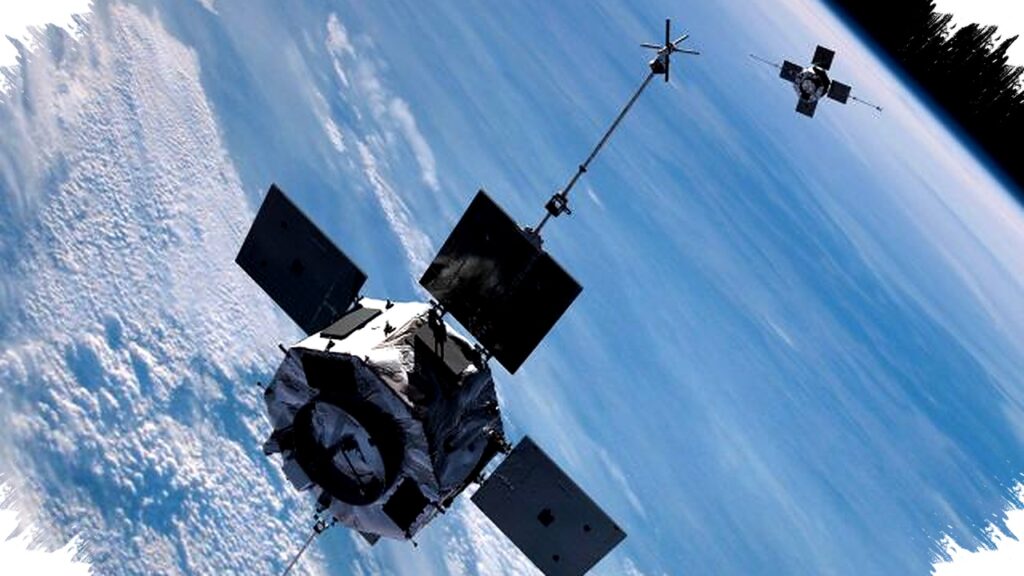
NASA’s Van Allen Probe A unexpectedly reentered Earth’s atmosphere early Wednesday, marking an uncontrolled descent years ahead of initial projections. Though most of the 600-kilogram spacecraft likely disintegrated upon reentry, NASA acknowledges the possibility that some fragments may have survived the fiery plunge.
The spacecraft plunged over the equatorial Pacific Ocean, south of Mexico and west of Ecuador, at approximately 6:37 a.m. ET, according to data from the US Space Force and confirmation by astrophysicist Jonathan McDowell. No reports of injuries or eyewitness sightings have emerged following the event.
Details of the Spacecraft and Mission
Launched in 2012, the Van Allen Probe A was part of a twin mission to study the Van Allen radiation belts—two bands of charged particles trapped by Earth’s magnetic field at altitudes of up to 93,300 miles. These radiation belts play a vital role in shielding the planet from harmful cosmic and solar radiation, as well as charged particles from solar wind.
During its operational life, which extended beyond expectations until its mission concluded in 2019, the probe provided unprecedented data on radiation belt dynamics. Among its key discoveries was evidence of a transient third radiation belt that can form during heightened solar activity.
Reentry Occurred Sooner Due to Solar Activity
NASA initially forecasted the probe’s reentry to take place in 2034, based on models developed prior to the current solar cycle. However, the solar maximum reached this year intensified space weather phenomena, causing increased atmospheric drag that accelerated the descent process.
“The increased solar activity amplified atmospheric drag on the spacecraft beyond our earlier estimates,” NASA explained. This same solar maximum is influencing the expected reentry schedule of Van Allen Probe B, which is now projected to deorbit before 2030.
Risk Assessment and Safety Considerations
NASA estimates the likelihood of any debris from the probe causing harm to a person at roughly 1 in 4,200. Although this risk surpasses those of some previous reentries, including China’s 2018 space station descent with an estimated risk of less than 1 in a trillion, it remains low in practical terms.
Dr. Darren McKnight, a senior fellow at LeoLabs, contextualized the risk by stating, “We’ve had past reentries with 1 in 1,000 chances and no incidents; a 1 in 4,000 risk isn’t catastrophic.” The space agency’s protocols require that American spacecraft be safely disposed of or reenter within 25 years following mission completion to mitigate long-term hazards in orbit.
Space Debris Challenges and Evolving Policies
Space debris management has become an increasingly prominent concern amid the rise of commercial space missions and satellite launches. Experts such as Marlon Sorge from The Aerospace Corporation highlight growing awareness about how to minimize risks posed by surviving debris on Earth.
Mission planners for the Van Allen probes had originally prepared for controlled reentry maneuvers designed to deplete remaining fuel and enable a gradual orbital decay. However, fuel constraints also limited options like relocating the spacecraft to graveyard orbits, which pose their own risks of collision and debris proliferation.
Incidents of debris surviving reentry are more common than publicly perceived. McKnight noted that roughly one object per week, including obsolete rocket bodies or payloads, survives atmospheric entry and reaches the surface.
Importance of Radiation Belt Research
Understanding the Van Allen belts has crucial implications for protecting human spaceflight and satellite technology. The belts shield astronauts and equipment from space weather hazards that could jeopardize missions and disrupt communications or navigation systems on Earth.
NASA’s Van Allen probes significantly advanced scientific knowledge of the belts’ behaviors under varying solar conditions. Their data continues to inform efforts to safeguard both orbital assets and terrestrial infrastructure.
As space traffic increases with global activity in space exploration and commercial ventures, managing end-of-life spacecraft remains a priority to reduce collision risks and minimize debris hazards both in orbit and on Earth. The early and uncontrolled reentry of Van Allen Probe A highlights the dynamic challenges faced by space agencies amid changing solar and orbital environments.