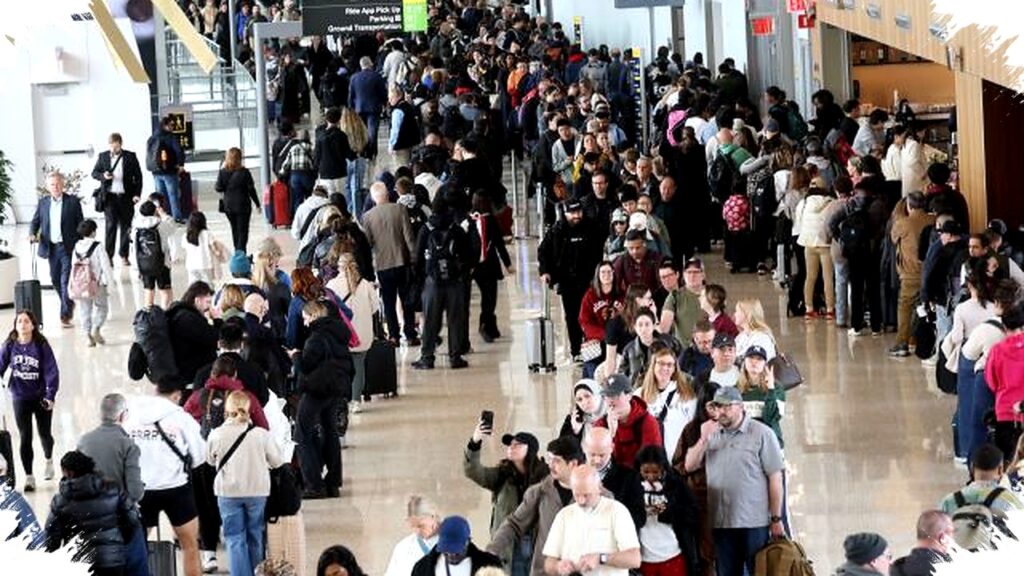
ICE agents have taken on a larger visible role at major U.S. airports as the partial government shutdown continues to strain TSA staffing and push security lines to record lengths. The Department of Homeland Security says the agents are helping with ID checks, crowd control, logistics, and airport entrances and exits after receiving standard TSA training.
The move comes as airport wait times have surged at hubs including Houston, New York, Atlanta, and Baltimore, while thousands of TSA officers have missed work or quit during weeks without pay. In Houston, airport officials said some travelers faced waits of up to four hours earlier in the week, and one major terminal was operating with less than half of its TSA checkpoints because of staffing shortages.
What ICE agents are doing at airports
ICE personnel are not replacing TSA screeners, and federal officials say they are not trained for specialized screening jobs such as operating X-ray machines. Instead, they are taking on lower-complexity tasks so TSA officers can stay focused on critical security work at the metal detectors and screening lanes.
According to DHS, the agents have been checking travelers’ IDs at some airports, guarding access points, and helping move passengers through crowded checkpoints. At Hartsfield-Jackson Atlanta International Airport, a CNN crew saw ICE agents directing ID verification and helping with passenger flow, while private security staff assisted with bins.
Airports under pressure from staffing shortages
The staffing crunch has hit hardest at busy airports during spring break travel, when passenger volume remains high. TSA data showed more than 3,120 officers did not report to work on one Wednesday, a callout rate of 11.14%, just below a record set days earlier, while nearly 500 officers have quit since the shutdown began, according to DHS.
Houston’s George Bush Intercontinental Airport has been among the most affected, with officials saying the airport can operate only about half of its 37 TSA checkpoints. Director of aviation Jim Szczesniak said the airport has reassigned hundreds of employees from finance, IT, maintenance, and other departments to help manage the crowds.
Lawmakers and the White House respond
Pressure on Congress intensified after airports warned that conditions could get worse if the funding standoff continued into the weekend and lawmakers headed toward recess. The Senate later approved a plan to fund most of DHS, including TSA, but the measure still needs House approval before shuttered agencies can fully reopen.
At the same time, President Donald Trump said he wanted the Department of Homeland Security to “immediately pay” TSA workers, using money tied to legislation he signed last year known as the One Big Beautiful Bill. Two people familiar with the plan said TSA checks for unpaid workers would depend on an internal review of how quickly the funds can be used.
How travelers are experiencing the delays
Passengers at several airports reported long and unpredictable waits, even as some midweek lines briefly improved. At LaGuardia, one general security line stretched to nearly two hours, while TSA PreCheck at the same airport took just over 40 minutes.
The situation has also forced airports to tell travelers to arrive much earlier than usual, with some advising three hours ahead of departure. In Houston, New York, and Atlanta, airport systems and local authorities have also brought in civilian security staff, police officers, and other personnel, though many of them cannot work the screening checkpoints themselves.
Key figures reported by TSA and airport officials
| Issue | Reported figure |
|---|---|
| Travelers screened on one Monday | 2.6 million |
| Travelers screened on Tuesday | 2.2 million |
| TSA officers absent on one Wednesday | 3,120+ |
| TSA callout rate | 11.14% |
| TSA officers who have quit since the shutdown began | Nearly 500 |
| George Bush Intercontinental checkpoints operating | About half of 37 |
Human toll on TSA workers
The shutdown has taken a financial toll on TSA employees, many of whom live paycheck to paycheck. TSA Administrator Ha Nguyen McNeill told a House Oversight hearing that officers have been sleeping in cars, selling blood and plasma, and taking second or third jobs just to cover basic costs.
Union leaders say the ICE deployment may help keep lines moving, but they view it as a temporary patch rather than a fix. Everett Kelly, national president of the AFGE, compared the effort to “giving a person dying of pneumonia a teaspoon of cough syrup,” saying it does not solve the underlying problem of unpaid security staff.
Airport officials in Houston said they have also tried to support workers directly by providing meals, gas cards, and help through local nonprofits. Even with those efforts, officials warned that long lines could persist as spring break traffic stays strong and the funding dispute in Washington remains unresolved.