


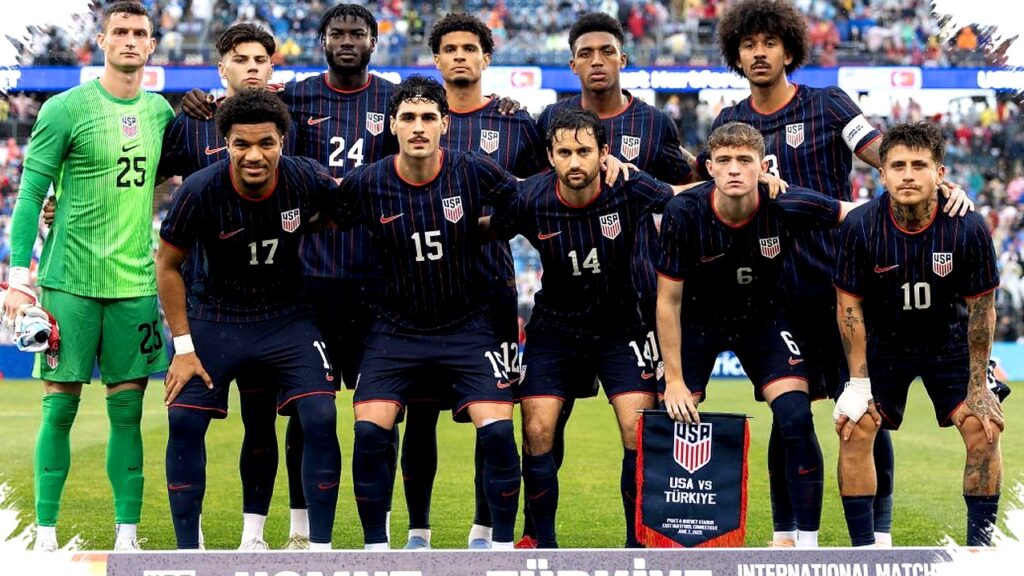
The U.S. men’s national team may not enter the next World Cup with a single obvious global superstar, but that is not necessarily a weakness. The bigger question is whether Mauricio Pochettino now has enough reliable depth to turn a solid starting XI into a genuine knockout-stage threat.
That question matters because World Cup history shows that depth is rarely optional for teams that reach the final four. ESPN’s Ryan O’Hanlon examined the past 16 semifinalists and found that the 12th-most used player averaged 42.6% of available minutes, while the 13th through 16th players still accounted for meaningful workloads, especially in the modern five-sub era.
Why depth has become a World Cup separator
World Cup match management has changed over time, and recent tournaments have pushed managers to use more of their squads. O’Hanlon’s data shows that among the last eight finalists from the past four World Cups, the 12th- through 16th-most used players averaged 40.4%, 33.4%, 28.5%, 20.3% and 13.7% of minutes, respectively.
That usage pattern reflects a simple truth: teams that survive the tournament usually need more than starters who can play well. They need bench players who can hold a lead, change a game, and stay dependable when fatigue, injuries or suspensions force rotation.
Where the U.S. stood in the last World Cup
The last U.S. World Cup run offered a strong top end but limited help beyond it. Christian Pulisic drove the attack, while Timothy Weah, Weston McKennie, Yunus Musah, Tyler Adams, Sergiño Dest and Antonee Robinson formed the core of a team that could compete with top opponents for stretches.
But the bench was thin, and the numbers reflected that problem. The U.S. 12th through 16th players averaged 37.5%, 29.2%, 25.0%, 14.4% and 12.5% of minutes, below the average for semifinalists and finalists across the same span.
A simple comparison helps show the gap:
| Slot | USMNT | Finalist average |
|---|---|---|
| 12th | 37.5% | 43.9% |
| 13th | 29.2% | 38.0% |
| 14th | 25.0% | 30.9% |
| 15th | 14.4% | 28.8% |
| 16th | 12.5% | 19.7% |
That list also showed who the U.S. had available off the bench at the time: Haji Wright, Brenden Aaronson, Cameron Carter-Vickers, Giovanni Reyna and Jesús Ferreira. The issue was not only limited minutes, but also limited trust and limited impact from several of those options.
Why the current group looks different
The next U.S. squad appears stronger in the areas that matter most for tournament depth. Pulisic remains the leading attacker, but the broader pool now includes players with more proven value in top European leagues, and that changes the equation for Pochettino.
Weah now starts for Marseille, Johnny Cardoso has logged major Champions League minutes for Atlético Madrid, and Malik Tillman has played a regular role for Bayer Leverkusen. Ricardo Pepi continues to build his profile at PSV, while Joe Scally keeps playing nearly every minute for Borussia Monchengladbach.
That matters because tournament depth is not only about talent. It is about players who can enter high-pressure matches without the level dropping too sharply.
The bench also looks more productive than before
Several players who were fringe options in the previous cycle now bring better club form and more confidence. Wright has become one of the top scorers in the English Championship, Aaronson has improved his goal involvement rate, and other players such as Aidan Morris, Patrick Agyemang, Cristian Roldan and Max Arfsten may offer more useful matchday options than the previous cycle’s depth pieces.
That does not guarantee results, but it does expand the tactical choices available to Pochettino. It also gives the U.S. a better chance to handle the late stages of knockout matches, when one substitution can decide whether a team survives or goes home.
What depth could change for the USMNT
- It can reduce the drop-off between starters and substitutes.
- It can help the team absorb injuries, fatigue and suspension risk.
- It can give Pochettino more ways to adjust during matches.
- It can improve the team’s odds in extra time and late-game scenarios.
The 2026 World Cup will be played in the United States, Canada and Mexico, and the conditions are likely to test squad management as much as raw quality. O’Hanlon noted that the heat expected in North America could make the 2022 pattern of heavier bench usage feel like a conservative guide, which raises the premium on having usable options beyond the first 11.
For the U.S., that is the encouraging part of the current cycle. The team may still be waiting for a true global star to carry it, but it now looks closer to having the kind of depth that past semifinal teams used to survive the grind of the tournament.
If the USMNT is going to push beyond its recent World Cup ceilings, the answer may not come from one player alone. It may come from a bench full of players who can keep the level high when the tournament begins to demand more than the starting lineup can provide.