


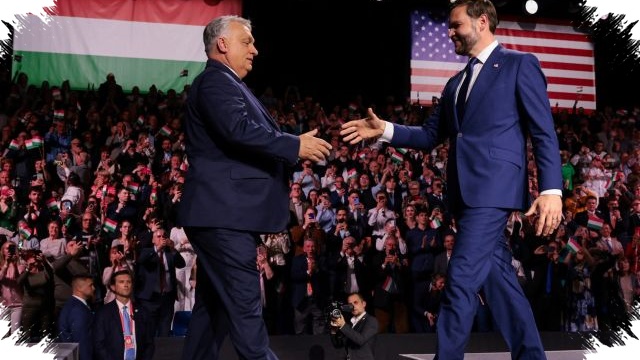
Viktor Orbán’s political future could soon reshape Donald Trump’s influence in Europe, as Hungary heads into a crucial parliamentary vote that may end the long-running partnership between the two leaders. The contest has become more than a domestic race, because Orbán has emerged as one of Trump’s strongest allies on the continent and a key symbol for the European far right.
The race has drawn unusual attention from Washington. JD Vance recently appeared in Budapest and told supporters to “stand with Viktor Orbán, because he stands with you,” while Donald Trump also voiced direct support, saying, “I’m a big fan of Viktor. I’m with him all the way. The United States is with him all the way.”
Why Orbán matters to Trump
Orbán has spent more than a decade turning Hungary into a political laboratory for right-wing populists. Analysts say he has built an ecosystem of think tanks, media outlets, universities and cultural institutions that give conservative movements in Europe a base of operations.
Bulgarian political scientist Ivan Krastev described Hungary as the “intellectual, institutional, and financial hub” of the European right. He said the Trump administration sees Orbán’s model as part of a wider effort to push Europe toward an anti-woke, anti-green and anti-immigrant agenda.
That influence has spread beyond Hungary. Steve Bannon once called Orbán “Trump before Trump,” while figures linked to the American conservative movement, including Tucker Carlson and the Conservative Political Action Conference, have repeatedly used Budapest as a stage.
The election showing pressure on Orbán
Orbán now faces one of his toughest electoral tests in years. Polls have given Péter Magyar’s Tisza party a double-digit lead for much of the past year, with the opposition focusing on corruption, health care and everyday economic concerns instead of foreign policy.
Magyar, once linked to Orbán’s camp, has also tried to frame the vote as a test of Hungarian sovereignty. He said: “No foreign country may interfere in Hungarian elections… Hungarian history is not written in Washington, Moscow, or Brussels – it is written in Hungary’s streets and squares.”
The result could carry weight well beyond Hungary. Krastev said an Orbán defeat would have “an incredible psychological impact” because Orbán has become a symbol of strength for the far right in Europe.
How Orbán built his system
Political scientists still debate how to describe Orbán’s rule, but many agree it sits between democracy and authoritarianism. Some call it a hybrid regime, while others use the term “competitive authoritarianism” because elections still take place even as the playing field remains uneven.
Péter Krekó, who leads a Budapest think tank, prefers the phrase “informational autocracy.” He said the main tool is not physical repression but pressure through messaging, disinformation and character attacks.
A few key features of Orbán’s political model include:
- Constant identification of enemies, from NGOs to journalists and liberal academics.
- Heavy use of state-aligned media and messaging to shape public debate.
- Support for institutions that train and promote conservative elites across Europe.
- Strategic use of foreign alliances to strengthen domestic legitimacy.
István Hegedűs, who served in Hungary’s first freely elected parliament, said Orbán’s politics have long been shaped by a “friends and enemies” worldview. He added that the system has survived by constantly finding new targets.
A foreign-policy asset for Trump
Orbán has also proved useful to Trump on foreign policy. Hungary depends heavily on Russian energy, and Trump previously imposed sanctions on Russian oil purchases before granting Hungary a one-year exemption.
Vance later praised Orbán’s energy policy, saying the rest of Europe “should have been following” it. That message fits a broader conservative argument that Brussels has weakened Europe by backing climate and migration policies they oppose.
The symbolic value of Orbán may be even more important than the practical one. Budapest has become a meeting point for MAGA-linked figures, conservative intellectuals and European nationalists looking for a common political language.
What is at stake if Orbán loses
If Orbán loses power, his ideological network is unlikely to vanish overnight. The Mathias Corvinus Collegium, the Danube Institute and other pro-government platforms would likely remain active, and conservative media outlets would probably keep operating.
Even so, a defeat would matter. It would weaken the claim that Orbán’s model is the future of Europe and could damage the confidence of nationalist forces that have treated Hungary as proof that their politics can win.
For Trump, it would remove one of his most visible and reliable allies in Europe at a time when his movement still looks to Budapest for inspiration. It would also send a message that the far-right project Orbán helped build can still be challenged at the ballot box, even in a system designed to make him look strongest.
Read more at: www.cnn.com