


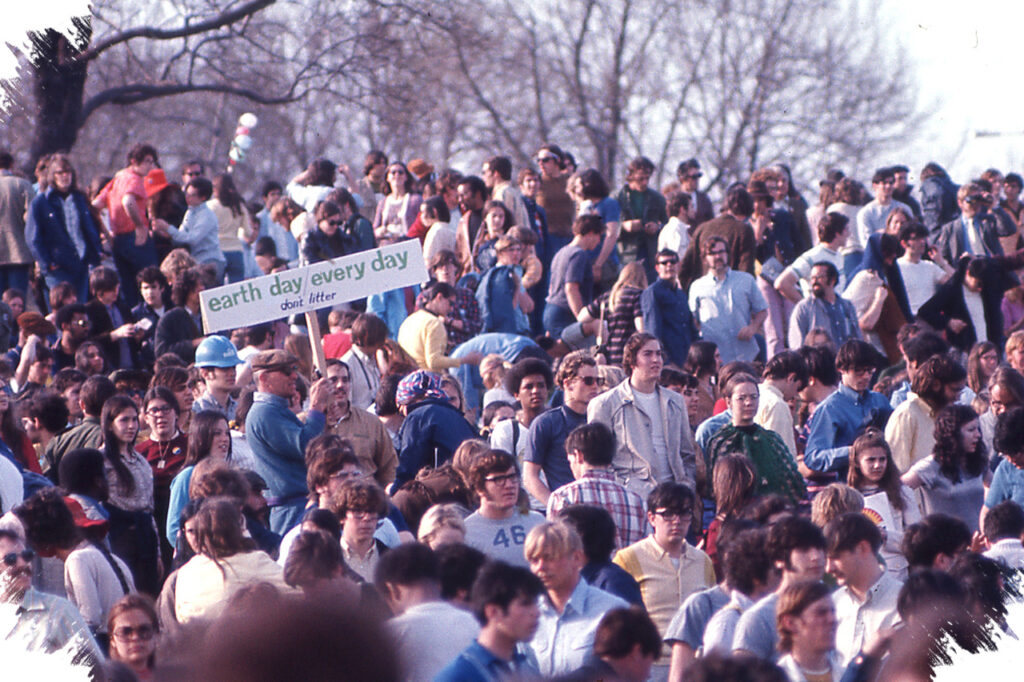
Earth Day began as a response to a country under strain, but it quickly became one of the largest civic environmental actions in U.S. history. The first Earth Day brought 20 million Americans into peaceful demonstrations, a scale that still stands out as a record.
Its rise was not accidental. Environmental historian Adam Rome, author of The Genius of Earth Day: How a 1970 Teach-In Unexpectedly Made the First Green Generation, says the movement grew out of the protest spirit of the late 1960s and the belief that major problems could still be solved through collective action.
How Earth Day took shape
Earth Day was founded by Wisconsin Senator Gaylord Nelson, a liberal Democrat who became convinced, while serving as governor, that environmental harm would become a defining national issue. He drew on the “teach-in” model used by the anti-war movement, turning Earth Day into a nationwide environmental conversation.
Rome says the organizing team reflected broader social unrest at the time. Many of the young people Nelson hired had worked in anti-war, civil rights, or feminist activism, while only one had environmental experience.
That mix helped make Earth Day feel both urgent and inclusive. It also made the event unusually bipartisan, with conservatives joining liberals in large numbers.
Why the first Earth Day mattered so much
The first Earth Day reached schools, campuses, public squares, corporate offices, and government buildings across the country. Congress even shut down for the day, and roughly two thirds of its members were scheduled to speak somewhere.
Rome describes the event as a national teach-in that pushed people to talk seriously about environmental damage, its causes, and their own role in it. He says people debated whether the crisis was just a nuisance or a civilization-threatening threat.
They also asked harder questions about daily life. For many, it was the first time the idea of consuming less, or differently, felt like an environmental issue.
A public conversation that felt personal
The first Earth Day was not just about policy. It also forced people to think about their relationship with nature and whether that relationship needed to change in a deeper way.
Rome says the conversations were civil, but they were challenging enough to reshape how many Americans thought about pollution, public health, and responsibility. That shift mattered because environmental journalism was still limited, and many of the issues had not yet entered mainstream public debate.
Why the moment feels harder to repeat
Today’s Earth Day looks different from the one in 1970. Rome says the current political climate makes it harder to imagine a broad, civil national conversation with the same effect, especially because trust in government and faith in shared solutions are far more fractured.
He notes that some students now look for smaller forms of connection, such as community gardens, rather than large public events. Those efforts can still bring people together, even if they do not resemble the original Earth Day model.
How Earth Day changed over time
Nelson did not expect Earth Day to become a permanent annual tradition. Yet in many places it continued, even as the scale changed and the events became quieter, more local, and often centered on children.
Rome says there has not been a recent nationally organized Earth Day comparable to the original, aside from the 20th anniversary. He also notes that the planned 50th anniversary was disrupted by the pandemic, which removed another chance to see what a large modern Earth Day might have looked like.
What the legacy still offers
Rome says the most important lesson from the first Earth Day is not that the same format should return. The deeper lesson is that it made people feel powerful enough to act, and that sense of empowerment helped drive measurable environmental progress.
He points to cleaner air and cleaner water as evidence that public pressure can produce real change, even if the work is unfinished. For that reason, the history of Earth Day remains relevant not because it offers a simple anniversary ritual, but because it shows how a divided country once came together around a shared environment and left with a stronger sense that action was possible.
Read more at: insideclimatenews.org