


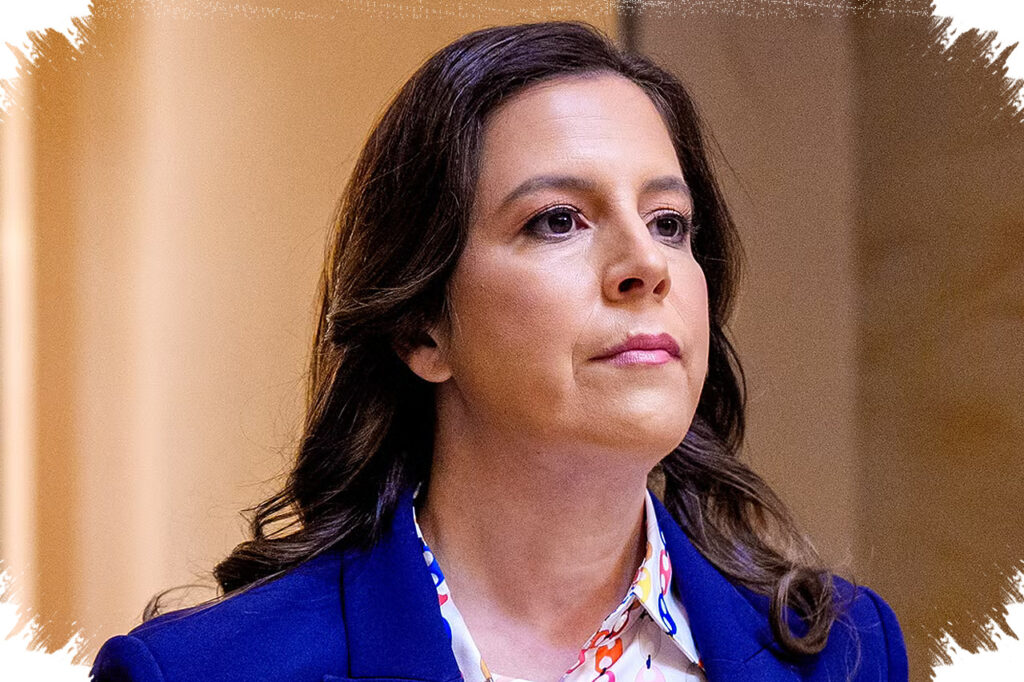
Elise Stefanik’s new book tries to turn her campus antisemitism hearings into a defining political narrative. But it leaves out a central element of the story: the broader context of Gaza, the protests, and the contradictory ways campuses and commentators responded.
Poisoned Ivies: The Inside Account of the Academic and Moral Rot at America’s Elite Universities revisits Stefanik’s high-profile questioning of the presidents of Harvard, MIT, and Penn, the exchange that made her a conservative star. The book treats that moment as a turning point, and it frames the hearings as proof that elite universities needed a hard political reckoning.
A book built around one famous exchange
The hearings remain the book’s centerpiece because they gave Stefanik national visibility. According to the book, she even went to the hearing while sick, “armed with Kleenex, cough drops, and doused with over-the-counter cold medicine,” and nearly let a colleague take her place for the key question.
That question, about whether calling for the genocide of Jews violates a university code of conduct, became the most famous line of the hearing. Former Harvard president Claudine Gay’s reply, “It depends on the context,” returns repeatedly in the book, including as an opening point and a final line meant to underline Stefanik’s view that the answer should have been obvious.
What the book does not add
The strongest criticism of Poisoned Ivies is not about what it says, but what it leaves out. The book focuses on campus antisemitism after Oct. 7, but it largely avoids describing what was happening in Gaza at the same time.
That omission matters because the campus protests cannot be fully understood without the wider political and humanitarian conflict that shaped them. The book also does not clearly reflect that many Jewish students and faculty publicly opposed the war, which complicates any simple picture of “Jewish campus response.”
Selective storytelling and contested episodes
The book draws heavily from conservative and right-wing coverage of campus unrest, including the New York Post, Tablet magazine, Bill Ackman, City Journal, the Free Press, the Heritage Foundation, and Canary Mission. It presents some incidents as emblematic examples of antisemitism, but several of those accounts were disputed or later appeared less solid.
One example involves Penn student Eyal Yakoby, whom Stefanik describes as courageously documenting antisemitism, even as his lawsuit against Penn was dismissed by a federal judge. Another is former Columbia professor Shai Davidai, whom the book portrays as a liberal two-state supporter, despite Columbia’s investigation into allegations that he harassed and doxed students and faculty.
Stefanik also recounts the Yale protest incident involving Sahar Tartak, saying she was “jabbed in the face” with a Palestinian flag. But video reviewed later did not clearly show a flag being shoved into her eye, and The New York Times corrected a similar claim in a Bret Stephens column by noting that the footage showed a flag hitting her face.
The missing context behind campus protests
Some of the book’s biggest examples are presented in a way that strips away the setting around them. The Columbia occupation of Hamilton Hall, for instance, is discussed without the detail that the occupiers renamed the hall after Hind Rajab.
That kind of omission gives the book an alternate-reality feel, where protests, administrators, and faculty appear detached from the events and arguments shaping the broader controversy. Without the surrounding context, the book pushes readers toward a simplified reading of the protests as proof of moral decline.
How the book fits Stefanik’s political arc
Poisoned Ivies also works as a record of Stefanik’s own rise, even as that rise has slowed. She moved from being a more moderate Republican to a strong Trump ally, and the campus hearings helped make her a national figure.
Trump later nominated her for ambassador to the United Nations, then withdrew that nomination because he did not want to risk her House seat in a special election. He also declined to endorse her run for New York governor, and Stefanik later suspended that campaign and said she would leave Congress at the end of her term in 2026.
Why the book matters now
Stefanik says the hearings helped reset American higher education, and the book presents them as a turning point in the relationship between universities and the federal government. That argument may still carry political weight, especially among conservatives who see the hearings as a moment of accountability.
But the wider environment has kept changing. Public attitudes toward Israel have shifted, protests have evolved, and the campus fights of 2023 and 2024 now look less like a final verdict than the start of a larger dispute over power, identity, and political language.