


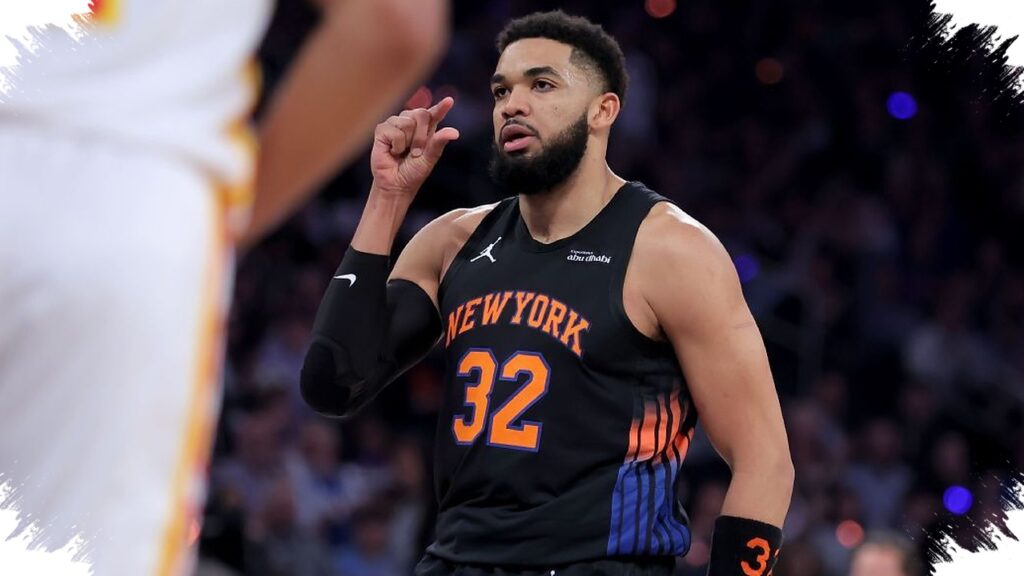
Karl-Anthony Towns has become one of the defining variables in the Knicks’ playoff run, and the margin for error is now thin. His size, shooting range and ability to attack mismatches give New York a weapon that can tilt a series, but the same traits also raise constant questions about how best to use him.
That tension sits at the center of the Knicks’ postseason stakes. The franchise is not being measured by progress alone, and the pressure around Towns stretches beyond one series against Atlanta.
A matchup problem Atlanta already knows
Towns created one of the key plays in Saturday’s Game 1 by driving from well beyond the lane, powering through defenders and finishing through contact for a three-point chance. That sequence summed up why he can be so difficult to defend when he is aggressive and engaged.
Atlanta coach Quin Snyder described the challenge as a matter of efficiency and choice for the defense. “It’s a little bit of pick your poison,” Snyder said, pointing to how Towns can punish teams in the post or in pick-and-roll action.
The numbers back up that concern. Against Atlanta this season, Towns has averaged 28.5 points per game, his highest mark against any opponent, while shooting 63% from the field and 50% from 3-point range.
How the Knicks are using Towns
New coach Mike Brown was hired to broaden the offense and reshape the roster after Tom Thibodeau’s exit. That shift has included more spacing, more perimeter shooting and a different role for Towns than he had in his first season in New York.
Brown has repeatedly signaled a willingness to let the offense flow from outside. The Knicks moved from 27th in 3-point attempts last season to 12th in Brown’s first season, which reflects the change in emphasis.
Towns’ production has still been meaningful, but not always in the way the team wants. He averaged 20.1 points per game during the regular season, his fewest since his rookie year, and his 13.8 shot attempts per game were a career low.
The debate around impact and usage
The conversation around Towns has followed him all season because his box score numbers have not always matched the feeling around his role. Some around the league believe he is being underused, while others think his game still needs more consistency on both ends.
An Eastern Conference assistant coach said Towns lacks the lateral quickness to hold up in certain defensive schemes for heavy minutes each night. Another scout said the broader team numbers do not show a dramatic drop-off, even if the eye test suggests something different.
That split has also shown up in the postseason. Towns scored 19 of his 25 points in the second half of Game 1, then finished with 18 in Game 2 as New York lost a 14-point lead and saw the series evened.
What the stakes mean for New York
The pressure on Towns is not only about performance in one matchup. The Knicks are operating under a clear expectation from owner James Dolan: reaching the team’s first NBA Finals since 1999 is treated as the standard, not the ceiling.
That expectation applies to Brown, to Mikal Bridges after the trade package that brought him to New York, and especially to Towns, who is 30 and already under constant scrutiny. A source close to Towns told ESPN that he “so badly wants things to work here” and wants to be “a Knick for life.”
Those stakes become even larger when playoff runs and roster planning overlap. Towns has two years remaining on his contract, including $57.7 million in 2026-27 and a $61 million player option for 2027-28, according to ESPN’s Bobby Marks.
Chemistry, sacrifice and the next test
Brown has stressed sacrifice throughout the season, and that theme has reached the rest of the core as well. Josh Hart has seen his minutes trimmed, OG Anunoby is playing fewer minutes, and Brunson’s production has stayed relatively steady.
At the same time, Towns and Brunson have reportedly worked more closely together recently, building a stronger two-man game as the playoffs have progressed. Brown said before the postseason that the team made “some pretty big changes through the course of the year,” a sign of how much the staff has adjusted while searching for the best version of the offense.
The Knicks now face the next phase of that test as the series moves to Atlanta for Game 3. For Towns, the run is about more than scoring bursts or occasional criticism, because the next six weeks could shape both New York’s playoff ceiling and the way his future with the franchise is judged.