


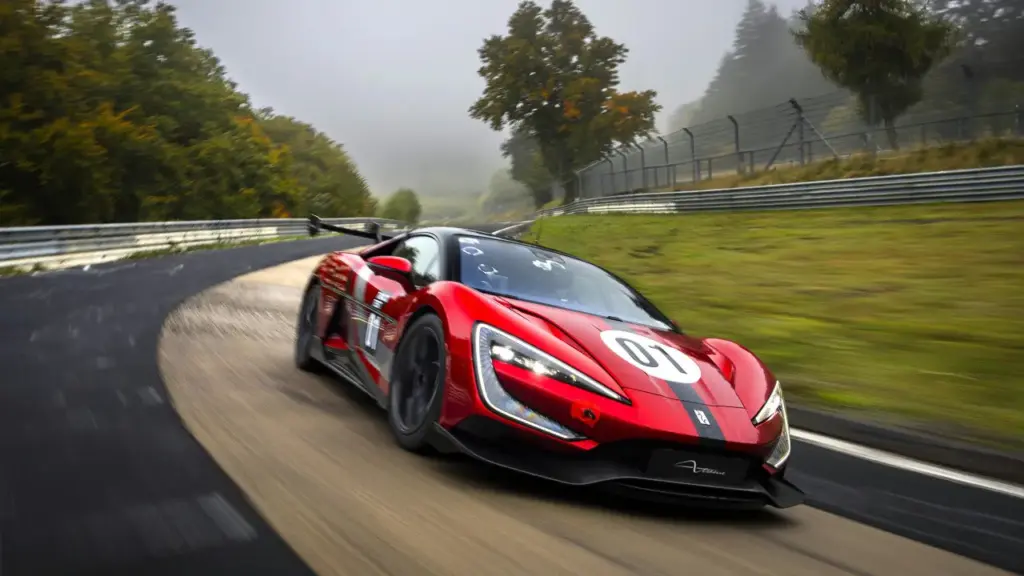
Electric cars no longer focus solely on efficiency. Today, leading automakers are proving that battery-powered vehicles can match and even surpass the performance of traditional combustion supercars. The world’s fastest electric cars demonstrate that the future of high-speed driving has arrived.
This list presents nine of the fastest electric cars globally. Some models achieve top speeds over 400 km/h, while others set records for acceleration and lap times. The innovations behind these cars redefine what is possible in automotive engineering and electrification.
1. BYD Yangwang U9 Xtreme—Pushing Nearly 500 km/h
BYD, a major force from China, introduced the Yangwang U9 Xtreme with a claimed top speed of 496.22 km/h. This figure builds a new benchmark for production electric vehicles. A quartet of permanent magnet motors provides nearly 3,000 horsepower, showing that electric powertrains can outperform traditional engines.
The car’s butterfly doors and e⁴ platform give it a futuristic appearance and structure. Its advanced DiSus-X active suspension offers high stability, crucial for extreme speeds. BYD later confirmed the U9 Xtreme broke the lap record at Nürburgring Nordschleife for production EVs, completing a lap in just 6 minutes and 59.157 seconds.
2. Aspark Owl SP600—Guinness World Record Holder
The Japanese Aspark Owl SP600 set a record at Germany’s Automotive Testing Papenburg, reaching 438.7 km/h. Guinness World Records recognized this as the fastest battery-powered electric prototype. The accomplishment came from precise engineering by Aspark and Italy’s MAT, using four independent motors and a lightweight structure.
This model features specialized Bridgestone Potenza RACE tires to maintain grip at high speeds. Weighing 2,000 kg, it achieves an ideal front-rear balance for stability. The SP600 is currently not legal for public roads, but a potential future version could meet street requirements.
3. Rimac Nevera R—Extreme Track Performance
Croatia’s Rimac Automobili pushed boundaries with the Nevera R, a hypercar that touched 431.45 km/h on the same track and day as the Aspark Owl. This special edition is optimized for track performance, utilizing four independently driven motors to maximize traction and control. The car weighs roughly 2,000 kg, ensuring stability and agility at speed.
Custom tires allowed the Nevera R to achieve its record, and while it is not homologated for public roads, its less extreme versions can comply with legal requirements.
4. Pininfarina Battista—Luxury Meets Velocity
Pininfarina Battista offers an Italian aesthetic combined with blistering performance. With four electric motors producing around 1,900 horsepower and 2,340 Nm of torque, this hypercar accelerates from 0 to 100 km/h in just 1.86 seconds. Its top speed is a verified 350 km/h, with a record of 358.03 km/h set in India.
Sharing its platform with the Rimac Nevera, the Battista meets global homologation standards for road use. It embodies both luxury and street-legal supercar status, delivering speed in style.
5. Tesla Roadster—Future Fastest with Unverified Claims
Tesla’s next-generation Roadster promises uncharted territory in the EV space. Tesla’s own data claims 0–96 km/h acceleration in less than one second and a top speed exceeding 402 km/h (250 mph). With a projected range up to 1,000 km per charge, it aims to set new standards for production EVs.
However, these figures remain unproven outside of Tesla’s projections. The public will need to wait for the final prototype and independent testing for confirmation.
6. Lotus Evija—British Design with Hypercar Power
The Lotus Evija brings British engineering to the electric hypercar segment. Only 130 units are planned for production, each with a full carbon fiber body and four independent electric motors. The total system output reaches 2,011 horsepower and 1,704 Nm of torque.
Lotus claims the Evija completes the 0–100 km/h sprint in under 3 seconds. A top speed of 350 km/h is limited by electronic controls rather than technical capability. During testing, it showcased rapid acceleration over short distances, emphasizing track prowess.
Despite its price and exclusive availability, the Evija is street-legal, designed mostly for collectors or racing enthusiasts.
7. Tesla Model S Plaid—High-Performance for Everyday Use
Tesla Model S Plaid is among the fastest mass-market EVs available. Operating with a tri-motor, all-wheel-drive system and output around 1,020 horsepower, it can reach 0–100 km/h in just 2.1 seconds. Real-world testing showed it covers the quarter mile in 9.4 seconds at 243 km/h.
The Model S Plaid’s standard top speed is limited to 262 km/h, but an optional Track Package can unlock speeds up to 322 km/h. With a range estimate of up to 592 km (on 19-inch wheels) and a starting price around $111,630, it offers extreme performance without losing practicality.
8. Porsche Taycan Turbo S—Precision and Comfort Combined
Porsche’s Taycan Turbo S headlines the EV market with two permanent magnet synchronous motors producing up to 938 horsepower in Launch Control mode. This sedan accelerates from 0–100 km/h in approximately 2.4 seconds and is electronically capped at 260 km/h for road safety.
A 105 kWh battery enables ultra-fast charging, going from 5% to 80% in about 18 minutes at 320 kW. With a claimed range up to 630 km (WLTP), the Taycan Turbo S balances speed, efficiency, and everyday comfort.
9. Faraday Future FF 91—Luxury SUV with Hypercar Spirit
The Faraday Future FF 91 sets itself apart as a luxury electric SUV with supercar-level acceleration. Its tri-motor all-wheel-drive setup delivers 1,050 horsepower and 1,977 Nm of torque. The FF 91 sprints from 0 to 97 km/h in 2.27 seconds, despite a bulkier frame compared to sports cars.
The car’s top speed is limited to 249 km/h, sufficient for its class. It carries a 142 kWh battery for long distance travel and supports fast charging up to 500 kW, enabling 5%–80% charging in roughly 18 minutes. EPA estimates place its maximum range at about 613 km.
Table: Top Speed Comparison of the Fastest Electric Cars
| No | Model | Top Speed (km/h) | Horsepower (HP) | 0–100 km/h (sec) | Road Legal |
|---|---|---|---|---|---|
| 1 | BYD Yangwang U9 Xtreme | 496.2 | ~3,000 | NA | No |
| 2 | Aspark Owl SP600 | 438.7 | NA | NA | No |
| 3 | Rimac Nevera R | 431.4 | NA | NA | No |
| 4 | Pininfarina Battista | 358.0 | 1,900 | 1.86 | Yes |
| 5 | Tesla Roadster* | >402 | NA | <1.0 | TBA |
| 6 | Lotus Evija | 350.0 | 2,011 | <3.0 | Yes |
| 7 | Tesla Model S Plaid | 322.0 (Track) | 1,020 | 2.1 | Yes |
| 8 | Porsche Taycan Turbo S | 260.0 | 938 | 2.4 | Yes |
| 9 | Faraday Future FF 91 | 249.0 | 1,050 | 2.27 | Yes |
*Performance figures based on manufacturer claims, independent verification pending.
With advancements in battery systems, electric motors, and aerodynamics, EV manufacturers keep breaking records. From hypercars like the BYD Yangwang U9 Xtreme to versatile SUVs like Faraday Future FF 91, these vehicles signify a paradigm shift in the automotive landscape.
The ever-growing lineup of electrified speed machines showcases the merging of green technology with undeniable excitement. The electric vehicle industry continues to expand boundaries, granting drivers new choices that challenge conventional expectations for speed, innovation, and sustainability.