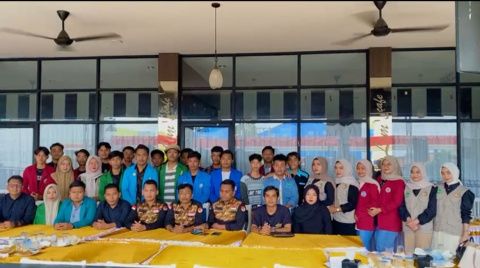
The regional consolidation event of the Nusantara Student Executive Board (BEM Nusantara) for the North Sumatra region recently concluded in Asahan after several days of intense discussion. This gathering, involving student leaders from across North Sumatra, resulted in eight key recommendations aimed at addressing pressing regional challenges from infrastructure to social justice.
This consolidation served as a crucial platform for students to unite their voices and actively advocate for community interests. Issues spanned education inequality, inadequate infrastructure, unresolved local government challenges, and the persistent social problems faced in the province.
Student Consolidation: From Discussion to Concrete Action


The President of BEM Nusantara for North Sumatra, Yogi Mahendra, emphasized to the press that the outcomes of the consolidation were not merely symbolic. He stated, “We didn’t just talk; we created real solutions for the region. These recommendations will be formally presented to the provincial government and the North Sumatra legislative council for urgent follow-up. We as students will oversee that each recommendation is truly implemented.”
Yogi reiterated the student movement’s position as constructive partners in regional development. “We aim to prove that students are part of the solution—not merely critics. What we advocate for today reflects our care for our homeland,” he said. His statement underlines a shift in student activism from protest to proactive participation in policymaking.
Meanwhile, the event’s organizing committee chair, Assay Pratama Lubis, expressed gratitude and pride over the event’s smooth execution despite some disruptions. “Although there was a brief attempt to stop the event, everything ran in an orderly and enthusiastic manner. This proves the unyielding spirit of our students in voicing the people’s interests,” Assay noted.
Strategic Recommendations: Eight Student-Driven Priorities
After three full days of discussions, BEM Nusantara North Sumatra presented eight focused recommendations set to be delivered to both local and national governments. Each point addresses a critical issue supported by facts and experiences at the grassroots level.
-
Immediate Repair of Damaged Roads in Sei Kepayang, Asahan:
The regional and provincial authorities are urged to prioritize fixing road infrastructure in coastal areas like Sei Kepayang to ensure equitable regional development. -
KIP College Program Transparency:
BEM Nusantara highlighted ongoing abuses concerning the Kartu Indonesia Pintar (KIP) scholarship program. Cases were reported where scholarship recipients were pressured by campus authorities under threat of aid withdrawal. -
Equal Access to Higher Education:
Many students from remote villages do not have fair opportunities or quotas at local universities, forcing them to study far from home. This was flagged as an urgent equity issue. -
Educational Infrastructure Improvement:
Several regencies and cities in North Sumatra still lack adequate educational facilities. The government needs to address these disparities with targeted resource allocation. -
Serious Action Against Drug Trafficking:
Regions like Binjai have been identified as drug distribution hubs. The lack of adequate government intervention has allowed these illegal networks to expand. -
Combating Human Trafficking:
Notable human trafficking cases in Langkat, resulting in fatalities such as the death of Argo Prasetyo, reveal systemic failures requiring immediate intervention and better protection for vulnerable groups. -
Flood Prevention in Medan:
As the provincial capital, Medan continues to face annual flooding that disrupts daily life and harms the environment. Participants called for robust long-term solutions. - Completion of Delayed Road Construction Projects:
Roadworks on the Sipiongot–Labuhan Batu border and Hutaimbaru–Sipiongot in Padang Lawas Utara have been stalled, allegedly due to negligent parties. Urgent completion is needed to enhance connectivity and support local livelihoods.
Key Issues Behind the Recommendations
Each recommendation stems from widespread, persistent challenges in North Sumatra. The lack of infrastructure maintenance, particularly in rural and coastal areas, hampers economic growth and limits mobility for isolated communities. Students contend that these inefficiencies signal gaps in local development policy execution.
Corruption and lack of transparency in scholarship programs like KIP have discouraged many talented youths. Reports of arbitrary threats and mismanagement highlight the need for a transparent selection and support system, as cited by several universities.
The discussion on education equity pointed to the low admission rates for students from remote backgrounds. The current system, according to BEM Nusantara, inadvertently perpetuates inequality and must be reformed for broader inclusivity.
Educational infrastructure, like classroom facilities and learning resources, are still highly inconsistent across the province. This gap is exacerbated by delayed government interventions, affecting the learning environment and performance of students particularly in underfunded schools.
Drug trafficking remains a major challenge, especially in urban fringes such as Binjai. Law enforcement efforts are seen as insufficient, and community leaders have called for a coordinated multi-agency response to curb narcotics distribution.
Human trafficking, particularly in regions like Langkat, is a source of grave concern. The numbers of victims continue to rise, with high-profile cases drawing national attention and raising demands for effective protective mechanisms.
Flooding in the provincial capital causes recurring distractions and environmental degradation, affecting public health and local productivity. Students urged that sustainable urban planning and infrastructure projects are required for long-term flood risk mitigation.
The delay in completing significant road construction limits access between districts, affecting transportation, trade, and access to essential services. Such delays frustrate residents and local businesses alike, reinforcing calls for government accountability.
BEM Nusantara’s Commitment to Continued Advocacy
The eight recommendations signify BEM Nusantara’s evolving role as both a critical partner and a motor for change in North Sumatra. Their actions go beyond advocacy, as they vow to monitor and encourage authorities to respond concretely to these key demands. This spirit of youth collaboration and community engagement is expected to drive further progress, ensuring the principles of fairness, justice, and social welfare for all residents of the region. The involvement of BEM Nusantara in these efforts remains vital for regional growth and systemic reform.