


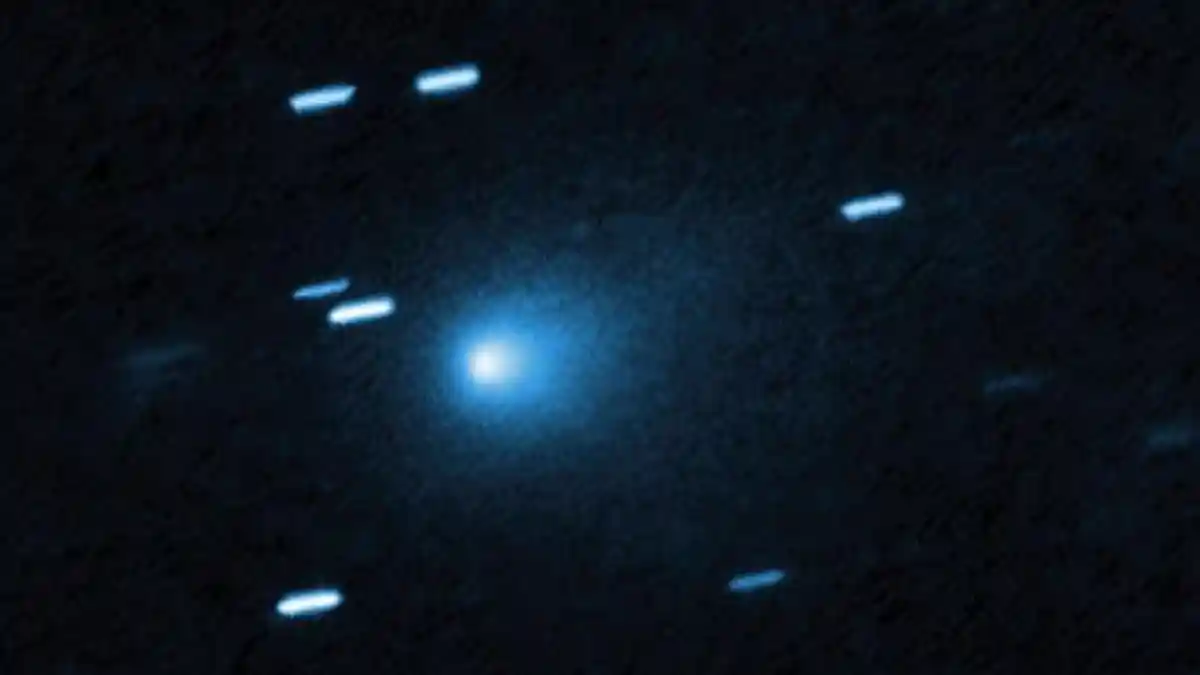
The appearance of comet 3I/Atlas crossing the solar system has triggered widespread discussions. On social media, several users speculated about its origins and associated the comet with alien life or advanced extraterrestrial technology.
The claim that 3I/Atlas might be an alien craft has been firmly denied by the Indonesian National Research and Innovation Agency (BRIN). According to BRIN’s Professor of Astronomy and Astrophysics, Thomas Djamaluddin, there is no scientific basis for such speculation. “Astronomers never speculate beyond the results of careful scientific observation. There’s no reason to suspect it as an alien spacecraft,” Thomas emphasized, referencing the rigorous standards applied in astronomical classification.
What is Comet 3I/Atlas?
3I/Atlas is defined as an interstellar object, meaning it originated from outside our solar system and is observed traveling through, rather than orbiting within, our planetary system. The comet is estimated to be around seven billion years old, making it significantly older than our own solar system, which scientists calculate to be about four and a half billion years old. This immense age suggests that 3I/Atlas formed in a different cosmic environment long before our Sun and planets even existed.
Naming and Classification
The formal name “3I/Atlas” uses the conventions set by the astronomical community. The number “3” indicates that this is the third interstellar object ever detected by astronomers. The letter “I” stands for “interstellar,” denoting its origin beyond the solar system. “Atlas” refers to the telescope system that first identified the comet while scanning the skies for moving objects.
Extraordinary Physical Characteristics
Scientific measurements reveal that 3I/Atlas displays some rare and remarkable characteristics:
- Speed: The comet travels at a blistering velocity of about 215,000 kilometers per hour, much faster than typical solar system comets.
- Size: The nucleus of 3I/Atlas has an estimated diameter of 25,000 kilometers, roughly twice the diameter of Earth. This colossal scale makes it one of the largest known comet nuclei.
- Coma: Further observations have found that the cloud of gas (coma) surrounding its head, formed mostly of carbon dioxide, stretches as far as 700,000 kilometers—or five times the diameter of Jupiter.
Unique Trajectory in the Solar System
Astronomers note that unlike most comets, which travel in elliptical orbits and periodically return to the inner solar system, 3I/Atlas follows a hyperbolic path. Such a trajectory ensures that the comet will pass through the solar system only once and will never return. This rare event offers a unique scientific opportunity to study material that originated in distant parts of the galaxy.
| Facts at a Glance: Comet 3I/Atlas | Feature | Details |
|---|---|---|
| Category | Interstellar object (not native to the solar system) | |
| Estimated Age | Seven billion years | |
| Speed | 215,000 kilometers per hour | |
| Nucleus Diameter | 25,000 kilometers | |
| Coma Size | 700,000 kilometers (five times Jupiter’s diameter) | |
| Orbit Type | Hyperbolic (one-time pass, no return) | |
| Discovery Instrument | ATLAS Telescope |
BRIN’s Scientific Response to Alien Speculation
The suggestion that 3I/Atlas could be an alien mothership stems from its unusual size and speed, along with the unique signals it emits as it passes through the solar system. However, BRIN and international astronomical bodies are united in their stance that these properties are not evidence of alien technology but rather of the comet’s interstellar origin and ancient cosmic history. “All interpretations remain strictly bound to data and observation,” stressed Thomas Djamaluddin in his statement.
Comet 3I/Atlas continues to intrigue scientists who analyze its path, composition, and behavior to uncover more about the history of our galaxy. Its fleeting journey presents a snapshot of a time before our Sun and opens the window to research materials from beyond our stellar neighborhood, making it a highlight among recent astronomical discoveries.