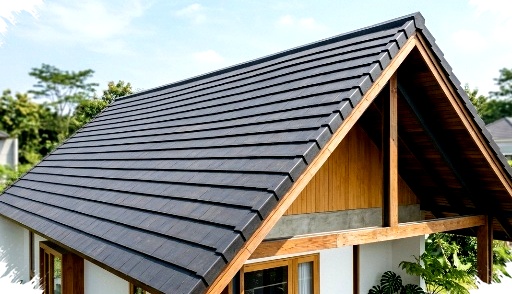
A well-designed tropical roof does more than finish a house. It helps manage heat, rain, airflow, and indoor comfort, which makes the choice of roof form an important part of home planning in warm and humid regions.
The same logic applies to kitchen appliances in busy households. A large-capacity rice cooker can improve daily efficiency for families that cook in bigger portions, while also reducing repeat cooking cycles and saving time.
Why tropical climates demand a different roof strategy
In tropical regions, roofs face two constant pressures: strong sunlight and frequent rainfall. A roof that traps heat or fails to drain water well can quickly make a home less comfortable and more costly to maintain.
The reference article notes that the roof is not only a cover for the building, but also a layer of protection for residents. That role becomes even more important in places where temperature, humidity, and rain can change quickly during the day.
A roof also affects air movement inside the house. Certain shapes allow hot air to rise and escape more easily, while others can make the attic or ceiling space hold heat longer.
Roof models that work better in hot and humid areas
Not every roof design performs the same in a tropical setting. The best choice usually balances heat resistance, rain protection, and visual compatibility with the home’s overall concept.
- Steep-sloped roofs help rainwater run off quickly and reduce the risk of leakage.
- High-pitched roofs can create extra space for ventilation above the ceiling.
- Extended eaves provide shade for walls and windows, limiting direct heat exposure.
- Ventilated roof systems improve airflow and help reduce indoor temperature buildup.
- Light-colored roof finishes can reflect more sunlight and reduce heat absorption.
Builders often choose these models because they respond better to tropical weather than flatter structures with weaker drainage planning. The more effectively a roof releases heat and water, the easier it is to keep the interior stable.
What to look at before choosing a roof
Roof selection should not depend on appearance alone. Structural performance, material durability, and local climate conditions all need to be considered together.
A practical checklist can help narrow the options:
| Factor | Why it matters |
|---|---|
| Slope | Supports faster rainwater runoff |
| Ventilation | Helps control heat inside the house |
| Material | Affects durability, weight, and maintenance |
| Eaves length | Adds shade and protects exterior walls |
| Ceiling space | Can improve thermal comfort |
| Maintenance access | Makes repairs easier over time |
These elements matter because a roof that looks attractive but performs poorly can lead to discomfort and higher maintenance costs later. In a tropical climate, performance usually matters more than decoration.
Large-capacity rice cookers answer a different kind of household need
The second major topic from the source article focuses on a large rice cooker, and the appeal is easy to understand. Families with several members often need to cook more rice at once, especially when meal schedules are tight and repeated cooking is inconvenient.
The article points out that a large rice cooker can be more practical and efficient because it prepares a bigger portion in one cycle. That reduces the need for multiple rounds of cooking and can help streamline daily kitchen routines.
For many households, this is not only about convenience. It is also about consistency, because a properly sized rice cooker can produce enough food for the whole family without constant adjustment.
How to choose the right rice cooker capacity
Rice cooker size should match the size and habits of the household. A model that is too small forces repeated cooking, while one that is too large may take up unnecessary space and consume more energy than needed.
Here is a simple guide:
- Small households usually need compact models for limited daily portions.
- Medium families often benefit from medium-size units that fit regular meal routines.
- Large families or shared homes typically need higher-capacity cookers for once-daily or batch cooking.
- Frequent guests or meal prep users may prefer a larger model for flexibility.
- Limited kitchen space may require a balance between capacity and physical size.
Capacity is only one part of the decision. Features such as keep-warm functions, nonstick inner pots, and energy-efficient cooking modes can also influence usability.
Efficiency matters in both home design and kitchen appliances
The roof and the rice cooker may seem unrelated, but both reflect the same household principle: choosing the right tool for the environment and the family’s needs. A roof designed for tropical weather protects comfort every day, while a rice cooker sized for the household supports smoother meal preparation.
This is where modern household planning has become more practical. Families increasingly look for solutions that reduce waste, save time, and improve daily comfort without adding unnecessary complexity.
For roofs, that means paying attention to ventilation, slope, and heat control rather than choosing only based on appearance. For rice cookers, it means matching capacity to actual consumption instead of buying a size that looks impressive but rarely gets used fully.
Simple considerations before making a purchase
Before selecting either a roof design or a large rice cooker, a household can assess basic needs first. The goal is to prevent mismatches that can affect comfort, cost, and long-term usefulness.
Important questions include:
- Does the home face strong sun for most of the day?
- Does the area receive frequent heavy rain?
- Is indoor airflow already limited?
- How many people eat from the same kitchen regularly?
- Is the priority speed, efficiency, or storage space?
Clear answers to these questions can guide better decisions. In tropical housing, smart roof planning can reduce heat stress, while in the kitchen, the right rice cooker capacity can support more efficient meal preparation day after day.
The growing interest in both topics shows that practical home decisions often shape comfort more than decorative choices do. A roof suited to tropical conditions and a rice cooker with the right capacity both serve the same purpose: making everyday living simpler, more efficient, and better adapted to the realities of the household.