


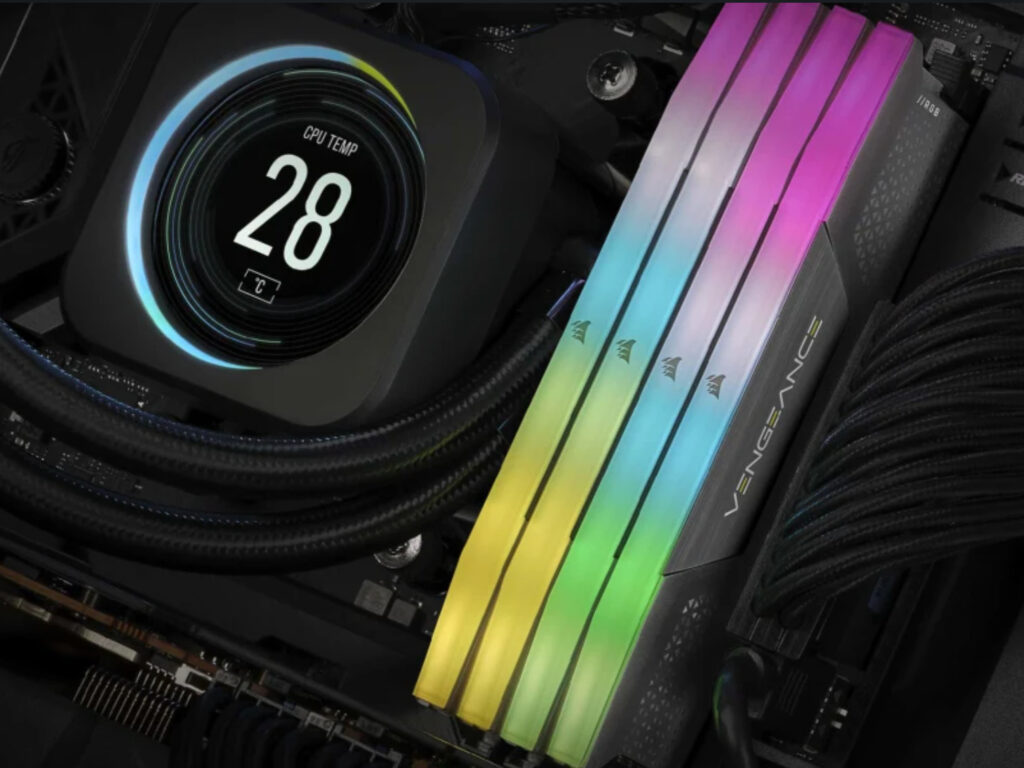
Corsair has been spotted using CXMT memory chips in its Vengeance line, a notable shift in a market long dominated by suppliers such as Hynix, Micron, and Samsung. The move stands out because it places a Chinese memory maker inside a mainstream Corsair product for the first time.
The module identified is a Corsair Vengeance DDR5 model, reportedly with RGB lighting, carrying the part number CMK5X16G3E60C36A2-CN. That CN suffix indicates a unit made exclusively for China, although the same module also carries UKCA and CE markings that suggest a possible path beyond that market.
A rare supplier change in mainstream RAM
The identification was first highlighted by user @wxnod on X/Twitter and later covered by technology outlets including Tom’s Hardware. The discovery matters because Corsair is one of the best-known names in consumer memory, and its supplier choices are watched closely across the PC industry.
For years, the RAM supply chain has been concentrated around established players from South Korea and other long-standing manufacturers. Seeing CXMT appear in a Corsair product signals that major brands may be growing more open to alternative sourcing from China.
The module in question is said to reach 6000 MT/s. It is also reported to support both AMD EXPO and Intel XMP, two widely used memory profiles for PC builders who want easier tuning and compatibility.
What the China-only marking suggests
The CN suffix is important because it points to a China-exclusive product variant. At the same time, the presence of UKCA and CE labels keeps open the possibility of sales in the United Kingdom and European Union.
That does not mean an immediate launch outside China is guaranteed. It does show that the product has been prepared with market markings that are relevant beyond a single domestic channel.
Why the move matters for the wider memory market
Corsair’s use of CXMT arrives at a time when RAM pricing has been under pressure from unusual market conditions. Demand from AI has already reshaped supply priorities, and Crucial, Micron’s consumer brand, has exited the consumer business.
That combination has been especially difficult for PC builders and smaller businesses that depend on retail memory parts. Any broadening of supply sources could help ease that strain if it develops into a wider trend.
There is also a broader strategic angle for China’s memory industry. If domestic companies can satisfy more of their own RAM and semiconductor needs, reliance on established suppliers in Korea and the United States could decline.
That shift would not only affect sourcing patterns. It could also reduce pressure on global demand and help bring RAM pricing toward a more stable level.
Some expectations for the market already point in that direction. Khe-hyun Kyung, a former Samsung Device Solutions executive who now advises Samsung, has said the RAM shortage may ease before the end of 2026.
For now, Corsair’s CXMT-backed Vengeance module remains a closely watched sign of where the market may be heading. If more major brands follow the same path, the RAM segment could become more competitive and more diverse than it has been in years.
Source: www.notebookcheck.net