


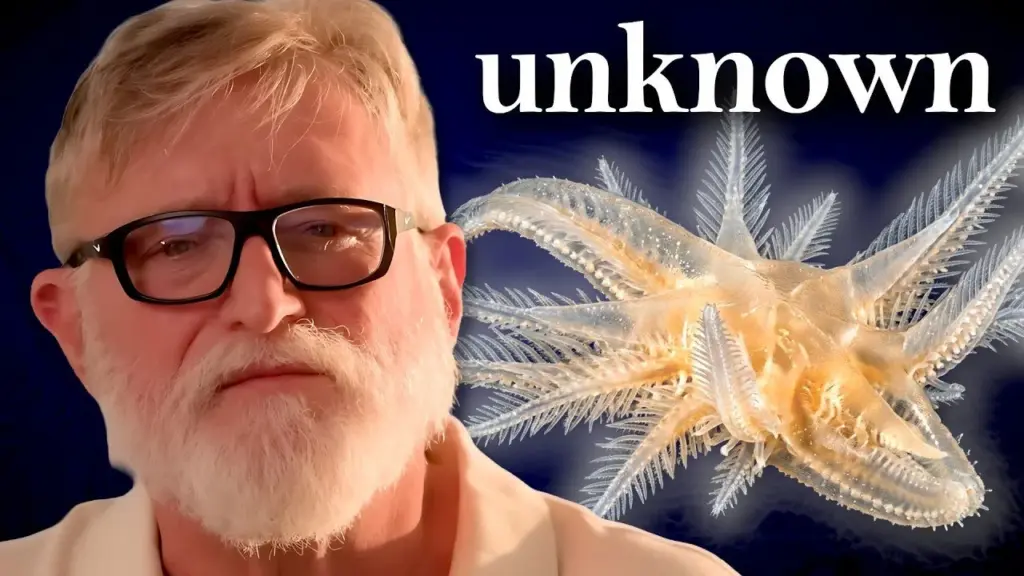
The deepest parts of the ocean are still revealing surprises, and one of the most unusual expeditions there has now tied a tech industry figure to serious marine science. Through Inkfish, the ocean research organization backed by Gabe Newell, the team has documented organisms in the hadal zone, including species that do not yet fit existing scientific classification.
The findings are notable not only because they add to the list of known deep-sea life, but because they come from an environment where almost nothing is easy to study. In the same expedition effort, researchers also found human-made debris at 7,500 meters, showing that pollution has reached one of the most remote places on the planet.
A frontier at extreme depth
Inkfish focused its work on the hadal zone, the deepest part of the ocean, located more than 10 kilometers below the surface. Conditions there are severe, with crushing pressure, almost no light, and temperatures close to freezing.
To reach that environment, the team used DSSV Pressure Drop and the submersible Bakunawa. Those platforms gave researchers access to trench systems that had been extremely difficult for humans to study before.
The work also reinforced a basic point about the deep ocean: it is not empty. It supports specialized ecosystems shaped by pressure, darkness, and low temperatures, and those conditions may help scientists understand the limits of life on Earth.
Species that do not fit the existing map
Across the expedition, Inkfish documented 108 different organism groups. That number suggests that biodiversity in the deep sea is far richer than earlier estimates had implied.
Among the observations were ancient crinoid fields, carnivorous sponges, and transparent snailfish. One of the most striking discoveries was a fish recorded at the deepest known living depth.
Some of the organisms could not yet be placed within current scientific classification. That leaves open new questions about how life evolves under intense pressure and in near-total darkness.
For researchers, every such finding adds another piece to a much larger puzzle. The deep ocean still contains major gaps in knowledge, and each expedition helps fill them with direct observations rather than assumptions.
Geology shaping life below the surface
The expedition also explored how seismic activity influences deep-sea ecosystems. One study area was affected by the 2011 Tohoku earthquake, where the team found a dense population of spoon worms inside a fault fracture.
That pattern suggests that instability after seismic events can create conditions in which certain organisms thrive. It also shows that undersea disasters are not always only destructive; they can also form new habitats.
At Boso Triple Junction, an active region where tectonic plates meet, researchers found a crinoid field with more than 1,500 sea lilies. The site offered another example of how geological activity shapes biological communities in the deep ocean.
The relationship between tectonics and marine life was one of the expedition’s clearest themes. Below the surface, the seafloor remains a dynamic environment constantly molded by shifting Earth processes.
Human debris even at 7,500 meters
The expedition also encountered a reminder of humanity’s reach. At 7,500 meters, the team found metal and wood debris, and the material had already been colonized by microorganisms.
That detail matters because it shows pollution is not confined to coasts or shallow waters. Even the most isolated parts of the ocean are now affected by human activity.
The finding also underlines how connected the global ecosystem is. Deep-sea environments that once seemed untouched are now carrying the footprint of life at the surface.
Technology pushing deeper exploration
Alongside DSSV Pressure Drop and Bakunawa, the broader research fleet included Leviathan and Dra. Their presence reflects advances in pressure-resistant engineering and underwater navigation.
Those systems make it possible to observe deep-ocean environments in greater detail than before. Improvements in submersible design, data collection, and remote sensing continue to expand what researchers can study in extreme conditions.
The value of the expedition goes beyond the excitement of new discoveries. The data collected provides a foundation for understanding deep-sea biodiversity and for protecting fragile ecosystems that face growing pressure from human activity and environmental change.
Newell’s support for Inkfish has helped open access to one of Earth’s last frontiers. What the expedition shows is that the deepest ocean still holds life that science has not fully described, while even those farthest reaches are no longer beyond the reach of human impact.
Source: www.geeky-gadgets.com