


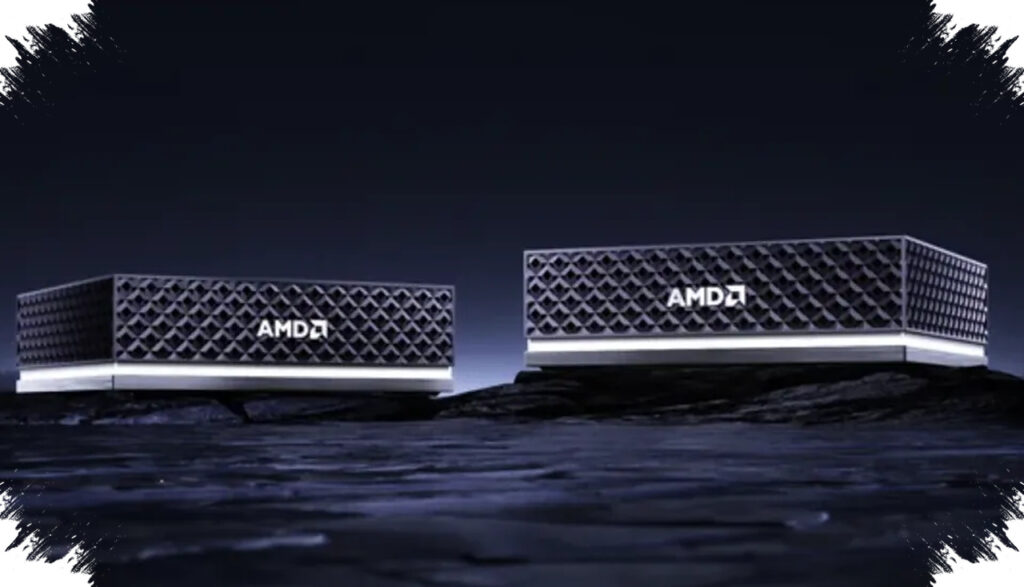
AMD is positioning Ryzen AI Halo as a compact alternative to cloud-heavy AI workflows, and the pitch is not only about performance. The company says the mini PC could help organizations and developers reduce recurring cloud spending enough to recover the purchase cost in as little as six months.
That claim gives the system a different kind of appeal from a typical premium desktop. Ryzen AI Halo is being framed as local AI infrastructure for data scientists and application developers, rather than as a general-purpose machine for everyday users.
A premium mini PC built for local AI
Ryzen AI Halo is priced from $3,999 and uses a small form factor that resembles Apple’s Mac Mini at first glance. AMD plans to open pre-orders in June 2026.
The focus is on running demanding AI tasks on the device itself instead of depending on cloud subscriptions. For teams that process around 6 million AI tokens per day and spend about $773 per month on that workload, AMD says the economics may favor an on-premises setup.
The memory setup is the main draw
The headline specification is unified memory of up to 128GB. AMD pairs that with a 50 TOPS NPU and a Radeon GPU with 40 compute units, aiming to give large language models more room to run locally.
This approach also sets Ryzen AI Halo apart from NVIDIA’s DGX Spark, which concentrates AI work on a Blackwell GPU alone. AMD is clearly targeting the same premium segment, but with a different balance of CPU, GPU, and memory resources.
Windows and Linux support widen the appeal
Another notable difference is software flexibility. Because Ryzen AI Halo is built on x64 architecture, it supports both Windows and Linux, while NVIDIA’s DGX Spark is limited to Linux.
That may matter for developers and enterprise teams that want a local AI system without locking themselves into a single operating environment. AMD is using that flexibility as part of its broader case for moving AI workloads away from cloud-only setups.
AMD also sketches a faster payback scenario
The company is pushing an even more aggressive cost argument for corporate use. With an added Radeon R9700 Pro graphics card priced at $4,000, AMD says the payback period could fall to three months.
That framing makes Ryzen AI Halo look less like a consumer gadget and more like an infrastructure purchase. The message is aimed at organizations that have watched AI server costs rise as usage expands.
Ryzen AI Max 400 expands the lineup
AMD is not stopping with Halo. The company is also preparing the Ryzen AI Max 400 family, led by the AI Max+ Pro 495.
That chip is listed with 16 cores, boost speeds up to 5.2GHz, a 55 TOPS NPU, and a Radeon 8065S GPU. Its memory ceiling is even higher, with unified memory up to 192GB and 160GB of VRAM-equivalent space.
The Ryzen AI Max 400 series is scheduled to arrive in global markets in the third quarter of 2026. AMD has not released official benchmark charts against the AI Max 395 series, but the specifications alone are enough to intensify competition in local AI computing.
Source: id.mashable.com