


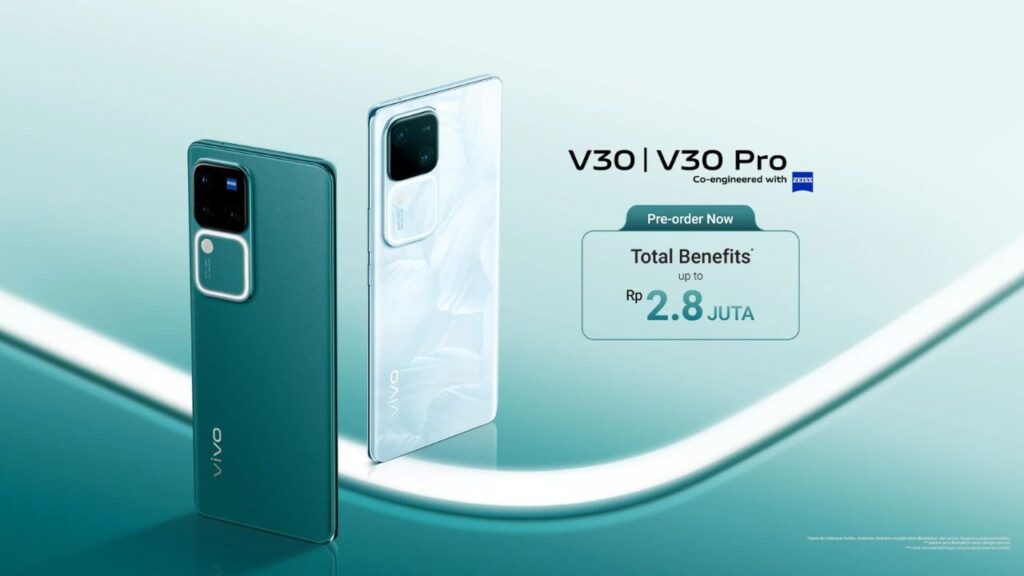
A slim body, a high-resolution portrait camera, and a Snapdragon 7 Gen 3 chipset give the Vivo V30 a more complete profile than many phones in its class. The device is positioned for users who want a stylish 5G handset that still feels fast for daily use, multitasking, and gaming.
What stands out most is how Vivo combines design and photography without making the phone feel overloaded. The V30 leans heavily on a premium look, but it also brings a set of specifications that make it competitive in the crowded midrange segment.
Portrait-focused camera system
Vivo places photography at the center of the V30’s appeal. The phone carries a 50MP triple-camera setup that covers the main camera, ultrawide camera, and front camera, so its imaging package is strong on both the rear and front sides.
The company also includes the latest Aura Light Portrait feature. It is designed to provide adaptive lighting for portrait shots, especially at night, so photos look more natural and polished.
That approach shows Vivo is not relying on high resolution alone. The V30 is built to deliver a more controlled portrait experience for users who care about detail and lighting quality.
Premium design with practical protection
The V30 continues the V Series formula with a thin and elegant body made with glass. Its design aims to deliver a premium feel while remaining comfortable for everyday use.
The phone is also rated IP54 for resistance to dust and water. That adds a layer of reassurance in normal daily conditions, although it is not intended for extreme wet environments.
On the front, Vivo uses a 1.5K AMOLED display. The panel offers 120Hz refresh rate and a peak brightness of up to 2800 nits, which helps keep visuals sharp, smooth, and easier to read in bright surroundings.
Snapdragon 7 Gen 3 for daily performance
Under the hood, the Vivo V30 relies on Snapdragon 7 Gen 3. The chipset is meant to handle everyday apps, multitasking, and gaming, giving the device a performance base that matches its polished exterior.
5G support further strengthens its position as a modern midrange phone. For users who want a device that feels responsive across common tasks, the hardware combination becomes one of the V30’s strongest selling points.
Vivo pairs the chipset with LPDDR4X RAM of up to 12GB and UFS 2.2 storage of up to 512GB. There is also Extended RAM of up to 12GB, which helps when several apps are running at the same time.
Large battery, fast charging, and package details
Battery life is another important part of the V30’s appeal. The phone carries a 5000 mAh battery, which is notable because it still comes in a thin body.
For charging, Vivo provides 80W fast charging. This helps reduce waiting time when the battery runs low, so the phone can return to use more quickly.
The retail box also includes an 80W charger and a soft case. That adds convenience because users do not need to buy the basic accessories separately.
Prices and color options
In Indonesia, the Vivo V30 is available in two memory variants. The 8GB RAM and 256GB ROM model is priced at Rp5.999.000, while the 12GB RAM and 512GB ROM version costs Rp6.999.000.
| Variant | Price |
|---|---|
| 8GB RAM / 256GB ROM | Rp5.999.000 |
| 12GB RAM / 512GB ROM | Rp6.999.000 |
The color choices are Hijau Khatulistiwa, Putih Puspa, and Hitam Vulkanik. Those options give buyers a choice between brighter tones and more classic finishes.
With its 50MP portrait camera, 1.5K AMOLED 120Hz display, Snapdragon 7 Gen 3, 5000 mAh battery, and 80W charging, the Vivo V30 brings together the main elements many midrange buyers look for in one package. Its mix of style, imaging, and performance keeps it competitive in a busy 5G market.