


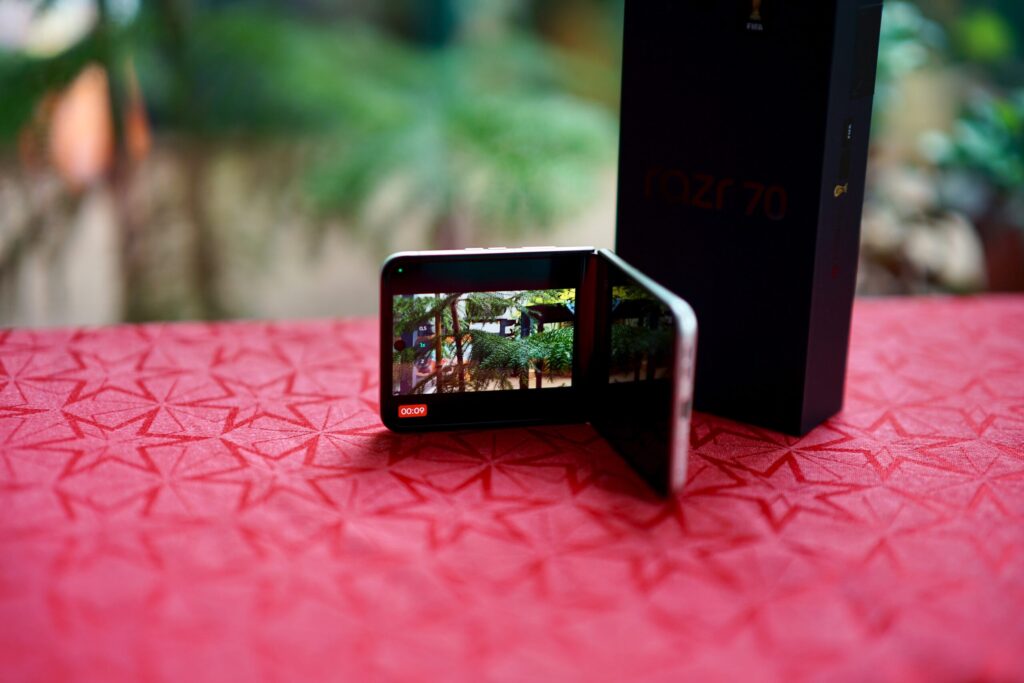
The Motorola Razr 70 makes its strongest case through how it works in daily use, not through camera numbers alone. Its foldable design adds a layer of practicality that a conventional phone cannot easily match, even if the imaging system still stops short of true flagship-level performance.
That gap matters because the phone is clearly capable enough for routine shots, yet it does not deliver the kind of detail or dynamic range expected from a higher-end device. For everyday users, that may be acceptable, but the test results also make its limits easy to see once the images are examined more closely.
Flexible hardware, familiar camera limits
Motorola equips the Razr 70 with a 50-megapixel main camera and a 32-megapixel internal camera. The inner camera is likely to see more use for video calls, while the external display makes the main camera easier to use for selfies.
That setup gives the phone a clear practical advantage. Users can rely on the main camera for self-portraits with the outer screen as a preview, rather than depending on a typical front camera.
The ultra-wide camera also gets a 50-megapixel resolution and a slightly larger aperture, but that upgrade does not transform the final image quality in a dramatic way. The results still show softness in detailed areas, which keeps this system better suited to quick captures than to demanding photography.
Where the image quality begins to fall short
Testing shows that the Razr 70’s main camera cannot keep pace with more expensive premium smartphones when detail is pushed hard. The weakness becomes most visible when images are enlarged or prepared for large prints.
That makes the phone less appealing for users who want very crisp results. Photos taken for social media can still look good enough in many cases, but that standard is not enough for more serious use.
Portrait photos in good light also perform reliably, although the camera is not recommended for A4-sized prints or professional work. In other words, the system works well within a limited range, but it does not offer the margin of quality that demanding users expect.
Good enough for everyday use
For casual owners who only take pictures occasionally, the baseline quality remains solid. The Razr 70 can still handle daily needs without standing out as exceptional among premium phones.
Its value lies more in versatility than in pure imaging strength. The foldable form factor is what makes the camera experience feel different, not a dramatic jump in sharpness or dynamic range.
That distinction is important for buyers who prioritize speed, convenience, and easy selfies. The phone is built to be practical first, and the camera system follows that same logic.
The foldable design is the real advantage
The Razr 70 can be positioned without a tripod, and it can also be held in landscape orientation in a camcorder-like grip that feels more secure. Those options make it easier to shoot in situations where a standard smartphone would be less comfortable.
That extra flexibility gives the camera setup real-world usefulness. Even if the picture quality does not reach flagship heights, the device’s shape opens up ways of shooting that regular phones do not offer.
The 50-megapixel main camera therefore provides a capable foundation, but not a class-leading one. Users who want higher detail should test the camera system directly before buying, while everyday users may find the Razr 70 entirely sufficient for routine photography.
Source: www.notebookcheck.net