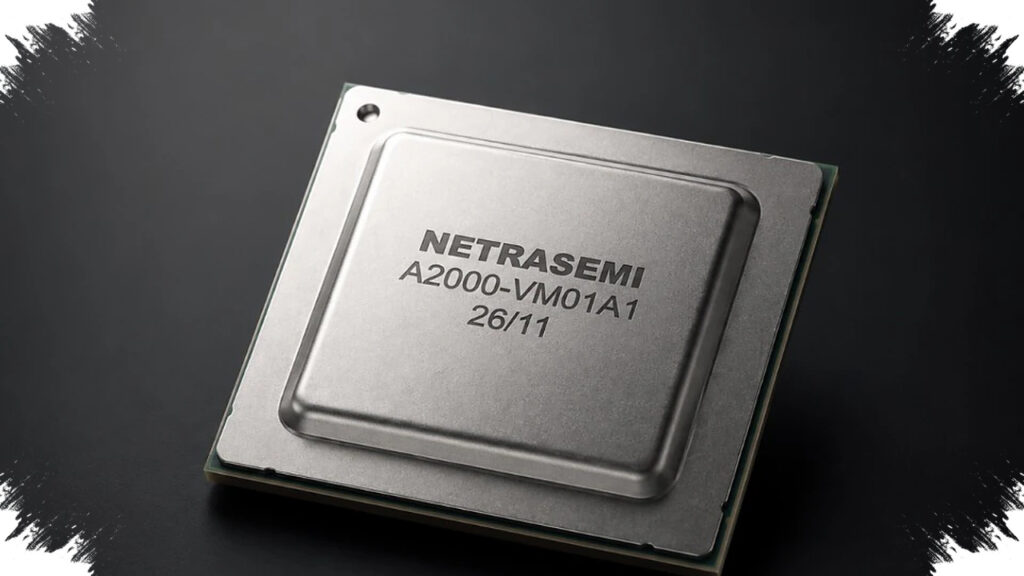
Netrasemi’s A2000 has cleared an early silicon bring-up milestone, putting the Kerala-based company closer to commercial production of what it describes as a high-end, locally developed edge AI processor. The 12nm chip is designed for inference workloads on the device itself, which makes it suitable for smart cameras, surveillance systems, robotics, and video gateways that need fast responses without relying entirely on the cloud.
The announcement matters because it shows an Indian startup moving beyond design work and into a more advanced phase of chip validation. Netrasemi has said it is aiming to begin commercial production before the end of this year, giving the project a concrete path from sample testing to real-world deployment.
Built for local, real-time AI processing
A2000 is positioned as an edge AI SoC rather than a general-purpose AI chip. Netrasemi says the design includes an in-house NPU, VPU, and ISP, all built around a 12nm TSMC node.
That setup is intended to keep AI processing on the device. By handling inference locally, the chip can support workloads that need immediate decisions, especially in video-heavy environments where delays from cloud dependence can be a disadvantage.
Netrasemi has emphasized that the chip is not simply an AI and machine learning combination packaged for marketing purposes. The company says it uses its own hardware acceleration IP and domain-specific optimization for high-performance real-time edge AI.
Why the bring-up stage matters
The silicon bring-up phase is a critical checkpoint in chip development. It comes after the first sample is manufactured and before mass production can move ahead.
At this stage, engineers verify whether the sample works according to design across its main functions. Netrasemi said A2000 has passed this early testing stage, which is one of the most important steps on the road to commercialization.
For a startup developing semiconductors, clearing bring-up is a technical signal that the project has moved past concept and into practical validation. It does not mean large-scale shipments have started, but it does show that the chip is functioning as intended at this stage.
Targets across cameras, robotics, and gateways
The company has lined up clear use cases for the chip. Smart cameras, surveillance equipment, robotics, and video gateways are among the intended markets.
Those segments often need efficient on-device visual processing and quick inference. In such environments, local AI can reduce dependence on network connectivity for certain analytic tasks and help systems respond faster.
That focus also explains why Netrasemi has placed so much weight on edge AI performance. The chip is being built for workloads where latency and local decision-making matter as much as raw AI capability.
A broader signal for India’s chip ambitions
The A2000 also stands out because of the process node involved. Netrasemi said 12nm is smaller than the node originally planned for production at Tata Electronics’ semiconductor facility in Dholera, Gujarat.
That Tata facility, which recently received support from the Dutch company ASML, was initially said to be capable of producing chipsets up to the 28nm node. Against that backdrop, an Indian company showing a 12nm chip design highlights how local ambitions are moving toward more advanced territory.
The distinction between design and manufacturing still remains important. Netrasemi designed A2000 in India, while the chip itself is being built on TSMC’s 12nm process.
Funding, policy support, and next steps
Netrasemi is also one of the first four startups selected to receive Rs 15 crore under the Ministry of Electronics and Information Technology’s DLI scheme in 2023. That early support has been part of the company’s path toward domestic chip development.
The startup has raised a total of Rs 125 crore so far, with backers including Zoho and Unicorn India Ventures. The involvement of investors such as Zoho has drawn attention to the project as interest in local semiconductor development continues to grow.
Chief executive officer and co-founder Jyothis Indirabhai said the company is working with several leading OEMs on early sample evaluation, co-development, and further research and development efforts. Those collaborations will likely shape how quickly the chip reaches practical adoption in edge AI products.
If commercial production starts as planned before the end of this year, A2000 could become an important milestone for an Indian chip startup trying to move from validation into customer-facing hardware. The next phase will depend on OEM evaluation and the pace at which the chip finds its place in real edge AI systems.