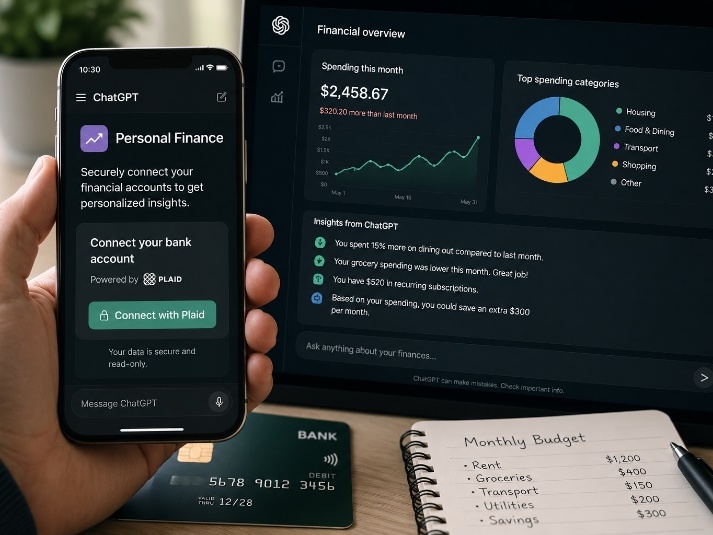
ChatGPT is moving closer to a role that touches one of the most sensitive parts of daily life: personal finances. OpenAI has begun testing a new financial feature that lets the chatbot connect to a user’s bank accounts and surface personalized money information directly inside a conversation.
The setup is designed to make ChatGPT more useful as a personal finance assistant, not just a writing tool. Once connected, it can help users examine spending patterns, review cash flow, and better understand their financial habits without switching between apps.
A banking connection built through Plaid
OpenAI is using Plaid to enable secure access to several types of financial accounts. Those include checking accounts, credit cards, savings accounts, loans, and other financial sources.
After the connection is in place, ChatGPT can organize the data into a clearer picture of a user’s finances. The idea is to make scattered account information easier to read and more practical to use in everyday planning.
Read-only access, not control
OpenAI says the feature is read-only. That means ChatGPT cannot transfer money, make payments, or carry out any action that would change the contents of an account.
This restriction is important because it keeps the AI in an advisory role. It can help interpret financial information, but it does not have permission to manage transactions or make decisions on the user’s behalf.
Limited preview for now
The feature is currently available only as a preview for ChatGPT Pro users in the United States. That limited release suggests OpenAI is still testing the financial tool in a controlled setting.
It also means the feature is not yet widely available to all users. Even so, its arrival points to a broader ambition for ChatGPT in everyday financial life.
Why the feature matters
For people who struggle to track subscriptions, monthly bills, savings goals, or irregular spending, the new integration could offer a more unified view. ChatGPT can help turn data spread across different accounts into information that is easier to understand.
That approach appears to be part of OpenAI’s larger plan for the platform. Rather than replacing banking services, the company seems to want ChatGPT to provide an added layer of analysis that helps users notice their own money habits more clearly.
Privacy remains the biggest concern
The practical value of the feature is clear, but the privacy questions are equally significant. Bank data is among the most sensitive personal information people have, and many users may hesitate to let an AI read their account history.
Those concerns are understandable because the data can reveal spending behavior, balances, loans, and private transaction patterns. In financial services, trust is essential, and the more access a tool receives, the more users will expect strong security, transparency, and control.
OpenAI’s latest move shows how far ChatGPT may expand beyond everyday conversation. Its success will likely depend on whether users feel comfortable letting the AI look at their accounts, even if it still cannot touch the money inside them.
Source: www.notebookcheck.net-

-

-

-