

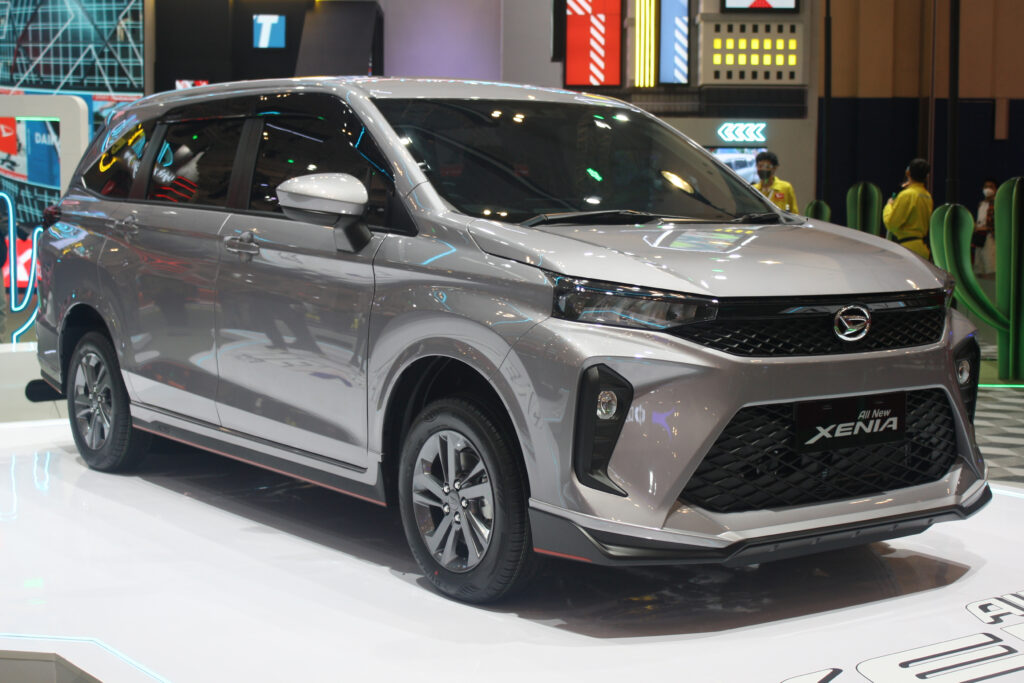
Daihatsu Xenia enters May 2026 with a price range that stretches from the low Rp 232 jutaan level to Rp 320 jutaan. That spread keeps the LMPV relevant for buyers who want a family car with different budgets and equipment levels.
The broad pricing ladder also shows how Daihatsu continues to position Xenia as one of its key models in the family car segment. Seven-seat capacity, practical packaging, and relatively affordable ownership costs remain part of its appeal.
A wider range for different needs
At the entry point, the Xenia 1.3 M MT is listed at Rp 232 jutaan. At the opposite end, the Xenia 1.5 R CVT ASA ADS sits at Rp 320 jutaan.
Between those two figures, Daihatsu offers a stepped structure. The Xenia 1.3 X MT is priced at Rp 245 jutaan, followed by the 1.3 X CVT at Rp 260 jutaan.
The next levels continue the same pattern. The Xenia 1.3 R MT is set at Rp 268 jutaan, while the 1.3 R CVT reaches Rp 280 jutaan.
For buyers looking higher up the range, the Xenia 1.5 R MT ADS is priced at Rp 292 jutaan. The Xenia 1.5 R CVT ADS is placed at Rp 306 jutaan before the line tops out at Rp 320 jutaan.
May 2026 on-the-road price list
| Variant | Price |
|---|---|
| Xenia 1.3 M MT | Rp 232 jutaan |
| Xenia 1.3 X MT | Rp 245 jutaan |
| Xenia 1.3 X CVT | Rp 260 jutaan |
| Xenia 1.3 R MT | Rp 268 jutaan |
| Xenia 1.3 R CVT | Rp 280 jutaan |
| Xenia 1.5 R MT ADS | Rp 292 jutaan |
| Xenia 1.5 R CVT ADS | Rp 306 jutaan |
| Xenia 1.5 R CVT ASA ADS | Rp 320 jutaan |
These prices may differ depending on region and local dealer promotions. Buyers still need to confirm the final amount before placing an order.
Two engine choices, manual and CVT options
Daihatsu offers Xenia with two engine options, 1.3 liter and 1.5 liter. The 1.3-liter unit produces around 98 PS and 122 Nm of torque, while the 1.5-liter engine delivers around 106 PS and 138 Nm.
Both engines are available with manual and CVT transmissions. That setup is intended to provide smoother driving while keeping fuel use efficient.
The difference between variants is not limited to engine size or gearbox choice. Comfort and safety equipment also help define the gap from one trim level to another, which is reflected in the increasing price ladder.
Features that separate the higher trims
In its newer generation, Xenia adopts a more modern appearance with a stronger front end than the previous model. The large grille and LED headlights give it a more premium impression.
Its body size supports its role as a family vehicle. The cabin can carry up to seven passengers, making it suitable for daily use and trips with a larger family.
Inside, the focus remains on practicality and comfort. The spacious cabin is paired with flexible seat arrangements to better handle passengers and luggage.
Some variants also bring a touchscreen head unit, Android Auto and Apple CarPlay connectivity, digital AC, and Start/Stop Engine button. Steering switch control and USB charging ports are also available on certain rows to support convenience during travel.
Safety equipment on selected variants
Daihatsu Advanced Safety Assist, or ASA, becomes one of the key differentiators on selected variants. The package includes Pre Collision Warning, Pre Collision Braking, Lane Departure Warning, Pedal Misoperation Control, and Front Departure Alert.
Beyond ASA, Xenia also offers Vehicle Stability Control, Hill Start Assist, ABS, EBD, rear parking camera, and dual airbags up to six points on certain variants. That combination gives the top trims a more complete safety package for both driver and passengers.
With its layered pricing, efficient engine options, roomy cabin, and expanding feature list, Xenia remains a competitive name in the family car market. The May 2026 pricing gives buyers a clear view of how far the range stretches, from the most affordable trim to the most complete version.