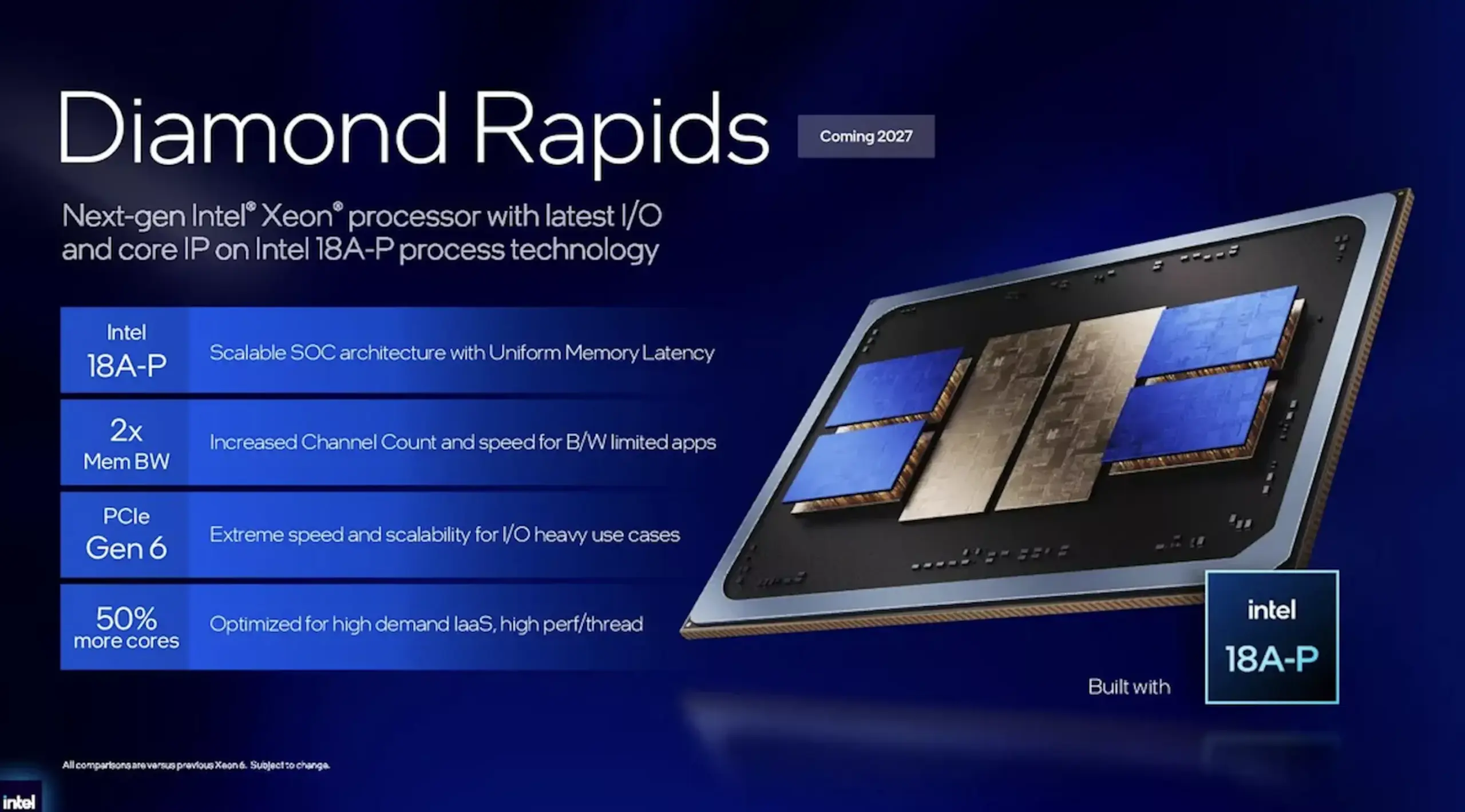
Intel is positioning Xeon 6 Plus as a server chip built for a new wave of computing demand, with agentic AI expected to place heavier pressure on data center infrastructure. The processor also marks a milestone for the company, becoming the first Intel data center product made on the 18A process.
The debut takes place at Computex 2026 in Taiwan, where Intel is framing the chip for use across data centers, edge computing, and telecommunications networks. That focus reflects a market where workloads are growing more complex and where efficiency matters as much as raw performance.
Built on Intel 18A


The headline feature of Xeon 6 Plus is its 18A manufacturing process, which Intel describes as its most advanced node today. The company says the new process is designed to improve performance and energy efficiency compared with previous generations.
On paper, the chip supports up to 288 E-cores in a single processor. Intel is also planning one- and two-socket configurations, with a maximum TDP of 450 watts per CPU.
Specifications aimed at heavy server loads
Xeon 6 Plus is built for demanding environments, and its platform numbers reflect that target. Intel says the chip includes 12 channels of DDR5 memory at 8000 MT/s, along with 96 PCIe lanes, 64 CXL lanes, and 576 MB of last-level cache.
Those capabilities are meant to support modern data center workloads that need high bandwidth, large memory capacity, and strong connectivity. Intel is pitching the processor as a fit for server systems that must balance scale, speed, and power use.
Why agentic AI matters
Intel’s timing is tied closely to the rise of agentic AI, which the company sees as a major new source of CPU demand. Kevork Kechichian, Executive Vice President and General Manager of Intel’s Data Center Group, said CPU demand continues to rise across enterprise software, databases, cloud services, and 5G networks.
He added that agentic AI adds a much larger layer of compute demand. Intel’s view is that autonomous AI agents will create far more activity than current usage patterns, forcing infrastructure to grow in both capacity and efficiency.
Claims of stronger efficiency and performance
Intel is also using performance claims to support the launch. One model highlighted by the company is Xeon 6990E+, which Intel says delivers up to 1.3 times higher average per-thread performance than AMD Epyc 9965.
The company also says the same model can improve per-thread-per-watt performance by as much as 1.3 times. That emphasis shows Intel is trying to compete on efficiency, not only on peak compute numbers.
Support from major server makers
Intel is backing Xeon 6 Plus with broad ecosystem support from server manufacturers. The list of partners mentioned includes Amax, ASRock, ASUS, Dell, Foxconn, Giga Computing, Gigabyte, HPE, Inventec, Lenovo, Mitac, MSI, Pegatron, QCT, and Supermicro.
A wide partner base could help the chip spread more quickly across enterprise and data center deployments. Intel appears to view that ecosystem support as a key part of accelerating adoption.
Telecom demand is also rising
The telecommunications sector is another reason Intel sees room for Xeon 6 Plus. Ericsson’s Chief Technology Officer for Asia Pacific, Magnus Ewerbring, expects data traffic from devices into networks to rise 10 to 15 times over the next decade.
Ericsson says future compute demand must remain efficient and predictable. In testing in real operational environments, Intel says Ericsson saw up to 30 percent better performance at the same core count.
Intel also claims a 60 percent gain in performance per watt and a 38 percent drop in server rack power consumption in that environment. Those numbers point to a market that is no longer focused on speed alone, but on how much work can be done within tighter power limits.
Source: www.idntimes.com