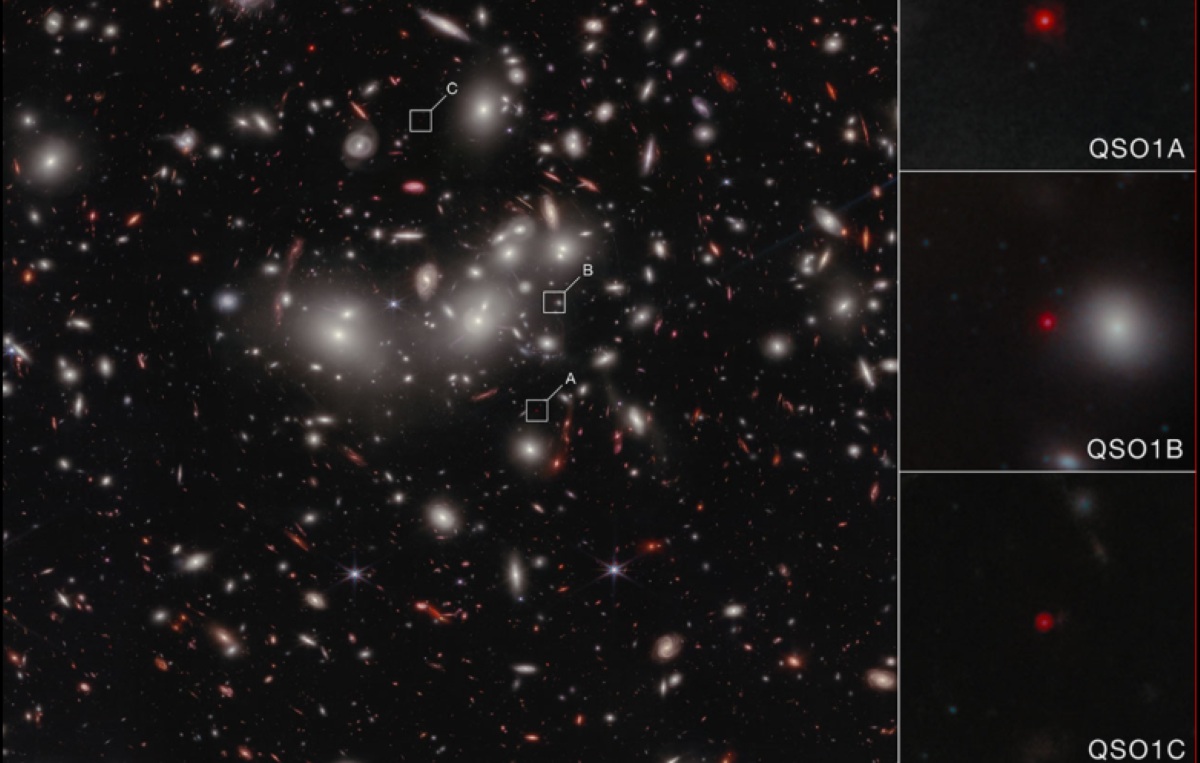
The James Webb Space Telescope has added new weight to a bold idea about the early universe: a supermassive black hole may have formed before its host galaxy was fully in place. Observations of Abell2744-QSO1, or QSO1, suggest that the object’s central black hole is far too dominant for the system to fit the usual picture of galaxy growth.
That finding matters because the long-accepted sequence has gone the other way. Galaxies were thought to form first, with massive stars inside them later collapsing into black holes that slowly grew over time.
A tiny object with an oversized core
QSO1 belongs to a class of sources known as Little Red Dots. It existed only 700 million years after the Big Bang, yet it spans just about 1,300 light-years.
Despite its small size, the system contains a black hole with a mass of about 50 million times that of the Sun. That black hole accounts for at least two-thirds of the system’s total mass, a ratio that researchers describe as highly unusual.
Gas motions pointed to a massive central engine
To study the object, the team used Webb’s Near Infrared Spectrograph, or NIRSpec, to trace the movement of hydrogen gas around QSO1. The gas showed a Keplerian pattern, meaning it orbits the center of mass in a way similar to planets circling the Sun.
That motion strengthened the view that the center of the system is dominated by a very large black hole. At the same time, the surrounding gas appears to be made almost entirely of hydrogen and helium, with very little of the heavier elements seen in more evolved environments.
A chemically young environment
The low abundance of heavy elements is another important clue. Elements such as oxygen were measured at less than 0.5% of the level found in the Sun.
Such a composition points to an environment that is still chemically young. In that setting, the extreme imbalance between the black hole and the galaxy around it becomes even harder to explain with a slow, step-by-step growth model.
Why the usual story is under pressure
The mass mismatch in QSO1 makes the standard scenario increasingly difficult to defend. Rather than a galaxy building up first and then producing a black hole through stellar collapse, the Webb data open the possibility that the black hole came first and helped shape the galaxy around it.
That idea aligns with the concept of direct collapse black holes. In that model, a black hole forms directly from a giant gas cloud or under extreme conditions shortly after the Big Bang.
Researchers see a possible shift in perspective
Roberto Maiolino of the University of Cambridge, one of the authors of the studies published in Nature and Monthly Notices of the Royal Astronomical Society, called the result extraordinary. He described it as a paradigm shift and a major reconsideration of the classic black hole formation scenario.
Ignas Juodžbalis, a Cambridge graduate student who led one of the studies, said the team appears to have found a black hole without a substantial host galaxy. He added that the object seems to have appeared before the process of star formation had really taken hold.
What QSO1 could mean for cosmic history
If QSO1 is not an isolated oddity, the early universe may have produced supermassive black holes much earlier than expected. In that case, such black holes may not be the end product of galaxy evolution, but the seeds that helped galaxies form around them.
Researchers are now continuing to look for similar objects to test whether QSO1 represents a wider pattern. If more systems like it are found, the order in which galaxies, stars, and black holes formed may need to be reconsidered from the ground up.
For now, QSO1 stands out as one of the most important objects in the debate over cosmic origins. Webb has not only revealed an unusual source, but also raised the possibility that the early universe followed a far more complex path than scientists once assumed.
Source: mediaindonesia.com-

-

-

-