


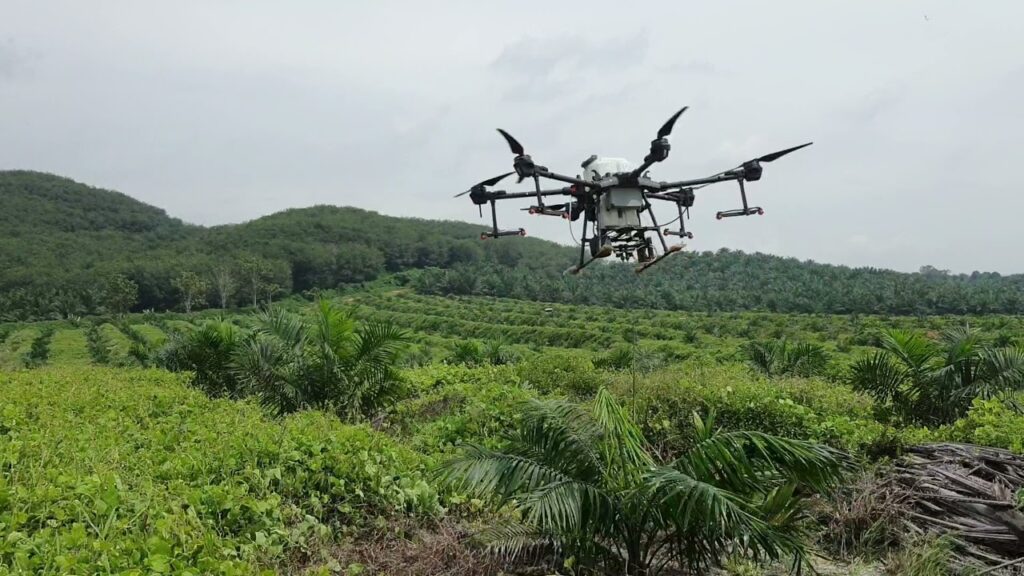
In a palm oil plantation in Riau, a task that once took hours on conventional operations is now being completed in minutes. The shift comes from the use of DJI Agras T40, a farming drone that has started to change the pace of fertilizing work in the field.
On a plot of 0.1 hectare, fertilization was reported to take only about two to three minutes. At a wider scale, one hectare can be finished in around 30 minutes, a speed that stands out in a region where plantation areas are large and daily operational time matters.
Faster work in a sector that depends on labor and time
Fertilizing and spraying in oil palm plantations have long been associated with heavy labor needs, long work periods, and high operating costs. The arrival of a drone such as DJI Agras T40 offers a different working pattern that is faster, more precise, and more efficient.
Halo Robotics, the official DJI Agriculture distributor in Indonesia, reported the drone’s use in fertilizing oil palm at one plantation area in Riau Province. The technology helps speed up work that was previously done manually.
For plantation operators, the value of shorter work time goes beyond finishing tasks sooner. A more compact process also makes it easier to carry out fertilizing and spraying more regularly according to field needs.
Precision is part of the appeal
DJI Agras T40 is not only notable for speed. It is designed to support precision agriculture through spraying and spreading systems that deliver work more accurately.
The drone has a spraying capacity of up to 40 kilograms and a fertilizer spreading capacity of up to 50 kilograms. It is also equipped with radar and sensing systems to help improve accuracy in field operations.
That accuracy matters because incorrect fertilizer dosing can affect plant growth and plantation management results. Better precision also supports more efficient use of resources, which can benefit both operating costs and more sustainable cultivation practices.
A sign of broader modernization in Riau
Riau holds an important position in Indonesia’s palm oil industry. Its vast plantation areas make technologies that can speed up work while maintaining accuracy increasingly relevant.
The use of DJI Agras T40 in a Riau oil palm plantation reflects a broader direction of modernization in Indonesian agriculture. Technology is moving deeper into farming and plantation sectors, not only into industry and services.
This shift matters because agriculture remains one of the pillars of the national economy. Technology adoption based on data and automation can help plantation businesses make quicker and more accurate decisions.
The drone’s role also shows that innovation can address operational problems that were once treated as routine. When manual work that is heavy and time-consuming can be shortened, room opens up to improve overall efficiency.
Why this example may matter beyond one plantation
The use of farming drones in Riau could serve as a model for other regions. It shows that investment in technology can produce direct and measurable benefits in the field.
Alongside time savings, the most visible gains are lower costs and higher productivity. That combination makes agricultural technology increasingly relevant for the needs of modern plantations in Indonesia.
Drone use also aligns with precision farming, which relies on technology to improve land management quality. In the next stage, integration with artificial intelligence and data analysis systems is mentioned as a way to support faster and more accurate cultivation decisions.
The Riau case shows that agricultural modernization is no longer a distant idea. DJI Agras T40 has already demonstrated a concrete answer to the operational challenges faced by plantation work.