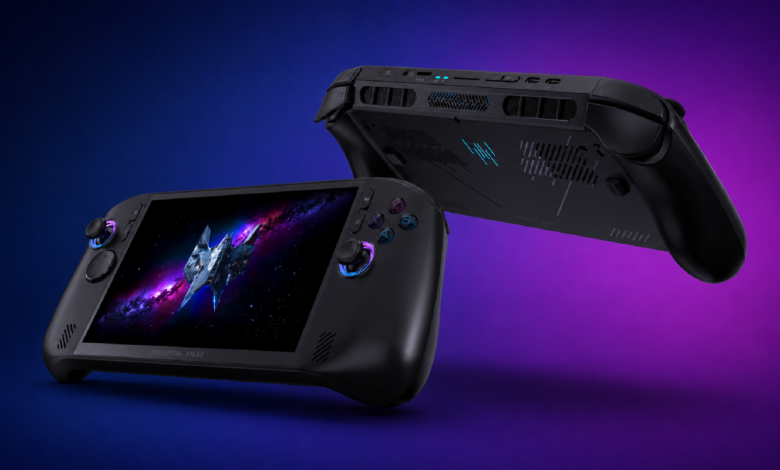
Intel is pushing handheld gaming into a more ambitious phase with Arc G-Series, a platform built to bring PC-class performance into portable Windows 11 devices. The move is aimed at players who want higher-end graphics without giving up the convenience of a handheld form factor.
The biggest question is no longer whether handhelds can run modern games, but how long they can do it comfortably. Intel is positioning efficiency, thermal balance, and longer play sessions as the core promise behind the new lineup.
Graphics That Aim Higher Than Typical Handheld Hardware
At the center of the platform is Intel Arc B390, which is based on the latest Xe3 architecture. Intel is using it to deliver visual features that are usually associated with more powerful gaming PCs.
Real-time ray tracing is included to improve lighting, shadows, and reflections in supported games. Intel is also bringing XeSS 3, a bundle that combines XeSS Super Resolution, XeSS Multi-Frame Generation, and Xe Low Latency.
That combination is designed to lift frame rates while keeping the image quality sharp and the response time low. For players of modern AAA titles, that balance matters because it helps handheld devices stay smooth without sacrificing too much visual detail.
Efficiency Has Become The Main Selling Point
Intel says efficiency is central to Arc G-Series because handheld devices must juggle performance and battery limits at the same time. The company is pairing the platform with 2 Performance Core, 8 Efficient Core, and 4 Low Power Efficient Core.
The chip design also uses Intel 18A, one of the company’s most advanced process nodes. Together, these choices are meant to help handhelds handle demanding games while using less power and lasting longer away from a charger.
Windows 11 Gets A More Console-Like Layer
Intel is also adding a dedicated Xbox mode in Windows 11. The mode uses a full-screen interface that is easier to control with a gamepad and brings the experience closer to a console-style layout.
For handheld users, that matters because quick navigation can be just as important as raw performance. A cleaner interface also makes it easier to move through a game library without constantly switching between desktop-style menus.
Another practical addition is Precompiled Shaders, which lets the device download shader data processed in Intel’s cloud. The goal is to shorten loading times and improve stability when a game starts for the first time.
Connectivity Is Built For Modern Accessories
Arc G-Series handhelds are also expected to support Wi-Fi 7 R2, dual Bluetooth 6, and Thunderbolt 4 with bandwidth up to 40 Gbps. That combination should help with accessories, external storage, and faster file transfers for large games.
These features are especially useful for users who treat a handheld as both a portable console and a compact PC. Faster connections can make docking, syncing, and expansion more practical in daily use.
OEM Partners Are Already Lining Up
Several OEM partners have already prepared handheld devices based on Intel Arc G-Series. The announced names include Acer Predator Atlas 8, MSI Claw 8 EX AI+, and OneXPlayer.
The first devices are scheduled to arrive in June 2026, with broader availability expected to expand gradually throughout the year. That rollout gives Intel a fresh opening to compete more aggressively in the Windows 11 handheld segment.