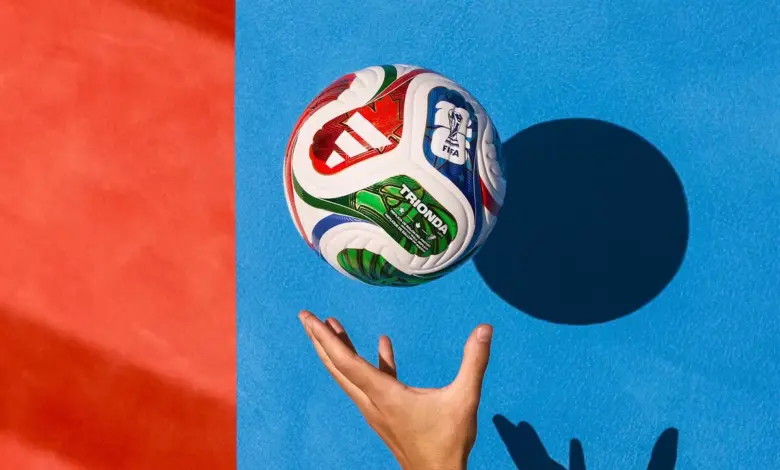
The official ball for the 2026 World Cup will arrive with an unusual requirement: it must be charged before it can be used in a match. Trionda, the tournament ball developed by FIFA and Adidas, carries a motion sensor inside it to track movement in real time.
That change turns the ball into more than a piece of equipment. It becomes part of a larger decision-making system designed to help officials read the game with greater precision, especially in moments that often lead to controversy.
How the sensor works during a match
Trionda is part of FIFA’s connected ball technology, the next step in a system already used at the 2022 World Cup in Qatar, the 2023 Women’s World Cup in Australia and New Zealand, and the Club World Cup in the United States. The ball must be connected to a power source about 90 minutes before use, and its battery can last up to six hours once fully charged.
The sensor inside the ball works together with cameras placed around the stadium. Their combined data feeds FIFA’s semi-automated offside technology, which is designed to identify when the ball was played and where players were positioned at that exact moment.
That timing matters because offside calls remain one of football’s most disputed decisions. With the ball and camera network working together, officials can get a clearer picture of the play before making the final call.
AI adds another layer to the tournament
FIFA is also preparing to use artificial intelligence to scan every player in the tournament. The scans will be used to create AI-based 3D avatars that give spectators a clearer visual explanation of player positions.
FIFA President Gianni Infantino has described the move as a major step forward for semi-automated offside systems. He says the technology can deliver better visuals, faster decisions, and explanations that are easier for everyone to understand.
Technology meets a long debate
The arrival of Trionda and the new AI tools comes at a time when football technology remains highly debated. Since VAR was introduced, many supporters have argued that technology has changed the emotional rhythm of the sport.
According to SBS News, a 2026 survey by the Football Supporters’ Association of nearly 8,000 Premier League fans found that more than three-quarters opposed the use of VAR. The same survey said more than 90 percent believed VAR had taken away the spontaneous joy of celebrating a goal.
Critics say technology has not removed controversy from football. Instead, they argue, it has shifted the argument into longer review processes that often leave fans frustrated even when the goal of fairness remains intact.
Piala Dunia 2026 itself will take place in the United States, Canada, and Mexico from 11 June to 19 July 2026. The tournament will feature 48 teams and a total of 104 matches.
Even with the new systems in place, FIFA still treats technology as support rather than replacement. The sensor inside Trionda can track the ball with high precision, but the final decision will still rest with the human officials on the pitch.