


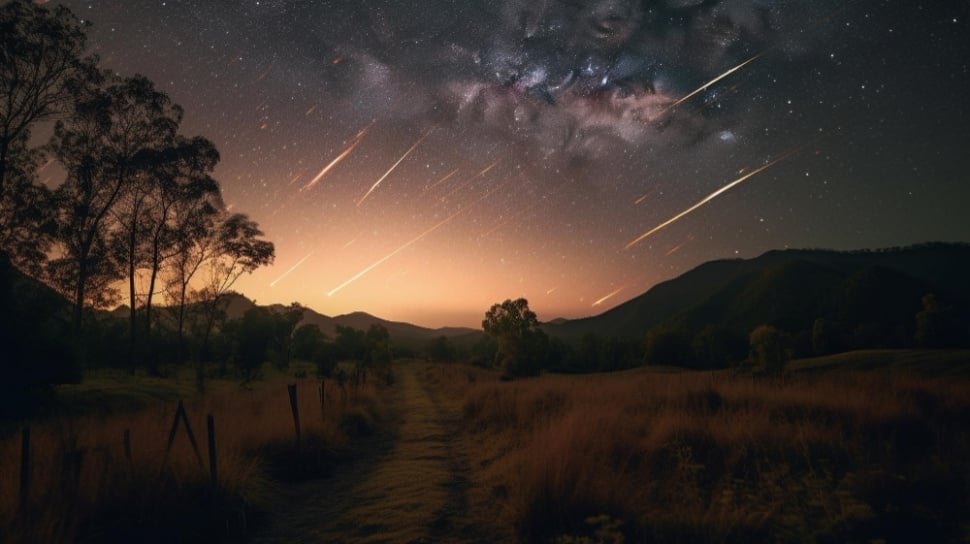
The Arietid meteor shower offers a rare challenge for skywatchers because most of its activity takes place in daylight. That leaves only a short pre-dawn window, roughly from 04.30 to 05.30 WIB in western Indonesia, as the best chance to catch a meteor streaking across the sky.
The shower peaks on 10 June 2026 and remains active from 22 May to 3 July 2026. EarthSky describes Arietid as the most active daytime meteor shower, which explains why the display is strong on paper but difficult to observe with the naked eye.
Why the best viewing time is before sunrise
The final hour before sunrise is when the eastern sky is still dark enough for a meteor to stand out. During this period, the radiant begins to rise above the horizon while sunlight has not yet overwhelmed the scene.
For observers in western Indonesia, this short interval offers the clearest opportunity to see the brighter meteors that may briefly appear low in the eastern sky.
Why Arietid is hard to see
Arietid is known for its high activity, but most of that activity happens after the sky has already brightened. EarthSky notes that the shower is among the most active in the world, yet its daytime nature severely limits direct visual observation.
That means the impressive meteor count does not translate into a large number of visible streaks for casual observers. Only the brightest meteors are likely to be seen, and even then the viewing window is extremely narrow.
Where to look and what conditions help
The best direction to watch is east, where the radiant lies near the constellation Aries. A clear horizon in that direction can improve the chance of spotting a meteor before the sky becomes too bright.
Dark observing locations also matter because light pollution can erase faint flashes that would otherwise be visible. A site with an open eastern view gives the shower its best chance of being noticed.
Simple steps to improve the experience
Observers should avoid bright lights before stepping outside so their eyes can adjust to darkness. It usually takes about 20 to 30 minutes for night vision to adapt enough to notice subtle flashes.
Moonlight can also interfere with the view at peak time, so a position shielded from the Moon may help. Even with those precautions, patience is essential because the visible activity can be sparse and brief.
Strong activity, limited visible payoff
Radar data suggests the shower can produce around 60 meteors per hour, and some estimates rise close to 200 meteors per hour under radar detection. Those figures reflect the shower’s intensity, not what the eye can easily see.
Because so much of the activity occurs during the day, the number of meteors visible in real time is usually much lower. For anyone hoping to witness Arietid, waking early and watching the eastern sky before dawn remains the most practical approach.