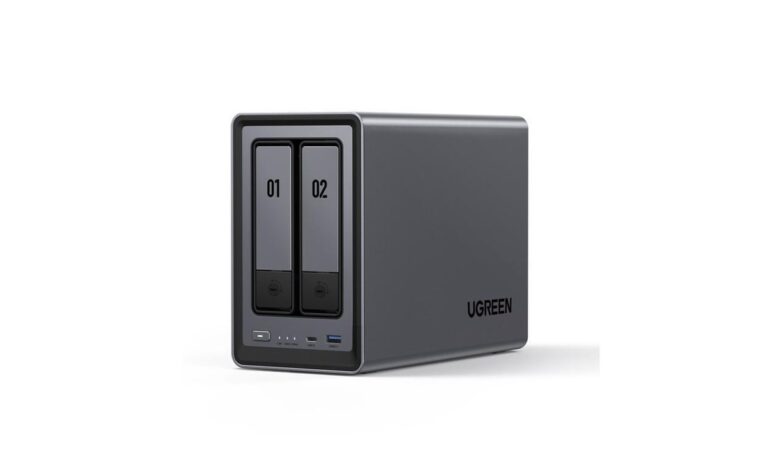
Ugreen’s NASync DH2300 is drawing fresh attention after a steep price cut brought the two-bay desktop NAS down to $187, one of its lowest levels so far. The lower price makes the device easier to consider for buyers who want a first NAS without stepping into a complex setup.
That appeal is not limited to storage alone. Ugreen positions the NASync DH2300 as a flexible home device that can also serve as a media center, a home lab component, and part of a home security setup.
A practical entry point for home storage
At $187, the NASync DH2300 is aimed at users who want to move away from public cloud dependence or finally try a NAS for the first time. The model has also become one of Ugreen’s most noticed products in recent months.
Although Ugreen is still a relatively new name in the NAS market, the company has earned a reputation for delivering capable hardware. Reports of extended use with other Ugreen NAS products have been positive, including higher-end models that even highlighted weaknesses in some competing approaches.
The DH2300 uses a two-bay desktop design and supports up to 64TB of storage. That makes it suitable for photo libraries, video collections, work files, device backups, and long-term home archives.
More than a networked hard drive
Most people think of a NAS as a remote-access storage box, but this model is built for broader use. When configured properly, it can become a local media hub, a place to run home services, and a base for experiments in a self-managed setup.
That wider role helps explain why NAS devices remain relevant even as cloud services dominate the market. For people who want more control over their data, a local NAS still offers access on the go without giving up ownership of the files themselves.
The hardware supports that flexibility with 4GB of LPDDR4X RAM. Ugreen also includes HDMI, Ethernet, and USB connectivity, giving the unit a more versatile set of physical connections than a basic storage device might suggest.
Hardware and software working together
HDMI is a notable addition because it opens the door to use cases beyond silent file storage in a corner of the house. It supports the idea of the NASync DH2300 as a home media center rather than only a background network appliance.
Ethernet remains the primary path for stable network access, while the USB ports help with external devices and data transfer from other storage media. The available connectivity is listed with USB-C and USB-A, while another description mentions two USB-A ports, indicating a fairly complete port selection for an entry-level NAS.
Software is just as important here, and Ugreen’s UGOS operating system is central to the experience. It enables the extra functions that set the NAS apart from basic storage hardware.
UGOS is not described as perfect, but it is said to get many important things right. Ugreen continues to improve the platform through updates, which matters for a NAS that depends on stability and simple administration.
Who will benefit most
The NASync DH2300 is best suited to users who want a straightforward system that is easy to set up. It also makes sense for buyers replacing an older NAS or moving away from mainstream cloud storage services.
One detail that matters is that the unit ships without hard drives, so buyers must choose their own drives separately. That means the final cost will depend on the capacity and type of drives selected.
With two bays, 4GB of LPDDR4X memory, support for up to 64TB, and a feature set that reaches beyond simple file backup, the NASync DH2300 stands out as a versatile option in its class. At $187, its value is not only in the discount but in the easy path it offers into a more flexible home NAS setup.