Amazon has disclosed, for the first time, how much water its data centers consume, and the scale is striking. The company says its facilities used about 2.5 billion gallons, or more than 9 billion liters, in 2025, while still arguing that its operations remain more efficient than those of major rivals.
The disclosure lands at a moment when AI infrastructure is under growing scrutiny for its demand on water and electricity. Amazon said water use at its owned and operated sites fell 2% from 2024, even as its data center footprint continued to expand.
A comparison Amazon wants to win
Amazon paired the disclosure with a direct efficiency comparison against Microsoft, Google, and Meta. In the data it shared, Amazon’s data centers used 0.12 liters of water per kilowatt-hour of electricity in 2025, which the company said was the lowest among the group.
That comparison, however, is not fully like for like. The Google figure shown was said to cover water consumption from Gemini AI data centers only, while AI-focused facilities generally use more water because they rely on high-end GPUs.
Amazon’s numbers also do not include water used to build new data centers. Water consumed at power plants supplying electricity to Amazon’s data centers is also excluded from the figure.
| Metric | Amazon | Context |
|---|---|---|
| Total water use in 2025 | 2.5 billion gallons | More than 9 billion liters |
| Water intensity | 0.12 liters per kWh | Company says lowest among major peers |
| Owned and operated site usage | Down 2% from 2024 | Even as the footprint grew |
Amazon said it now has about 924 data centers worldwide. A leaked memo from 2022 projected that the company’s data centers could use 7.7 billion gallons of water per year by 2030, though Amazon did not respond to that report.
Public pressure is forcing more transparency
The announcement arrives as data center operators face stronger demands for disclosure. Seattle recently imposed a one-year moratorium on data centers, a move that was also supported by some Amazon employees.
Public approval in the United States also appears weak. A Reuters poll ending on June 8 found that one in three Americans supports building data centers, but only 14% would feel comfortable if one were built near where they live.
Those concerns are amplified by global projections. The United Nations University Institute for Water, Environment and Health estimates that the data center water footprint could reach 9.3 trillion liters by 2030.
The institute said that amount would be enough to meet the annual domestic water needs of all 1.3 billion people in sub-Saharan Africa. That projection underscores how quickly pressure could grow as AI and cloud computing continue to expand.
How Amazon says it reduces consumption
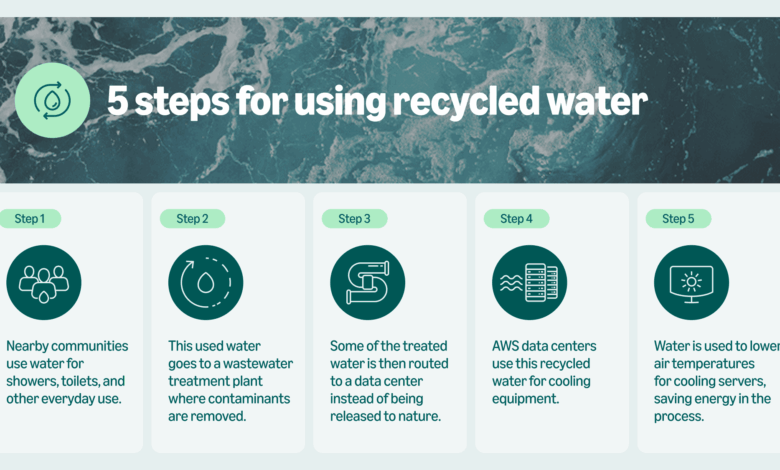
Amazon says most of the water it uses goes toward cooling servers. The company says its data centers rely on outside air for cooling about 90% of operating time and switch to water-based evaporative cooling only during the hottest hours on the hottest days of the year.
The company also says it is replacing water sources. According to Amazon, 26 locations now use 100% treated or recycled water, while 130 additional locations have been contracted globally for similar arrangements.
Amazon is targeting water positivity by 2030. That means it wants to return more than one gallon to communities for every gallon used in the direct operation of its data centers, and it says it has already achieved 75% of that goal.
As a comparison point, Amazon said its data center water use is far lower than the water Americans use on lawns and gardens. The company put U.S. lawn and garden consumption at around 3.3 trillion gallons a year, or more than 1,300 times Amazon’s data center water use.
Regulators are beginning to treat water use as public information
Amazon’s disclosure also reflects a broader shift in the industry. In The Dalles, Oregon, city officials agreed to release Google’s water consumption records after a long legal fight.
Utah has also passed the first U.S. law requiring certain new data center projects to publicly disclose annual water use. Measures like these signal a change in how data center water consumption is viewed, moving it beyond an internal operational detail.
For Amazon, the 2025 disclosure is a way to frame the debate around efficiency rather than total consumption. But with continued expansion and intensifying public attention, water use is likely to remain one of the most sensitive measures in the AI race.