Samsung appears to be preparing a very specific answer to the rumored iPhone Fold, and it is not centered on raw specifications. The company is reportedly focusing on comfort, multitasking, and a layout that works better for media use in landscape mode.
That strategy is what makes the Galaxy Z Fold 8 Wide stand out. Rather than chasing the widest possible screen, Samsung seems to be shaping a foldable that feels easier to hold, easier to use, and more aligned with the company’s long-running productivity-first approach.
A different kind of foldable race
The clash between the two devices reflects two different ideas of what a premium foldable should be. Samsung is said to be emphasizing ergonomic handling and multitasking, while Apple is expected to lean toward a wider display that feels closer to a tablet.
In that context, the “Wide” version of the Z Fold 8 looks less like a larger Fold and more like a deliberate alternative. It is positioned to compete with the iPhone Fold by offering a distinct balance between portability and productivity.
Why the shape matters most
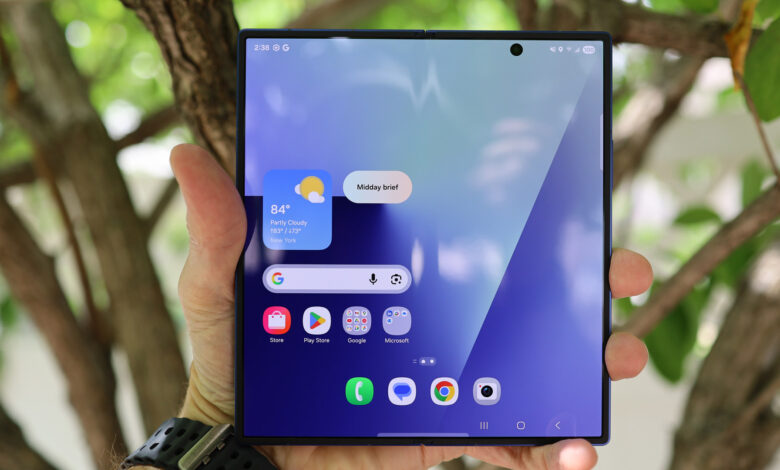
The main talking point is the form factor. The Galaxy Z Fold 8 Wide is linked to a 4:3 inner display ratio on a 7.6-inch LTPO AMOLED panel, paired with a 5.4-inch LTPO AMOLED cover screen.
That shape reportedly gives the device a passport-like feel when unfolded. According to the leak, the design should be easier to grip and more comfortable for landscape media consumption, which is also expected to be a major strength of the iPhone Fold.
Samsung does not appear to be copying Apple’s approach directly. Instead, it is trying to preserve the signature Fold identity while making the hardware more practical for daily use.
Comfort over brute force
The contrast with Apple becomes sharper when the design philosophy is compared side by side. The Galaxy Z Fold 8 Wide is associated with a taller build, while the iPhone Fold is said to pursue a wider look.
That difference changes how each device is likely to feel in use. Samsung’s version should favor multitasking and vertical scrolling, while Apple’s model may be better suited to watching videos, gaming, and creative tasks such as photo editing or sketching.
The visual language also differs. Samsung is said to be using sharper edges and uniform bezels for a more symmetrical, professional look, while Apple is expected to choose rounded corners and slightly uneven bezels for a softer appearance.
The cover screen is still critical
On a foldable, the outer display often does most of the work. That makes the size and shape of the cover screen a major part of the user experience, especially when the device is used without being unfolded.
The Galaxy Z Fold 8 Wide is expected to have a narrower front display because of its taller body. That may help portability and one-handed handling, although typing and casual browsing could feel less natural than on a traditional slab phone.
The rumored iPhone Fold, by contrast, is expected to have a wider cover screen. That would make it feel closer to a standard smartphone for messaging, browsing, and general navigation.
Samsung’s answer seems to be comfort. With a body said to weigh around 201 grams, the Z Fold 8 Wide is being positioned as a foldable that remains manageable through long periods of use.
Samsung’s strongest card is software
Hardware is only part of the story for Samsung. The company has years of experience refining foldable software, and that still matters more than flashy component lists for many users.
The Galaxy Z Fold 8 Wide is said to support signature Samsung multitasking features, including split-screen use, app continuity, and multiple active windows. For productivity-focused buyers, that remains one of the clearest reasons to choose a Fold.
Apple is expected to bring multitasking features to the iPhone Fold as well, possibly borrowing ideas from iPad tools such as Slide Over and Split View. Even so, Samsung still appears to have the more mature foldable software experience.
What the leaked specs suggest
Leaked specifications point to the Snapdragon 8 Elite Gen 5 for Galaxy as the processor inside the Z Fold 8 Wide. Memory options are said to include 12GB or 16GB of RAM, with storage ranging from 256GB to 1TB.
The camera setup appears to follow the same practical mindset. The Wide variant is said to use a dual-camera system with a 50MP main camera and a 50MP ultra-wide camera, without a telephoto lens.
That sets it apart from the standard Fold 8 and the Ultra model, which are rumored to feature a 200MP main camera, a 50MP ultra-wide camera, and a 10MP 3x telephoto camera. The trade-off suggests Samsung is prioritizing the device’s form and feel over top-tier camera reach.
The battery is said to be around 4,800 mAh, with dimensions of 161.4 x 123.9 x 4.9 mm when unfolded. Together, those details reinforce the idea that Samsung is building a distinct product identity rather than simply stretching the existing Fold formula.
Timing and price place it in rare air
Samsung may launch the Galaxy Z Fold 8 Wide in July or August, which would give it an early runway before the iPhone Fold is expected to arrive in late September. That timing could matter in a premium category where first impressions often shape the conversation.
Both devices are rumored to sit in the $2,500 to $3,000 range. That price band keeps them firmly in ultra-premium territory and limits the audience to buyers who are willing to pay for a new form factor.
Samsung still has another advantage in display technology. Its AMOLED panels are expected to deliver strong color, deep blacks, and high contrast, while Apple is said to focus more on color accuracy, brightness, and a natural visual profile.
That leaves the Galaxy Z Fold 8 Wide with a clear role. It is not trying to win by being the most extreme foldable on paper, but by offering a more comfortable and more mature interpretation of what a high-end foldable can be.