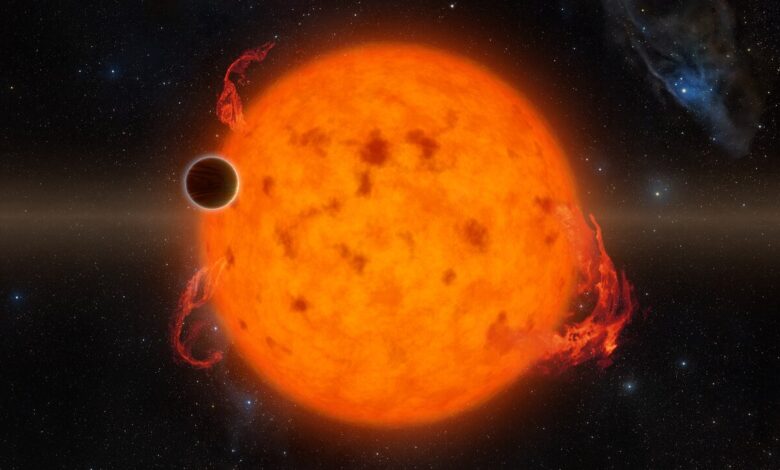
Astronomers have identified TOI-1883 b as one of the lightest super-Neptunes ever measured, a result that deepens the mystery around how some giant planets end up so unusually low in density. The planet stands out not only for its size, but also for how little mass it appears to contain for its volume.
The object lies about 383 light-years from Earth and circles the red dwarf TOI-1883 every 4.5 days. That tight orbit places the planet extremely close to its host star, making it a striking example of a world that may have changed dramatically over time.
What the new measurements show
A research team led by Izuru Fukuda of the University of Tokyo carried out follow-up observations to refine the planet’s properties. Using the Infrared Doppler instrument, or IRD, on the Subaru Telescope in Hawaii, the team reduced the uncertainty that had remained after the planet’s initial identification in 2024.
The updated measurements place TOI-1883 b at about 13.7 times the mass of Earth and roughly 5.7 times Earth’s radius. From those values, astronomers estimate a density of only 0.4 g/cm³, putting it among the least dense planets ever discovered.
Why its appearance matters
That low density suggests TOI-1883 b may be a highly inflated, or “puffy,” exoplanet. Its unusual structure has made it a useful target for scientists trying to understand how close-in giant planets evolve and lose material.
One leading possibility is that the planet migrated inward after forming farther from its star. In that scenario, intense ultraviolet radiation from TOI-1883 could have stripped away much of its mass over time, leaving behind a far more diffuse planet than expected.
Even so, the planet’s full history is still unclear. The available data point to a dramatic evolutionary path, but they do not yet explain exactly how TOI-1883 b became so unusually low in density.
Why further observations are needed
The team says more observations will be necessary to understand the planet’s formation and its present state. Additional studies could help determine whether TOI-1883 b is a rare survivor of atmospheric loss or the result of a different formation pathway altogether.
For now, TOI-1883 b remains a rare case of a giant planet that looks almost hollow by planetary standards. Its combination of low mass, large size, and close orbit makes it one of the most intriguing super-Neptunes identified so far.