


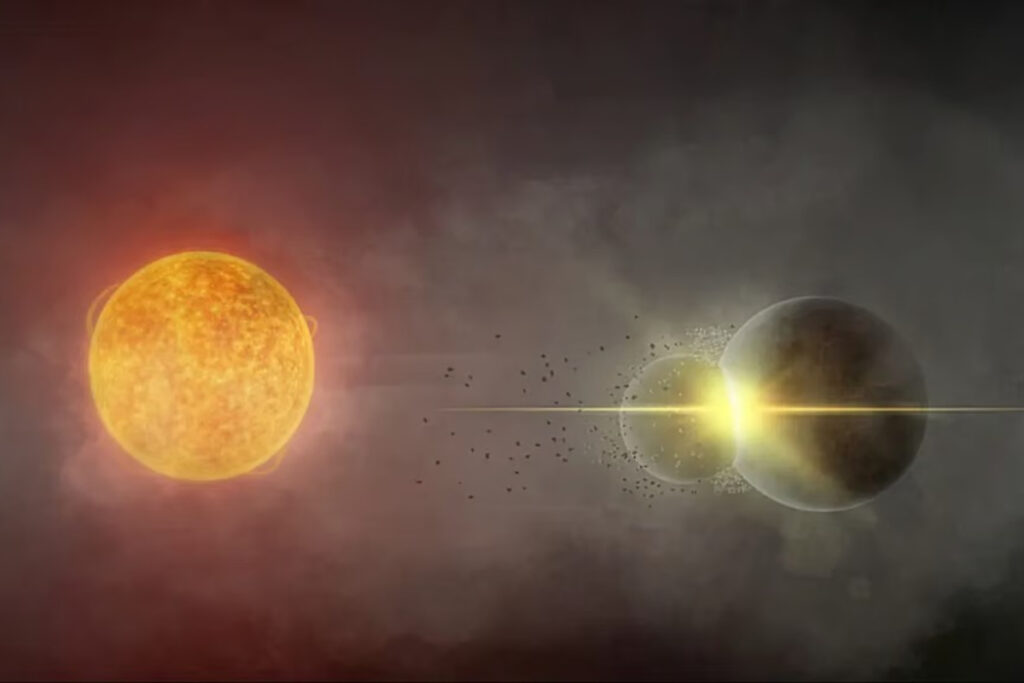
A distant star system known as Gaia20ehk is drawing attention after astronomers identified a warm dust signature that may point to a violent collision between young planetary bodies. The object, also cataloged as Gaia-GIC-1, sits about 11,000 light-years from Earth and showed an unusual shift in brightness over several years.
What makes the signal striking is the way the system changed across wavelengths. In visible light, the star became dimmer and increasingly erratic, while in infrared it grew steadily brighter, a pattern that is difficult to explain with a normal Sun-like star.
A dust cloud with the heat of a recent impact
Researchers believe the infrared excess comes from newly formed circumstellar dust that is still warm, with an estimated temperature of about 627 degrees Celsius. The dust mass is described conservatively at around 400 quintillion kilograms, suggesting a substantial amount of rocky material is now orbiting close to the star.
The dust cloud is located roughly 1.1 astronomical units from the star, about the same distance as Earth is from the Sun. That location matters because it places the debris in a region where rocky planet building can be studied in real time, at least when the geometry happens to line up for observers on Earth.
Why the event stands out to astronomers
According to Anastasios Tzanidakis of the University of Washington, the object had appeared stable for years before showing three drops in brightness starting around 2016. By 2021, the behavior became even more chaotic, strengthening the case that something unusual was happening in the system.
The leading explanation is that the dust and rocky debris came from a recent collision between large planetesimals, the kind of primitive bodies that can grow into full-sized planets. In this scenario, the impact would have produced a broad cloud of material that now passes in front of the star as it orbits.
Not a common view into planet formation
Large impacts among growing worlds are thought to be part of how rocky planets form, and the process may resemble the kind of giant collision that helped create the Moon about 4.5 billion years ago. In young planetary systems, bodies can merge, break apart, or be pushed into new orbits as they continue to evolve.
Directly witnessing that kind of event is rare because the viewing angle must be just right. Astronomers need the debris to cross between the star and Earth, which makes systems like Gaia20ehk especially valuable when they are found.
Other explanations were considered
The research team also weighed alternatives such as the destruction of a comet or a tidal disruption event. After comparing the available evidence, they concluded that the aftermath of a planetesimal collision best matches the full set of observations.
Follow-up observations with the James Webb Space Telescope are expected to refine the dust temperature and composition. The study by Tzanidakis and James R. A. Davenport was published in The Astrophysical Journal Letters on March 11, 2026, adding a rare data point to the study of how rocky planets begin to take shape.