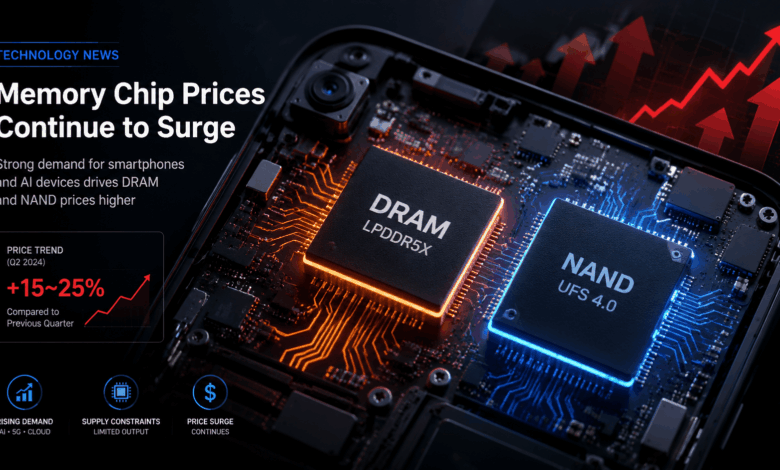
Global smartphone makers are heading into 2026 under mounting pressure as memory prices continue to climb. TrendForce expects worldwide smartphone production to fall by about 16.2 percent year on year to 1.051 billion units.
The core problem is clear: higher memory costs are raising production expenses for vendors across the industry. As a result, cheaper phones are likely to feel the biggest impact first.
Stock is running low, and prices are rising
In the first quarter of 2026, global smartphone production reached about 284 million units, down 1.7 percent from the same period last year. TrendForce said the effect of higher memory prices was still limited at that stage because many manufacturers were still using parts purchased when prices were lower.
That cushion is now fading. By the second quarter of 2026, low-cost memory inventories are beginning to thin out, while memory prices keep rising and pressuring profit margins.
TrendForce said many vendors are responding by taking a more conservative view of production plans. If memory prices continue to climb, some manufacturers may have no choice but to raise smartphone prices repeatedly just to protect profitability.
Low- and mid-range models face the most pressure
The impact will not be evenly distributed. Brands with stronger premium portfolios and deeper financial resources are better positioned to absorb higher component costs.
By contrast, Chinese phone makers that rely heavily on affordable models are expected to be more cautious with production targets. That makes the entry-level and mid-range segments the most vulnerable, since profit margins are typically much thinner there than in premium devices.
TrendForce said Xiaomi produced 26 million units in the first quarter of 2026, Oppo 29.5 million units, and Vivo 22 million units. All three are facing margin pressure from higher memory costs, and their annual targets could be revised lower if the situation does not improve.
Transsion, the parent company of Infinix, Tecno, and Itel, is also exposed to the same pressure. With its business centered on affordable phones, the company is seen as especially vulnerable because of its thin margins.
Samsung and Apple remain in a stronger position
In the middle of the broader slowdown, Samsung and Apple are expected to stay on firmer ground. Samsung remained the most productive smartphone maker in the first quarter of 2026 with about 62.6 million units, up 2.3 percent from a year earlier.
Apple followed with about 60.2 million units, a sharp 19.7 percent increase year on year. TrendForce linked that jump to higher production of new iPhone models and the launch of the iPhone 17e.
TrendForce said both companies are better able to absorb rising memory costs because of their financial strength and premium product portfolios. That could allow them to preserve, or even expand, market share if rivals decide to slow production.
| Rank | Brand | Production | Quarter-on-quarter change | Year-on-year change | Market share |
| 1 | Samsung | 62.6 million units | 8 percent | 2 percent | 22 percent |
| 2 | Apple | 60.2 million units | -31 percent | 20 percent | 21 percent |
| 3 | Oppo | 29.5 million units | -25 percent | 8 percent | 10 percent |
| 4 | Xiaomi | 26 million units | -37 percent | -38 percent | 9 percent |
| 5 | Vivo | 22 million units | -8 percent | -8 percent | 8 percent |
| 6 | Transsion | 19.8 million units | -6 percent | -3 percent | 7 percent |
The shift could make the smartphone market more uneven in the months ahead. Premium players appear better protected, while budget-focused brands may need to trim output as memory costs continue to climb.