


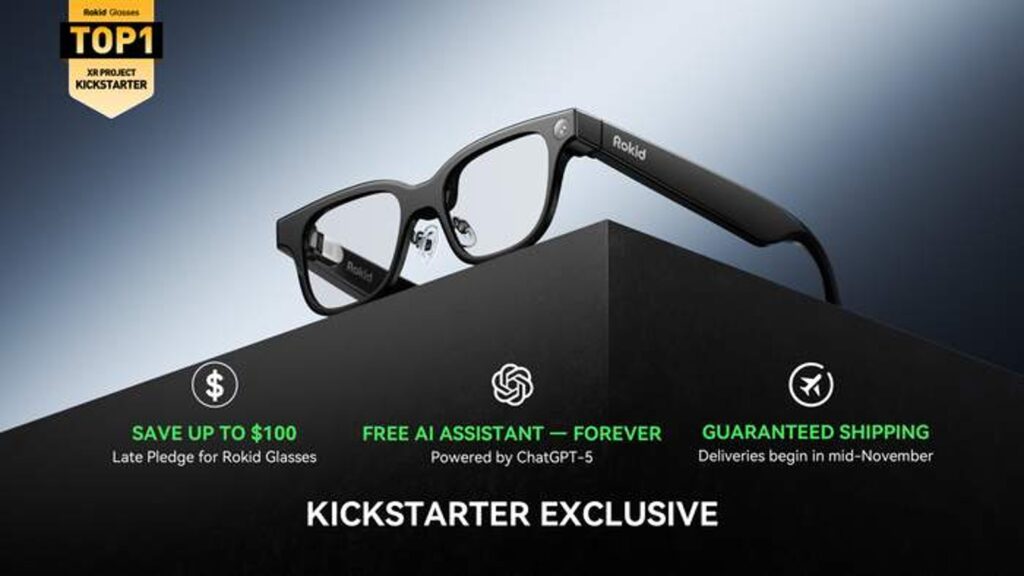
Rokid AI Glasses appear to have reached a clear verdict after several months of use: the device makes the most sense for people who can actively use its camera, AI tools, and hands-free design.
That conclusion matters because the glasses are not priced or positioned like a casual novelty. At $350, they sit in the premium range, and their strongest value only becomes obvious when the wearer has a specific use case.
Camera performance is the feature that changes the equation
The 2.5K camera is one of the most important reasons the device stands out. For creators who need point-of-view footage, the quality is strong enough to feel genuinely useful rather than decorative.
The recording options also make the glasses more adaptable. Horizontal and vertical capture formats give users flexibility for platforms such as YouTube and TikTok without requiring heavy editing afterward.
For regular content production, that combination carries real practical value. It gives the wearer a direct and stable visual perspective that ordinary devices do not always replicate as easily.
For more casual users, however, the camera may not be enough to justify the purchase on its own. If recording is not part of daily routines, the feature can feel like an extra rather than a necessity.
AI support gives the glasses a stronger identity
Rokid also leans heavily on AI as a differentiator, integrating Gemini AI and ChatGPT into the experience. The result is a more contextual, real-time conversational interface that behaves like a hands-free assistant.
That function appears to be one of the device’s biggest strengths in everyday use. Compared with some rivals, the conversation experience is described as smoother and more intuitive.
In direct comparison with Ray-Ban Meta Gen 2, Rokid’s conversational performance is said to come out ahead. That gives the glasses a stronger software identity, not just a wearable hardware one.
Real-time translation is useful, but only for the right user
Another notable feature is real-time translation across 89 languages. For travelers and users in multilingual settings, that can be a highly practical tool.
It is especially helpful in face-to-face conversations and navigation situations where pulling out a phone would interrupt the flow. The hands-free format makes the experience more immediate.
Still, the value depends on frequency of use. For a simple phrase or one-off translation, a phone app such as Google Translate may still be the more convenient choice.
Light weight helps, but the fit is not universal
Comfort is another area where the glasses show clear promise. Their lighter build compared with many competing devices makes them easier to wear for longer periods.
That matters for users who stay active throughout the day and need a device that does not feel cumbersome. The compact form also supports the idea of all-day hands-free use.
Even so, comfort is not equally effortless for everyone. Some users may need additional adjustments to get the fit right.
The single-frame design does not suit every face shape, and accessories such as adjustable hooks or nose pads may be needed to improve the fit. That reduces some of the plug-and-play simplicity expected from a wearable product.
Battery life and price point reveal the intended audience
Battery endurance is another strength that supports the device’s practical appeal. A single charge is said to be enough for a full day of use, whether for content creation, travel, or a busy schedule.
That kind of stamina is important for a wearable product that is meant to stay ready at all times. It reduces the need for frequent recharging and helps the experience feel more seamless.
At $350, Rokid AI Glasses remain a premium purchase even though they are $30 cheaper than Ray-Ban Meta Gen 2. The price is easier to justify for users who can make use of the camera, AI conversation, and translation features.
For casual buyers, the cost may still feel high if those capabilities are not part of daily life. After months of use, the device looks less like a universal gadget and more like a specialized tool with a clearly defined audience.