


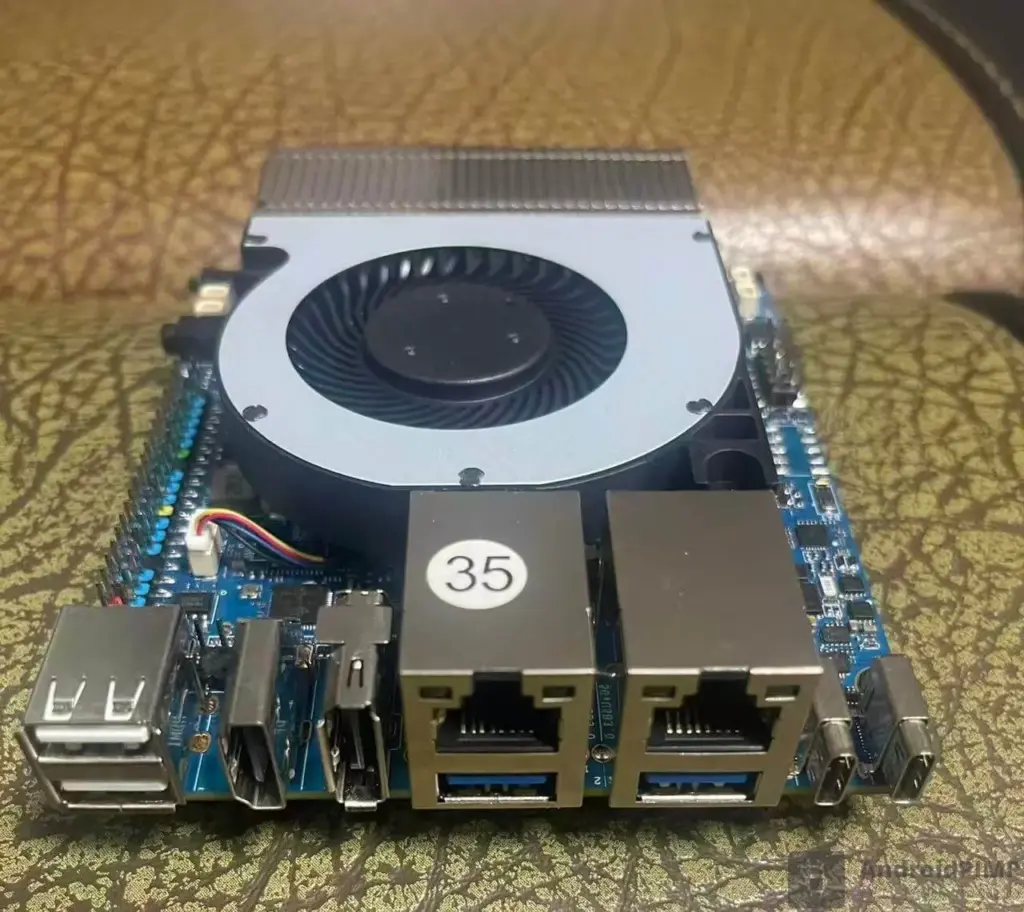
Orange Pi 6 is positioning itself as one of the most aggressive single-board computers in its class, with specifications that look closer to a compact mini PC than a typical SBC. Its strongest appeal comes from AI performance, dual Ethernet, and storage expansion options that are unusually ambitious for this category.
That combination matters because many users now want a small device that can handle modern workloads without giving up low power consumption or flexible deployment. Orange Pi 6 is clearly aimed at that demand, especially for users who want more than the usual entry-level board experience.
AI performance is the headline feature
According to the manufacturer, Orange Pi 6 can reach up to 45 TOPS for AI, although that figure represents total system performance rather than the output of a dedicated AI unit alone. The board’s NPU contributes 28.8 TOPS on its own, while the remaining performance comes from the CPU and GPU working together.
That detail is important because the 45 TOPS number reflects a combined workload across the whole system. In practice, that means the peak figure is not just about the NPU, and reaching it may come with a power-efficiency trade-off as the CPU and GPU are pushed harder.
Aim clearly set on servers and NAS use
Orange Pi 6 is powered by the CIX CD8180 SoC with 12 processing cores, giving it a more serious compute profile than many boards in the same size class. The platform is built to support heavier tasks rather than light hobby use alone.
Its networking and storage layout reinforce that direction. The board includes two Ethernet ports, each supporting up to 2.5 Gbit/s, which makes it a compelling option for home server or NAS scenarios.
Storage expansion goes well beyond microSD
Storage flexibility is one of the most distinctive parts of the design, because Orange Pi 6 can accommodate up to two M.2 2280 SSDs. Each drive uses four PCIe 4.0 lanes, which gives the board a much more desktop-like expansion profile than many SBC competitors.
A SATA adapter card is also planned for NAS-oriented setups, adding another layer of flexibility for users who want to prioritize storage over general-purpose portability. microSD support is still present, but the real emphasis is clearly on SSD-based usage.
Memory, ports, and display output
The board ships with LPDDR5 memory in 8 GB, 16 GB, or 24 GB configurations, depending on the version. That range gives users more room for multitasking and heavier applications than entry-level boards typically allow.
For external connections, Orange Pi 6 provides two USB 3.0 Type-A ports, two USB 2.0 ports, and two full-function USB 3.0 Type-C ports. Those Type-C ports also support video output, giving the board more display flexibility than a basic SBC layout.
Built for flexible expansion, but not yet on sale
Display support includes DisplayPort 1.4 with output up to 4K at 120 Hz, plus HDMI 2.0 with support up to 60 Hz. MIPI CSI support is also included, while power comes in through USB Type-C and the familiar 40-pin GPIO header remains available for accessories and experiments.
The board measures 90 x 90 mm, but pricing and availability have not been announced yet. Orange Pi 5 is already available on Amazon, while Orange Pi 6 is still awaiting a more complete official release update.