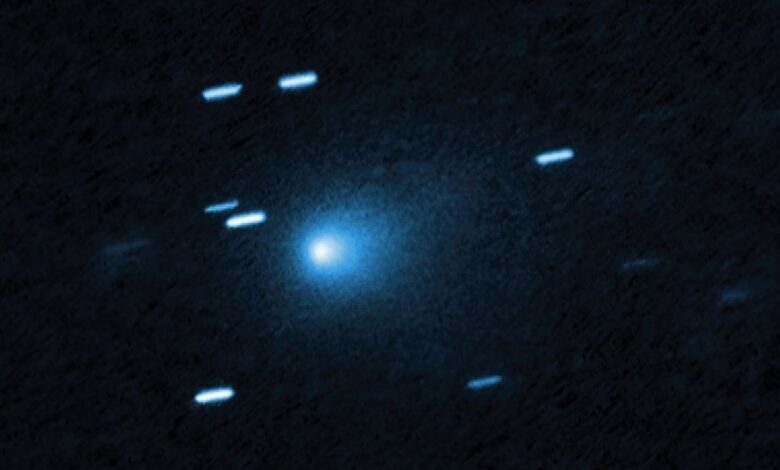
An interstellar visitor is drawing unusual attention because it may carry material from a time long before the Solar System formed. The comet, known as 3I/ATLAS, is estimated to be as old as 12 billion years, far beyond the Solar System’s roughly 4.5-billion-year history.
That age estimate places 3I/ATLAS among the oldest objects ever observed in the Solar System’s neighborhood. It also makes the comet a rare chance for astronomers to study matter that appears to come from another part of the Milky Way.
Why scientists think it is so ancient
A new study published in Nature suggests that 3I/ATLAS could be one of the oldest objects ever detected near our Solar System. Martin Cordiner of NASA’s Goddard Space Flight Center, the study’s lead author, called it “possibly the oldest object ever observed in our solar system.”
The conclusion comes from analysis of chemical ratios and isotopes captured by NASA’s James Webb Space Telescope and the ALMA observatory in Chile. Those measurements point to a composition that differs from the icy bodies more commonly seen in the Solar System.
A composition that stands out
One of the strongest clues is the comet’s deuterium content, a form of hydrogen associated with heavy water. Compared with comets in the Solar System, 3I/ATLAS contains about 10 times more deuterium.
Cordiner said that such a high level of heavy water makes sense in astrokchemistry only if the object formed in an extremely cold environment. Based on the isotopic evidence, astronomers estimate that the comet may have formed in temperatures around minus 243 degrees Celsius.
Possibly born when stars were just beginning to form
The comet’s exact origin in the Milky Way is still unclear, but researchers suspect it was thrown out of its home system when planets were beginning to take shape. After that, it is believed to have drifted through the galaxy for billions of years.
Its low level of chemical enrichment is another clue that it may have formed near young stars rather than in a more chemically mature environment. Cordiner also said 3I/ATLAS could be a relic from the era known as “cosmic noon,” when star formation was especially active about 10 billion years ago.
If that interpretation is correct, the comet may preserve a snapshot of conditions in the early Milky Way and offer a rare window into the galaxy’s distant past.
Moving out of the Solar System
Peter Veres, an astronomer involved in identifying the comet at the International Astronomical Union’s Minor Planet Center, said the object is leaving the Solar System and will not return. That makes continued observation more difficult as it moves farther away.
Even so, astronomers expect more interstellar objects to be found in the coming years. The new Vera C. Rubin Observatory in Chile is expected to improve the chances of detecting similar cosmic visitors and deepen understanding of objects from beyond the Solar System.
For now, 3I/ATLAS remains a fleeting but scientifically valuable messenger from another part of the galaxy, carrying clues that may predate the birth of the Solar System itself.