


SpaceX is moving its orbital computing push from concept to a more defined plan. Elon Musk has confirmed the “Starmind” trademark as the official name for an orbital AI data center constellation that could eventually include up to one million AI-capable satellites.
The branding comes as the project gains regulatory momentum. SpaceX filed with the FCC earlier in 2026 for a constellation designed to act as an AI computing layer in orbit, signaling that the company is building more than a conventional satellite network.
A different kind of satellite network
The idea is not to do what Starlink does today by simply extending internet access to underserved areas. Instead, SpaceX wants to move the computing itself into space and create a distributed orbital system for AI workloads.
Musk has described the architecture as “racks of compute” linked by laser connections between AI satellites. The system would also connect with Starlink, while data would be returned to Earth through antennas or low-latency laser links.
What the satellites are designed to carry
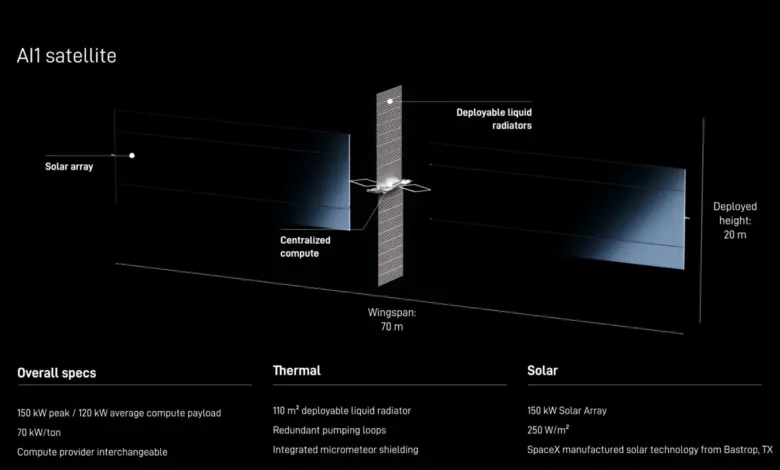
Each AI1 satellite is said to carry an average compute payload approaching 120 kilowatts, with peak capacity reaching about 150 kilowatts. SpaceX is also planning a large physical footprint for every unit.
According to the details shared so far, each AI1 satellite would use solar panels spanning roughly 70 meters and would operate at an altitude of about 600 km.
Why SpaceX thinks orbit makes sense
The push is driven by practical limits on Earth. SpaceX sees AI data centers facing space constraints, community pushback, and power and water restrictions that are becoming harder to ignore.
Orbit, by contrast, is being positioned as a place with almost limitless solar energy, natural cooling through vacuum, and no zoning approvals to delay construction. Musk has even suggested that space could become the lowest-cost location for AI computing within a few years.
Production is already part of the plan
The first AI1 prototype is scheduled to launch in early 2027. Mass production is then expected to begin by the end of that year at a new facility called Gigasat.
That timeline shows the project is being treated as an industrial effort, not just a theoretical concept. Even so, the scale remains extraordinary, and it is still unclear how much of the vision can be delivered at full size.
With the Starmind trademark now attached to the effort, SpaceX has given its orbital AI project a more public identity. If the plan advances as intended, it could become one of the most ambitious attempts yet to build a computing layer outside Earth.